Introduction: The Return of Gunboat Diplomacy
On April 13, 2026, the international order shifted toward a level of confrontation not seen since the Cold War. At exactly 10:00 a.m. EDT, the United States military officially commenced a naval blockade of Iranian ports and a partial interdiction of the Strait of Hormuz. This move, following the collapse of marathon ceasefire negotiations in Islamabad, has sent shockwaves through global financial centers, from the New York Stock Exchange to the gold vaults of London and the energy hubs of Singapore.
The blockade is not merely a regional skirmish; it represents a fundamental pivot in U.S. economic statecraft under the current administration. By leveraging the U.S. Navy’s Fifth Fleet—including the USS Abraham Lincoln and its strike group—Washington has effectively closed one of the world’s most critical maritime chokepoints to any vessel aiding the Iranian economy. The resulting vacuum in energy supply and the spike in geopolitical risk have created a “perfect storm” for investors, driving up the cost of living while simultaneously fueling a historic rally in safe-haven assets.
The Mechanics of the 2026 Blockade
The current blockade operates on two fronts: the physical interdiction in the Persian Gulf and the “proxy blockade” currently strangling the Cuban economy.
The Iranian Theater
According to U.S. Central Command (CENTCOM), the blockade is being enforced “impartially” against all nations attempting to enter or depart Iranian ports. This includes the major hubs along the Arabian Gulf and the Gulf of Oman. While CENTCOM maintains that freedom of navigation for vessels transiting to non-Iranian ports (such as those in Iraq or Kuwait) will be respected, the reality on the water is far more volatile. On the first day of operations, maritime analytics reported that tankers, including the Malawi-flagged Rich Starry, were forced to turn back just minutes after the blockade took effect.

The Cuban “Fuel Blockade”
Parallel to the military action in the Middle East, the U.S. has maintained a secondary “fuel blockade” on Cuba since late January 2026. This strategy uses the International Emergency Economic Powers Act (IEEPA) and Section 301 tariffs to penalize third-party countries that supply oil to Havana. The result has been a 90% contraction in Cuba’s fuel supply, leading to 20-hour blackouts and a humanitarian crisis that the United Nations has termed a “serious violation of international law.”
The Stock Market: A Tale of Two Realities
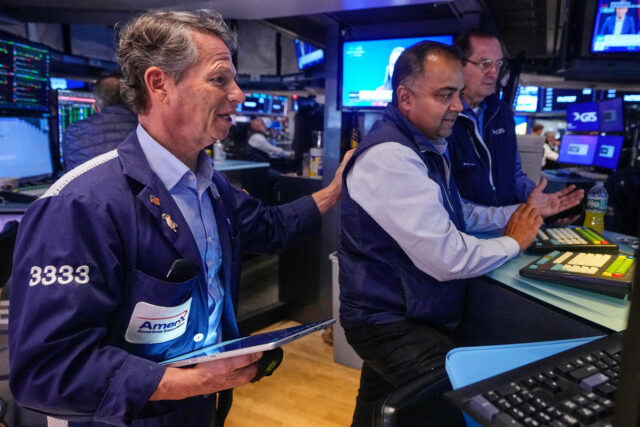
Wall Street’s reaction to the April 13 blockade has been characterized by a surprising resilience in tech-heavy indexes, contrasted by sharp declines in industrial and consumer-facing sectors.
| Index | Value (April 13, 2026) | Daily Change | YTD Change |
| Dow Jones (DJIA) | 48,063.29 | -0.52% | -3.24% |
| S&P 500 | 6,582.69 | +0.02% | -3.84% |
| NASDAQ | 21,879.18 | +0.30% | -5.86% |
| Russell 2000 | 2,530.04 | -1.10% | +1.94% |
Defense and AI Resilience
While the Dow fell by 250 points in early morning trading, the Nasdaq composite actually saw a modest gain. This divergence is driven by two factors. First, the defense sector has surged as companies like Lockheed Martin and Northrop Grumman anticipate increased government spending on naval and missile systems to maintain the blockade. Second, the “AI Revolution” of 2025–2026 continues to act as a hedge. Investors are betting that productivity gains from artificial intelligence will offset the inflationary pressures caused by rising energy costs.
Consumer Discretionary and Transportation Hits
Conversely, the “Main Street” economy is feeling the pinch. Airlines, logistics firms (such as FedEx and UPS), and manufacturing companies are seeing their margins evaporate amid skyrocketing fuel costs. The Russell 2000, which tracks smaller, more domestically-focused U.S. companies, has been particularly sensitive to the threat of stagflation—a combination of stagnant economic growth and high inflation.
Oil Prices: The $110 Threshold
The most immediate and visceral impact of the blockade has been in the energy markets. The Strait of Hormuz is the world’s most important oil transit point; roughly one-fifth of the world’s daily oil consumption passes through this narrow waterway.
The Price Surge
As of mid-April 2026, West Texas Intermediate (WTI) crude has surged past the $100 mark, with some contracts trading as high as $111.72 per barrel. Brent Crude is seeing similar spikes. The closure of Iranian ports removes roughly 1.5 to 2 million barrels of oil per day from the global market. Furthermore, Iran’s threat to retaliate against “any port in the region” has added a massive risk premium to shipments from Saudi Arabia and the UAE.
The Russian Paradox
In a strange twist of 2026 geopolitics, the U.S. blockade on Iran has inadvertently strengthened the Russian economy. To prevent global oil prices from reaching “catastrophic” levels (exceeding $150), Washington has been forced to ease some sanctions on Russian oil. This has allowed Moscow to sell crude at higher prices, providing a “windfall” that experts from Chatham House suggest will sustain Russia’s war efforts in Ukraine for the foreseeable future. President Putin now finds himself in a position of increased leverage, as the West’s desperation for non-Iranian energy outweighs its desire to isolate the Kremlin.
Precious Metals: The Flight to Safety
As the “Hormuz Hold” continues, investors are fleeing traditional currencies and bonds in favor of tangible assets. Gold and silver are currently undergoing what many analysts call a “historic run.”
Gold’s Meteoric Rise
Gold has reached unprecedented levels, trading near $4,700 per ounce.
- Geopolitical Hedging: Unlike fiat currencies, gold carries no counterparty risk and cannot be “sanctioned” or “blocked” in the same way as bank transfers or physical cargo.
- Inflation Protection: With oil prices driving up the cost of everything from groceries to shipping, gold is serving as the ultimate shield against the eroding purchasing power of the U.S. Dollar.
- Central Bank Accumulation: Central banks in the “Global South” have accelerated their gold purchases in 2026, seeking to diversify away from the dollar-based financial system which they increasingly view as a tool of warfare.
Silver and Industrial Metals
Silver, often called “the poor man’s gold,” has followed suit, though its path is more volatile. While it benefits from the “safety” trade, its heavy use in electronics and solar panels means that if the blockade leads to a full-blown global recession, industrial demand could crater, putting a ceiling on its price.
Geopolitical Implications: A Multipolar Fracturing
The 2026 blockade is more than a military maneuver; it is a catalyst for the fracturing of the global trade system.
The Rise of the “Shadow Fleet”
In response to U.S. sanctions and blockades, a “shadow fleet” of aging tankers has grown significantly. These vessels often operate with “false flags” (like the landlocked Malawi) and use “dark ship” tactics—turning off their transponders to evade detection. The U.S. administration’s warning that any ship targeting the blockade will be “immediately eliminated” suggests that the risk of a kinetic naval engagement involving these “rogue” tankers is at an all-time high.
Humanitarian Concerns in Cuba
The fuel blockade on Cuba has highlighted the human cost of economic warfare. With 11,000 children awaiting surgery and hospitals struggling to maintain power, the international community is divided. While the U.S. justifies the measures as necessary to combat an “unusual and extraordinary threat” aligned with Russia and Iran, UN human rights experts have condemned the move as “collective punishment of civilians.”
The Outlook: Strategic Reserves and Diplomatic Deadlocks
As we move through the second quarter of 2026, the question for the stock market is how long the U.S. can maintain this pressure without triggering a domestic recession.
- Strategic Petroleum Reserve (SPR): The administration may be forced to release more oil from the SPR to stabilize prices, though reserves are already at historical lows following the 2025 energy crisis.
- The Fed’s Dilemma: Federal Reserve leadership, currently undergoing a transition in 2026, faces a nightmare scenario. Raising interest rates to fight energy-driven inflation could crash the already fragile small-cap sector, while doing nothing could lead to hyper-inflationary expectations.
- The November Midterms: With U.S. midterm elections approaching, the political pressure to end the blockade—or achieve a decisive victory—will be immense.
Conclusion
The U.S. blockade of 2026 has rewritten the rules of the global economy. By weaponizing maritime access, Washington has successfully pressured its adversaries but at the cost of extreme market volatility and a surge in the price of essential commodities. For the investor, the current landscape requires a pivot toward “hard assets” and defense technology, as the era of cheap energy and stable global trade remains, for now, at the bottom of the Persian Gulf.
Sources and Links:
- U.S. Central Command (CENTCOM): U.S. to Blockade Ships Entering or Exiting Iranian Ports
- CBS News: Live Updates: U.S. military blockade on Iranian ports in the Strait of Hormuz begins
- Verfassungsblog: Weaponizing Necessity: Fuel Blockade and the US Economic Warfare Against Cuba
- United Nations OHCHR: UN experts condemn US executive order imposing fuel blockade on Cuba
- Holland & Knight: OFAC Sanctions: Top 5 Trends for 2026
- Chatham House: The Iran war has been an economic gift for Putin
- First Financial Trust: Market Week: April 6, 2026
- BNN Bloomberg: Oil rises back above US$100, but U.S. stocks hold steadier after U.S.-Iran talks fail
- U.S. Bank: Geopolitical conflict and its impact on global markets
- BNP Paribas: The 3 main factors disrupting 2026 equity markets
Disclaimer
Artificial Intelligence Disclosure & Legal Disclaimer
AI Content Policy.
To provide our readers with timely and comprehensive coverage, South Florida Reporter uses artificial intelligence (AI) to assist in producing certain articles and visual content.
Articles: AI may be used to assist in research, structural drafting, or data analysis. All AI-assisted text is reviewed and edited by our team to ensure accuracy and adherence to our editorial standards.
Images: Any imagery generated or significantly altered by AI is clearly marked with a disclaimer or watermark to distinguish it from traditional photography or editorial illustrations.
General Disclaimer
The information contained in South Florida Reporter is for general information purposes only.
South Florida Reporter assumes no responsibility for errors or omissions in the contents of the Service. In no event shall South Florida Reporter be liable for any special, direct, indirect, consequential, or incidental damages or any damages whatsoever, whether in an action of contract, negligence or other tort, arising out of or in connection with the use of the Service or the contents of the Service.
The Company reserves the right to make additions, deletions, or modifications to the contents of the Service at any time without prior notice. The Company does not warrant that the Service is free of viruses or other harmful components.