The 10 A.M. Ultimatum: A New Phase of Gulf Warfare
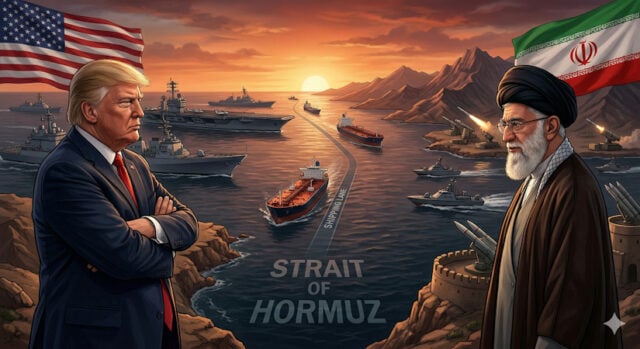
This morning, the Middle East’s geopolitical landscape shifted from localized conflict to a full-scale maritime confrontation. At precisely 10:00 a.m. Eastern Time, the United States officially commenced a naval blockade of all Iranian ports and a strategic interdiction operation within the Strait of Hormuz. Following the collapse of high-stakes peace negotiations in Islamabad, Pakistan, the Trump administration has moved to dismantle what it describes as Iran’s “maritime extortion” of the world’s energy supply.
The blockade, enforced by U.S. Central Command (CENTCOM), targets any vessel entering or departing Iranian coastal areas. While the U.S. Navy has clarified that it intends to maintain freedom of navigation for ships traveling to non-Iranian ports—such as Kuwait, the UAE, and Qatar—the tactical reality on the water remains extreme tension. The Strait of Hormuz, a narrow waterway through which 20% of the world’s oil and liquefied natural gas (LNG) flows, has effectively become a militarized “kill zone” where the margin for error has vanished.
Trump’s Directive: “Immediately Eliminated”
President Donald Trump, utilizing his preferred medium of Truth Social, issued a series of blunt and escalatory warnings to the Islamic Republic as the blockade took effect. He revealed that the U.S. has already severely degraded Iran’s traditional naval capabilities, claiming that 158 Iranian ships are currently “lying at the bottom of the sea.”
However, the President’s most striking comments were directed at Iran’s remaining “fast attack ships”—small, agile vessels that the IRGC (Islamic Revolutionary Guard Corps) has historically used for swarming tactics.

“Warning: If any of these ships come anywhere close to our BLOCKADE, they will be immediately ELIMINATED, using the same system of kill that we use against the drug dealers on boats at sea,” Trump wrote. “Any Iranian who fires at us, or at peaceful vessels, will be blown to hell.”
This rhetoric marks a departure from traditional “proportional response” doctrines, signaling a policy of total destruction for any vessel deemed a threat to the blockade’s integrity. The President also announced that the U.S. Navy has begun “destroying the mines the Iranians laid in the Straits,” accusing Tehran of sabotaging international waters to inflate oil prices and fund its war effort.
Iran’s Asymmetric Defense: The “Counter-Blockade”
Tehran has responded with a mixture of defiance and strategic ingenuity, launching what military analysts call a “counter-blockade.” Having lost much of its blue-water navy in earlier stages of the 2026 Iran War, the Islamic Republic is relying on geography and unconventional weaponry to maintain leverage.
The “Tehran Toll Booth”
In a move that has infuriated Washington, Iran has attempted to redirect all commercial traffic through a new shipping corridor that skirts the islands of Qeshm and Larak. By forcing ships into Iranian territorial waters under the guise of “avoiding mines,” Tehran has effectively established a “toll booth,” charging exorbitant passage fees to merchant vessels.
Naval Assets and Threats
Despite Trump’s claims of total naval dominance, Iran maintains a formidable “fortress” strategy. Their counter-blockade measures include:
- Midget Submarines: Capable of hiding in the shallow, acoustically noisy waters of the Strait to launch torpedoes at larger U.S. destroyers.
- Anti-Ship Ballistic Missiles: Shore-based batteries that can target ships moving at high speeds from hundreds of miles away.
- Free-Floating Sea Mines: The most disruptive tool in the Iranian arsenal. These mines, once released into the current, can drift into international shipping lanes, making the passage of non-insured commercial tankers nearly impossible.
Iranian Defense Ministry spokesperson Reza Talai stated that the Strait would “forever remain under the control of Iran,” labeling the U.S. blockade as “nothing more than piracy.”
Global Economic Shockwaves
The impact on global markets was instantaneous. As news of the blockade’s enforcement broke, oil prices surged. Brent crude, which hovered around $70 per barrel before the war began in February, spiked to over $104 per barrel.
Energy analysts warn that a prolonged closure or a “hot” naval battle in the Strait could push prices toward $150, potentially triggering a global recession. While the U.S. and Europe have reduced their direct dependence on Persian Gulf oil compared to previous decades, the East remains highly vulnerable. China, India, and South Korea receive the lion’s share of energy flowing through Hormuz, and any sustained disruption threatens to halt the industrial engines of Asia.
International Reactions: A Divided World
The international community is sharply divided over the legality and necessity of the U.S. blockade.
- China: Foreign Minister Wang Yi called for an immediate ceasefire, stating that a blockade of Hormuz “is not in the common interests of the international community.” Beijing has urged “calm and restraint,” though it has stopped short of threatening direct military intervention to escort its tankers.
- Russia: The Kremlin warned that the blockade would “rattle global markets” and create a dangerous precedent for international maritime law.
- Israel: Prime Minister Benjamin Netanyahu has been the most vocal supporter of the move. During a cabinet meeting on Monday, he stated that Israel “supports this firm position” and is in “constant coordination” with the United States to ensure the Iranian regime is deprived of its war-funding oil revenue.
- India: Having been granted limited passage rights by Iran earlier this month, New Delhi now finds itself in a precarious diplomatic position, balancing its energy needs with its strengthening strategic partnership with Washington.
In a surprising and rare public feud, the Vatican has emerged as one of the most consistent critics of the Trump administration’s military strategy. Pope Leo XIV, who assumed the papacy following the death of Francis, has leveraged his platform to condemn the escalation of violence in the Gulf.
On Palm Sunday and Easter Sunday, Leo XIV delivered a series of “pounding critiques,” warning that “God does not listen to the prayers of those who wage war.” The Pope has expressed deep concern that the blockade and the subsequent “elimination” of ships will lead to a tragedy of “immense proportions.”
“Stability and peace are not achieved through mutual threats, nor through the use of weapons, which sow only hatred and fear,” the Pope stated during a recent Angelus address.
President Trump has dismissed these concerns, suggesting that the Pope is “out of touch” with the realities of modern security and asserting that “nuclear power in the hands of volatile people” like the Iranian leadership is a far greater moral threat than a naval blockade.
Strategic Outlook: The Battle of the Ship vs. the Fort
As of April 13, the world watches the “battle between the ship and the fort.” The U.S. Navy, bolstered by aircraft carriers like the USS Abraham Lincoln, possesses the most sophisticated electronic warfare and missile defense systems in history. However, Iran’s strategy does not require a traditional victory; it only requires making the Strait too dangerous or too expensive for the world to use.
The coming days will determine if Trump’s “eliminate” order will successfully deter Iranian aggression or if it will spark a wider regional conflagration that draws in neighboring Gulf monarchies. For now, the “world’s most critical energy lifeline” remains a hair-trigger environment where a single missile launch or a drifting mine could change the course of the 21st century.
Sources Used and Links:
- Wikipedia: “Naval blockade of Iran”
- CBS News: “Live Updates: U.S. military blockade on Iranian ports in the Strait of Hormuz begins”
- The Times of Israel: “Trump threatens to destroy Iranian ships that try to cross Hormuz amid US navy blockade”
- India Today: “Iran’s choke point trump card vs Trump’s counter-blockade: Who will win?”
- The Straits Times: “Is it realistic for US Navy to counter-block Iran’s Hormuz Strait blockade?”
- The Jerusalem Post: “US to begin enforcing Strait of Hormuz blockade from Monday”
- CGTN: “China calls for calm, ceasefire as Hormuz tensions rise”
- National Catholic Reporter: “Pope urges peace, warns about wider Middle East conflict”
- Washington Post: “Lambasting Pope Leo, Trump risks rare feud with the Catholic Church”
Disclaimer
Artificial Intelligence Disclosure & Legal Disclaimer
AI Content Policy.
To provide our readers with timely and comprehensive coverage, South Florida Reporter uses artificial intelligence (AI) to assist in producing certain articles and visual content.
Articles: AI may be used to assist in research, structural drafting, or data analysis. All AI-assisted text is reviewed and edited by our team to ensure accuracy and adherence to our editorial standards.
Images: Any imagery generated or significantly altered by AI is clearly marked with a disclaimer or watermark to distinguish it from traditional photography or editorial illustrations.
General Disclaimer
The information contained in South Florida Reporter is for general information purposes only.
South Florida Reporter assumes no responsibility for errors or omissions in the contents of the Service. In no event shall South Florida Reporter be liable for any special, direct, indirect, consequential, or incidental damages or any damages whatsoever, whether in an action of contract, negligence or other tort, arising out of or in connection with the use of the Service or the contents of the Service.
The Company reserves the right to make additions, deletions, or modifications to the contents of the Service at any time without prior notice. The Company does not warrant that the Service is free of viruses or other harmful components.