The Great Arctic Audit of 2025
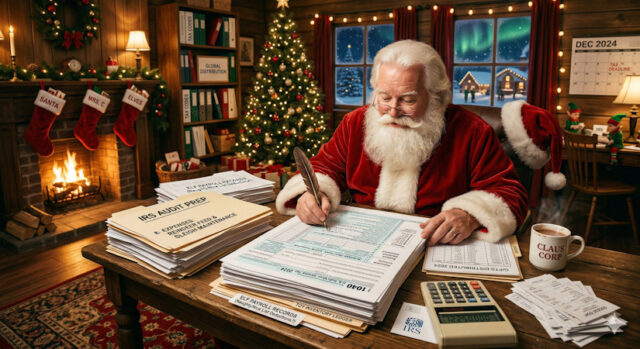
For centuries, the North Pole operated under a fiscal cloud as gray as a December sky in Murmansk. While children saw a jolly old elf in a red suit, the Internal Revenue Service saw something else entirely: a “High-Wealth Individual” with a massive manufacturing operation, an undocumented workforce of thousands, and a global logistics network that ignored every international trade treaty since the Silk Road.
By the end of 2024, the “Claus Corporation” was on the brink of a regulatory meltdown. The workshop was facing a “Chimney Nexus” crisis, where every state in the Union was demanding sales tax for the “free” delivery of toys. The European Union was eyeing a “Sugar and Carbon Tax” on sleigh emissions (specifically reindeer flatulence), and the IRS was breathing down Santa’s neck regarding “Transfer Pricing” on the billions of toys manufactured in international waters and brought into the U.S. without a single customs declaration.
Then came the One Big Beautiful Bill Act (OBBBA)—affectionately (or notoriously) known by the administration as the “BBB” (Big Beautiful Bill). Signed into law on July 4, 2025, by President Trump, this legislative leviathan didn’t just change the tax code for humans; it inadvertently became the “Christmas Miracle” that saved the North Pole from bankruptcy.
Section 1: The 15% “Made in America” Pivot
The cornerstone of the OBBB is a reduction of the corporate tax rate from 21% to 15% for companies that manufacture their products entirely within the United States. For Santa, who had long claimed the “North Pole” was a neutral, sovereign entity, this was the ultimate incentive to bring “jobs back to the heartland.”

For decades, Santa had resisted moving south. “The ice is nice, and the rent is zero,” he would often tell his board of directors (consisting mostly of Mrs. Claus and a very stressed reindeer named Bernard). However, with the new 100% tariffs on toys imported from rival manufacturing hubs and the lure of the 15% domestic rate, Santa made the unthinkable decision: he moved the primary workshop to a defunct steel mill in Youngstown, Ohio.
By declaring the workshop a “U.S.-based manufacturing entity,” Santa not only dodged the trade wars but also qualified for the “Domestic Production Deduction” expanded under the OBBB. The transition from “Arctic Outsider” to “American Artisan” has turned the North Pole into the “North Coast,” and the tax savings are, in Santa’s words, “absolutely huuuuge.”
Section 2: The “No Taxes on Elf Overtime” Loophole
Perhaps no provision in the OBBB has boosted morale more than the elimination of taxes on overtime pay. Under the 2025 laws, the first $12,500 of qualified overtime compensation is entirely deductible for the employee.
In the North Pole, “overtime” isn’t a choice; it’s a way of life from September to December. Previously, the elves—who are categorized as “Highly Skilled Magical Artisans”—were seeing nearly 40% of their peak-season earnings swallowed by the federal government. This led to the “Great Candy Cane Strike of ’22,” where production of wooden trains slowed to a crawl.
With the OBBB, the elves are now keeping more of their hard-earned cocoa-money. This has created a secondary economic boom in Youngstown, where local toy-making supply stores and peppermint-latte cafes are thriving. Because the elves’ overtime is now tax-free, Santa has been able to increase production by 22% without increasing his total payroll liability, a feat of “supply-side Christmas” that would make Milton Friedman weep with joy.
Section 3: Reindeer as “Heavy Machinery” and Bonus Depreciation
The IRS has long debated the tax status of Dasher, Dancer, Prancer, and Vixen. Are they “livestock”? Are they “commuter vehicles”? Or are they “performing assets”?
Under Section 168(k) of the internal revenue code, as reinforced and made permanent by the OBBB, businesses can take 100% bonus depreciation on qualified assets. Santa’s legal team argued that the Reindeer-Sleigh apparatus is a “Specialized Global Delivery System” with a useful life of less than 20 years (due to the high-intensity nature of supersonic travel).
By classifying the reindeer as “High-Performance Biological Transport Assets,” Santa was able to write off the entire “acquisition cost” (mostly carrots and magic lichen) of the team in a single tax year. Furthermore, the OBBB’s new Auto Loan Interest Deduction—which allows for a deduction of up to $10,000 for vehicles assembled in the U.S.—was applied to the new “Sleigh 2.0” model, which was recently retrofitted with parts from a Ford plant in Michigan.
Section 4: The “Tips for Tips” Clause
One of the most tongue-in-cheek provisions of the OBBB was the “No Taxes on Tips” initiative. While designed for the hospitality industry, Santa’s accountants found a brilliant application: The Milk and Cookies Provision.
For years, the IRS had considered the millions of cookies and gallons of milk left on hearths across America as “Barter Income.” They argued that Santa was exchanging “Delivery Services” for “Perishable Goods,” and they wanted their cut of the chocolate chips.
Under the BBB, the first $25,000 of “tipped income” is now tax-exempt. Since the fair market value of a sugar cookie is approximately $0.50, Santa can now consume nearly 50,000 cookies per night before he owes a single dime to Uncle Sam. “It’s a victory for the digestive system and the wallet,” says Buddy the CPA, Santa’s lead tax elf. “The IRS wanted to tax the sprinkles. President Trump said, ‘Keep the sprinkles.'”
Section 5: The SALT in the Chimney
For Santa, who now maintains a massive residential property in a “High-Tax State” like Ohio (and a summer cottage in Florida), the SALT (State and Local Tax) deduction was a sticking point. The original 2017 tax cuts capped this at $10,000, which barely covered the property taxes on a gingerbread house, let alone a global headquarters.
The OBBB raised the SALT cap to $40,000. This allowed Kringle to deduct a significantly larger portion of the local taxes paid to the city of Youngstown, which in turn funded the “Kringle Infrastructure Project”—a series of specialized runways designed for vertical reindeer takeoff. By leveraging the higher SALT deduction, Santa has been able to reinvest in “Green Sleigh Technology,” proving that you can be “Big and Beautiful” while also being “Lean and Mean.”
Section 6: The “Naughty List” Intangible Asset
One of the most complex parts of Santa’s 2026 tax return involves the Amortization of Intangible Assets. Specifically: The Naughty-or-Nice List.
The IRS argued that the List is a “proprietary database of consumer behavior,” similar to a mailing list or a credit score database. They wanted Santa to value the list at billions of dollars and amortize it over 15 years. However, the OBBB’s provisions on Qualified Business Income (QBI) allowed Santa to take a 20% deduction on the income generated by his “information services.”
By arguing that the Naughty-or-Nice list is a “public safety tool” rather than a commercial database, Santa’s lawyers successfully reduced the taxable value of the list. They argued that because the “naughty” children only receive coal—which is now a subsidized energy source under Trump’s “Energy Independence” executive orders—the list actually helps the U.S. achieve its coal production goals.
Section 7: Impact on the North Pole Economy
The shift in policy has led to what economists are calling the “Kringle Convergence.” By moving operations to the U.S. and taking advantage of the OBBB, Santa has seen a 14% increase in net toy-profitability.
Critics, of course, have been vocal. Some members of the “Coalition for Grinch-like Governance” argue that giving a billionaire like Santa a tax break while he already receives “free labor” from elves is the height of corporate greed. They’ve pointed to the fact that Santa doesn’t pay “Chimney Use Fees” or “Airspace Sovereignty Tariffs.”
However, the administration has been quick to defend the move. “Santa is a great guy, a total winner,” a spokesperson recently said. “He was being treated very unfairly by the old tax code. We gave him the Best Bill, One Big Beautiful Bill, and now he’s bringing those toy-making jobs back to America where they belong. The elves love it. The reindeer love it. It’s a win for Christmas.”
Conclusion: A Very Merry Filing Season
As April 15, 2026, approaches, the North Pole (now conveniently located at Exit 16 off I-80) is a hive of activity. For the first time in history, the elves aren’t just making toys; they’re filing 1040s with smiles on their faces.
Santa himself is reportedly thrilled. Between the Child Tax Credit increase to $2,200 (which he claims for several thousand “dependents” under a very loose interpretation of “foster elf care”) and the 15% corporate rate, the Claus Corporation is more liquid than a bowl of melted snowman.
While some may scoff at the idea of a magical entity benefiting from a very human tax code, the results speak for themselves. The sleigh is faster, the toys are “Made in the USA,” and for the first time in centuries, the only “red” on Santa’s books is the color of his suit. Thanks to the BBB, Christmas isn’t just coming—it’s deductible.
Sources Used and Links:
- Charles Schwab: “One Big Beautiful Bill Act Tax Cuts” – https://www.schwab.com/learn/story/one-big-beautiful-bill-act-tax-cuts
- Bipartisan Policy Center: “2025 Federal Income Tax Brackets and Other 2025 Tax Rules” – https://bipartisanpolicy.org/explainer/2025-federal-income-tax-brackets-and-other-2025-tax-rules/
- Fidelity: “What is the One Big Beautiful Bill Act and what does it mean for me?” – https://www.fidelity.com/learning-center/personal-finance/one-big-beautiful-bill
- National Association of Tax Professionals (NATP): “What would Santa’s tax return look like?” – https://www.natptax.com/news-insights/blog/what-would-santas-tax-return-look-like/
- Meadows Collier: “Does Santa Have Tax Problems? A Look at Kris Kringle’s Potential IRS Nightmares” – https://www.meadowscollier.com/does-santa-have-tax-problems-a-look-at-kris-kringles-potential-irs-nightmares
- WPXI Exclusive: “President Donald Trump talks 1-on-1 about tax cuts and manufacturing” – https://www.wpxi.com/news/local/exclusive-former-president-trump-talks-1-on-1-about-steelers-game/ZMTLEBPWDVCUZI35DDLXEZL76I/
Disclaimer
Artificial Intelligence Disclosure & Legal Disclaimer
AI Content Policy.
To provide our readers with timely and comprehensive coverage, South Florida Reporter uses artificial intelligence (AI) to assist in producing certain articles and visual content.
Articles: AI may be used to assist in research, structural drafting, or data analysis. All AI-assisted text is reviewed and edited by our team to ensure accuracy and adherence to our editorial standards.
Images: Any imagery generated or significantly altered by AI is clearly marked with a disclaimer or watermark to distinguish it from traditional photography or editorial illustrations.
General Disclaimer
The information contained in South Florida Reporter is for general information purposes only.
South Florida Reporter assumes no responsibility for errors or omissions in the contents of the Service. In no event shall South Florida Reporter be liable for any special, direct, indirect, consequential, or incidental damages or any damages whatsoever, whether in an action of contract, negligence or other tort, arising out of or in connection with the use of the Service or the contents of the Service.
The Company reserves the right to make additions, deletions, or modifications to the contents of the Service at any time without prior notice. The Company does not warrant that the Service is free of viruses or other harmful components.