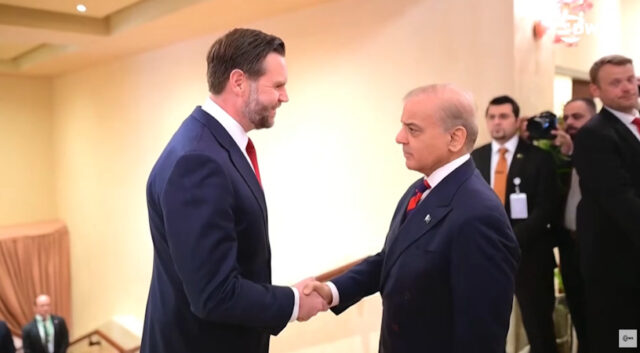
The high-stakes diplomatic gamble in Islamabad hit a wall early Sunday morning, as 21 hours of grueling, face-to-face negotiations between the United States and Iran concluded without a breakthrough. Despite the intense effort, Vice President JD Vance announced that the delegations would disperse for a brief recess before returning to the table later today, as both sides remain fundamentally at odds over the future of Iran’s nuclear program and the lifting of “Maximum Pressure” sanctions.
The 21-Hour Standoff
The talks, which began Saturday morning under the mediation of Pakistani Prime Minister Shehbaz Sharif, were the first direct, high-level meetings between the two nations in years. However, the initial optimism surrounding the “Islamabad Breakthrough” faded as the clock ticked past midnight.
“We held substantive discussions for twenty-one hours,” Vice President Vance told reporters in a pre-dawn briefing at the Marriott Islamabad. “But the simple fact is that we need to see an affirmative commitment that Iran will not seek a nuclear weapon. They have chosen not to accept our terms at this time. We are being flexible, but we are not going to compromise on the security of the American people or our allies.”

Iranian state media, including the Tasnim News Agency, painted a different picture, accusing the American delegation of “excessive demands” and “unilateralism.” Sources within the Iranian delegation suggested that the U.S. refused to provide a clear timeline for the lifting of economic sanctions or a guarantee that the ceasefire would hold if talks dragged on.
Despite the current impasse, both delegations have agreed to resume negotiations on Sunday afternoon. The fragile two-week ceasefire, brokered on April 7, remains the only thing preventing a return to the full-scale aerial bombardment that has characterized the last six weeks of conflict.
Trump’s Stance: “Regardless of What Happens, We Win”
Speaking today from the United States, President Donald Trump maintained his signature posture of strength and “Maximum Pressure.” In comments that reached the negotiating table in Islamabad almost instantly, the President signaled that while he is open to a deal, he is prepared for a total military resolution should the talks fail.
“Regardless of what happens, we win,” Trump declared. “The Strait of Hormuz will be open, with or without Iran’s cooperation. My top priority is simple: the Islamic Republic will never, ever have a nuclear weapon. They know what the alternative is. They saw it on April 7th.”
The President’s remarks refer to his recent ultimatum, where he warned that a “whole civilization” could be lost if Iran did not comply with demands to reopen global shipping lanes and dismantle its remaining nuclear infrastructure. Although that threat was suspended to allow for the current ceasefire, Trump’s rhetoric today suggests that the “apocalyptic” military options remain on the table. He emphasized that U.S. Navy destroyers have already begun clearing mines in the Strait, marking the first time American warships have transited the waterway since the war’s inception.
The Moral Plea: Pope Leo XIV’s “Enough to War!”
As the political leaders sparred, a different kind of authority made his voice heard from the Vatican. Pope Leo XIV, the first American-born Pope in history, held a somber prayer vigil for peace at St. Peter’s Basilica on Saturday evening. His address, delivered as the sun set over Rome, was a blistering critique of the current global trajectory toward “total destruction.”
Leo XIV’s comments were interpreted by many as a direct rebuke of the “delusion of omnipotence” currently permeating the White House and the Kremlin. Tensions between the first American Pope and the Trump administration have reached a boiling point; reports suggest that Pentagon officials, including Elbridge Colby, previously summoned the Vatican’s ambassador to warn that the Church should “better take America’s side” in the conflict. Today, however, Leo XIV stood firm, calling the threat of civilizational destruction “truly unacceptable.”
The Timeline of Conflict: From “Maximum Pressure” to “The Great Strike”
The path to Islamabad was paved with fire. The 2026 Iran War began on February 28, 2026, when the United States and Israel launched a massive, coordinated strike against Iranian nuclear and military infrastructure. The operation, which followed the collapse of indirect talks in Oman, resulted in the assassination of Supreme Leader Ali Khamenei and other high-ranking officials, including Ali Larijani.
Since then, the region has been spiraling:
- The Nuclear Crisis: Iran suspended all IAEA inspections and accelerated enrichment before the U.S. strikes degraded several key facilities.
- The Maritime War: Iran planted mines throughout the Strait of Hormuz, effectively strangling 20% of the world’s oil supply and sending global markets into a tailspin.
- The Humanitarian Toll: Amnesty International has warned of “atrocity crimes,” citing U.S. and Israeli strikes on civilian infrastructure, including power plants and bridges, which have left millions in Iran without basic necessities.
The Terms of the Deal: A 10-Point Plan vs. Total Disarmament
The negotiations in Islamabad are centered on two competing visions for the Middle East. Iran has presented a 10-point negotiation plan that includes:
- An immediate and permanent end to Israeli strikes on Lebanon and Hezbollah.
- The unfreezing of billions of dollars in Iranian assets held in foreign banks.
- A regional security framework that recognizes Iranian “sovereignty” over the Strait of Hormuz.
The American delegation, led by Vance, has been instructed to accept nothing less than the “complete, verifiable, and irreversible” dismantling of Iran’s nuclear program and an end to its support for regional proxies like the Houthis and Hashd al-Shaabi.
“The Vice President is not there to make concessions,” a senior White House official stated. “He is there to provide the Iranian regime with an exit ramp before the ceasefire expires and the full weight of the U.S. military is reintroduced.”
A World in Wait
As the third round of trilateral talks continues into the evening in Pakistan, the global community remains on edge. The presence of Jared Kushner—the architect of the Abraham Accords—suggests that the U.S. may be looking for a “Grand Bargain” that integrates Iran into a new regional architecture, provided the current regime undergoes a radical shift in policy.
However, with Israeli Prime Minister Benjamin Netanyahu vowing to continue fighting “until victory” regardless of the ceasefire, and Iranian Revolutionary Guards threatening to “deal severely” with U.S. warships in the Strait, the road to a lasting peace remains fraught with peril. For now, the world waits to see if the “delusion of omnipotence” will give way to the “table of dialogue” championed by Pope Leo XIV.
Sources Used and Links:
- U.S.-Iran peace talks underway in Islamabad after weeks of frantic diplomacy – OPB https://www.opb.org/article/2026/04/11/u-s-iran-peace-talks-underway-in-islamabad-after-weeks-of-frantic-diplomacy/
- Israel-Iran war LIVE updates: ‘Regardless of what happens, we win,’ says Trump – The Hindu https://www.thehindu.com/news/international/iran-israel-us-war-west-asia-conflict-live-updates-on-april-11-2026/article70850012.ece
- Iran: President Trump’s apocalyptic threats demand urgent global action – Amnesty International https://www.amnesty.org/en/latest/news/2026/04/iran-president-trumps-apocalyptic-threats-of-large-scale-civilian-devastation-demand-urgent-global-action-to-prevent-atrocity-crimes/
- Leo XIV prayer vigil for peace in the Vatican Basilica on Saturday, April 11 – Basilica San Pietro https://www.basilicasanpietro.va/en/news/leo-xiv-prayer-vigil-for-peace-in-the-vatican-basilica-on-saturday-april-11-at-6-00-pm
- Dioceses, parishes take up Pope Leo’s call to pray for peace, plan vigils for April 11 – OSV News/NCR https://www.ncronline.org/news/dioceses-parishes-take-pope-leos-call-pray-peace-plan-vigils-april-11
- Pope says ‘enough of war’ and decries ‘delusion of omnipotence’ at peace vigil – The Guardian https://www.theguardian.com/world/2026/apr/11/pope-leo-us-israel-iran-war
- Did Trump admin threaten Pope Leo XIV? Pentagon officials allegedly told Vatican to ‘better take America’s side’ – Hindustan Times https://www.hindustantimes.com/world-news/us-news/did-trump-admin-threaten-pope-leo-xiv-pentagon-officials-allegedly-told-vatican-to-better-take-americas-side-101775682637016.html
- 2025–2026 Iran–United States negotiations – Wikipedia https://en.wikipedia.org/wiki/2025%E2%80%932026_Iran%E2%80%93United_States_negotiations
- US/Israel-Iran conflict 2026 – The House of Commons Library https://commonslibrary.parliament.uk/research-briefings/cbp-10521/
Disclaimer
Artificial Intelligence Disclosure & Legal Disclaimer
AI Content Policy.
To provide our readers with timely and comprehensive coverage, South Florida Reporter uses artificial intelligence (AI) to assist in producing certain articles and visual content.
Articles: AI may be used to assist in research, structural drafting, or data analysis. All AI-assisted text is reviewed and edited by our team to ensure accuracy and adherence to our editorial standards.
Images: Any imagery generated or significantly altered by AI is clearly marked with a disclaimer or watermark to distinguish it from traditional photography or editorial illustrations.
General Disclaimer
The information contained in South Florida Reporter is for general information purposes only.
South Florida Reporter assumes no responsibility for errors or omissions in the contents of the Service. In no event shall South Florida Reporter be liable for any special, direct, indirect, consequential, or incidental damages or any damages whatsoever, whether in an action of contract, negligence or other tort, arising out of or in connection with the use of the Service or the contents of the Service.
The Company reserves the right to make additions, deletions, or modifications to the contents of the Service at any time without prior notice. The Company does not warrant that the Service is free of viruses or other harmful components.