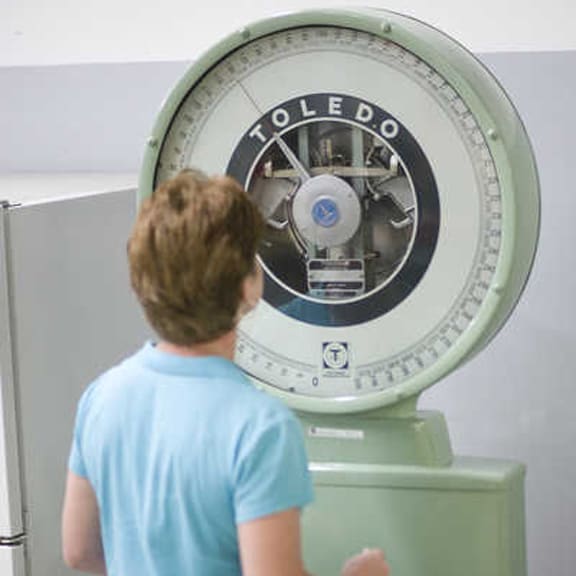
For nearly a century, a specific ritual has defined the Florida grocery shopping experience. It begins the moment you pass through the automatic sliding doors. Before you reach for a cart, before you smell the wafting aroma of rotisserie chicken from the deli, and before you navigate the sea of green-and-white signage, you stop. You step onto a heavy, industrial-grade metal platform. You wait for the large, circular dial to quiver and settle. Only after you’ve verified your weight—perhaps with a grimace or a satisfied nod—does the shopping trip truly begin.
This is the Publix scale, known officially within the company as the “People Weigher.” For generations, these massive Mettler Toledo Model 2830 scales have stood as silent sentinels at the front of Florida’s most beloved supermarket chain. However, as of 2026, the era of the Publix scale is drawing to a close. What was once a standard fixture in every store is becoming a rare relic of a bygone era in retail history.
The Vision of George Jenkins

To understand why the removal of a piece of weighing equipment feels like a cultural loss, one must understand the man who put them there: George W. Jenkins. When Jenkins opened the first Publix Food Store in Winter Haven, Florida, in 1930, he wasn’t just looking to sell groceries; he was looking to revolutionize the customer experience.
In the 1930s, personal health was a private matter, but personal scales were a luxury. Most Americans did not own a bathroom scale; those who wanted to know their weight typically had to visit a doctor’s office or pay a penny to use a commercial scale in a public place like a train station or a pharmacy. Jenkins, a master of customer service who famously built his brand on the motto “Where Shopping is a Pleasure,” saw an opportunity.

In 1940, when he opened the “Publix Food Palace”—a store so grand it featured air conditioning and automatic doors—he installed a high-quality Toledo scale and made it free to use. It was a brilliant marketing move. By providing a service that usually cost money, Jenkins built immediate trust and goodwill. In its first year alone, the scales at Publix were used more than five million times. It wasn’t just about weight; it was about the store providing value before a single cent was spent on groceries.
The Machine: Mettler Toledo Model 2830
The scales themselves are marvels of mid-century industrial engineering. The Mettler Toledo Model 2830 is not your typical bathroom scale. It is a “heavy-duty” mechanical device, built to withstand the rigors of thousands of people stepping on it every week. Its design is unmistakable: a large, round glass face with a red needle, supported by a thick green or white pedestal, resting on a wide cast-iron base.
For decades, these machines were manufactured by the Toledo Scale Company (later Mettler Toledo). They were built to last, often operating for 50 or 60 years with minimal maintenance. The precision of these scales was legendary; because they were industrial-grade, they were often more accurate than anything a consumer could buy for their home. In fact, many Publix regulars still swear by the “Publix weight” over their home digital scales, trusting the mechanical integrity of the Toledo over modern electronics.
The Beginning of the End
The decline of the Publix scale didn’t happen overnight. The first sign of trouble came in 2015 when Mettler Toledo officially ceased production of the Model 2830 and its specific proprietary parts. For Publix, this was a logistical nightmare. The company had over 800 scales in operation across Florida and Georgia, and suddenly, the supply chain for repairs had vanished.
In response, Publix did something extraordinary: they bought up every remaining piece of inventory, every spare part, and every retired scale they could find. They effectively cornered the market on their own history to keep the tradition alive as long as possible. A specialized repair shop was maintained in Lakeland, Florida—the company’s headquarters—where technicians became masters of a disappearing craft. Armed with a “Publix People Weigher Repair” handbook, these artisans would strip broken scales for parts to keep others running.
However, even the most dedicated technicians cannot defeat time. As the years passed from 2015 to 2026, the stockpile of parts began to dwindle. Every time a scale was irreparably damaged—often by children swinging on the arms or the heavy humidity of Florida corroding internal components—it was removed and not replaced. New stores built in the 2020s were designed without the signature nook for the scale, signaling to customers that the future of Publix would be sleeker, more digital, and significantly lighter.
A “Florida Thing”
One of the most curious aspects of the Publix scale is its geography. While Publix has expanded aggressively into Alabama, Tennessee, South Carolina, North Carolina, Virginia, and Kentucky, the scales largely remained a Florida and South Georgia phenomenon. To a Floridian, the scale is a part of the landscape, like palm trees or afternoon thunderstorms. To a shopper in Virginia, the idea of a giant scale at the front of a grocery store is a baffling eccentricity.
This regionality has turned the scale into a symbol of Florida identity. It represents a time when the Sunshine State was a smaller, more community-focused place. For many, the scale is a “rite of passage” marker. Parents have photos of their toddlers standing on the platform, and those same toddlers, decades later, use the scale to weigh their own children.
The Social Rituals of the Scale
The scales served purposes far beyond tracking weight-loss goals. In coastal Florida cities, the scales became unofficial airport kiosks. Travelers on their way to Miami International or Orlando International would stop at Publix to weigh their luggage, ensuring their suitcases were under the 50-pound airline limit. It was a common sight: a traveler struggling to balance a massive Samsonite on the circular platform while their family looked on anxiously.
There is also the “Post-Holiday Weigh-In.” Every year after Thanksgiving and Christmas, the scales would see a spike in usage. It became a shared social moment—shoppers laughing (or sighing) together as the needle moved further right than it had in November. In a world that is increasingly isolated, the Publix scale was a rare “third place” object that forced a brief moment of shared humanity.
The Future: Nostalgia and Preservation
As we move through 2026, the presence of a scale in a Publix store has become a marker of the store’s age. If you see a scale, you are likely in an older, “legacy” location. If the entrance is empty, you are in the modern era of the “Pleasure of Shopping.”
Publix has made it clear that they will not let the memory die completely. The original scales from George Jenkins’ first stores are preserved at the corporate headquarters in Lakeland. There is talk of these scales appearing in museum exhibits or as non-functional decorative pieces in flagship stores. But for the daily shopper, the “live” experience is fading.
The end of the Publix scale reflects a larger shift in retail. We live in an era of efficiency, self-checkout, and rapid turnover. A giant, heavy, mechanical scale that requires a specialized technician to fix is an anomaly in a world of high-speed internet and cloud-based inventory. But efficiency doesn’t create memories; quirks do. George Jenkins understood that a grocery store could be more than a place to buy bread; it could be a place of comfort, trust, and tradition.
When the last needle finally stops moving, Florida will have lost a small but significant piece of its soul. We will still have the “Pub Sub,” the fried chicken, and the impeccable service, but the front of the store will feel a little emptier. For now, if you happen to walk into a Publix that still houses a Mettler Toledo 2830, take a moment. Step on. Watch the needle. It’s a weight of history that we won’t be able to carry much longer.
Sources Used and Links:
- Publix Super Markets Newsroom: “Stepping onto the Publix scales.” corporate.publix.com/newsroom/news-stories/stepping-onto-the-publix-scales
- WKMG ClickOrlando: “Scaling back: New Publix stores are coming to Florida. Here’s what they’ll be missing.” clickorlando.com/features/2024/02/16/new-publix-stores-are-coming-to-florida-heres-what-theyll-be-missing/
- The Coastal Star: “Weighty tradition: Ever-present scale is an evergreen Publix amenity.” thecoastalstar.com/profiles/blogs/weighty-tradition-ever-present-scale-is-an-evergreen-publix-ameni
- WJXT News4JAX: “No scaling back: Tradition of Publix scales lasts decades and counting.” news4jax.com/2019/07/09/no-scaling-back-tradition-of-publix-scales-lasts-decades-and-counting/
- WTSP 10 Tampa Bay: “‘No need to panic’: Florida Publix’s iconic scales aren’t going anywhere — yet.” wtsp.com/article/news/regional/florida/publix-super-market-scales-florida-shortage/67-28af4d9a-0366-40d6-a957-bbf8aaf7cf7d
- CBS News Miami: “Tell Your Tia, Abuela, Mom: Publix’s Iconic Entrance Scales May Soon Be History.” cbsnews.com/miami/news/tell-your-tia-abuela-mom-publixs-iconic-entrance-scales-may-soon-be-history-2/
Disclaimer
Artificial Intelligence Disclosure & Legal Disclaimer
AI Content Policy.
To provide our readers with timely and comprehensive coverage, South Florida Reporter uses artificial intelligence (AI) to assist in producing certain articles and visual content.
Articles: AI may be used to assist in research, structural drafting, or data analysis. All AI-assisted text is reviewed and edited by our team to ensure accuracy and adherence to our editorial standards.
Images: Any imagery generated or significantly altered by AI is clearly marked with a disclaimer or watermark to distinguish it from traditional photography or editorial illustrations.
General Disclaimer
The information contained in South Florida Reporter is for general information purposes only.
South Florida Reporter assumes no responsibility for errors or omissions in the contents of the Service. In no event shall South Florida Reporter be liable for any special, direct, indirect, consequential, or incidental damages or any damages whatsoever, whether in an action of contract, negligence or other tort, arising out of or in connection with the use of the Service or the contents of the Service.
The Company reserves the right to make additions, deletions, or modifications to the contents of the Service at any time without prior notice. The Company does not warrant that the Service is free of viruses or other harmful components.