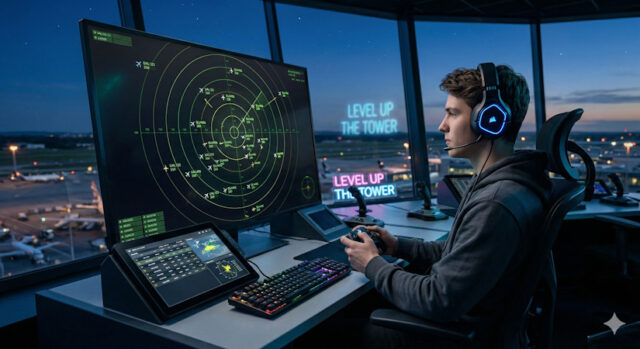
In a move that blends high-stakes aviation with the world of digital entertainment, the Trump administration has officially launched a nationwide recruitment campaign targeting video gamers to fill the critical shortage of air traffic controllers (ATCs). Announced on April 10, 2026, by U.S. Transportation Secretary Sean P. Duffy, the initiative aims to capitalize on the “hard skills” of the roughly 200 million Americans who regularly play video games—such as rapid multitasking, spatial awareness, and complex problem-solving under pressure.
“To reach the next generation of air traffic controllers, we need to adapt,” Secretary Duffy stated during a press briefing in Washington, D.C. “This campaign’s innovative communication style and focus on gaming taps into a growing demographic of young adults who have many of the hard skills it takes to be a successful controller.”
The announcement comes as the Federal Aviation Administration (FAA) prepares to open its annual hiring window at midnight on April 17, 2026. With a goal of onboarding thousands of new recruits to stabilize a workforce that has been understaffed for a decade, the administration is positioning the tower as the ultimate “high-score” career.
The Cognitive Connection: From Joysticks to Radar Screens
The decision to target gamers is not merely a marketing gimmick; it is grounded in data. According to the Department of Transportation (DOT), feedback from exit interviews with veteran controllers repeatedly highlighted video gaming as a significant influence on their professional success. These controllers cited gaming as a primary factor in their ability to “think quickly, stay focused, and manage complexity.”

The FAA has identified four key transferable skills that high-level gamers possess which are essential for managing modern airspace:
- Demonstrated High Cognitive Functions: The ability to process large amounts of data simultaneously.
- Multitasking: Managing multiple flight paths and communication channels at once.
- Spatial Awareness: Visualizing three-dimensional relationships between aircraft in a fast-moving environment.
- Strategy and Problem-Solving: Anticipating conflicts before they occur and adjusting routes in real-time.
“Safety is the FAA’s top priority, and that starts with hiring top talent and equipping them with world-class tools,” said FAA Administrator Bryan Bedford. The campaign, titled “Level Up,” includes “mission requirements” on the hiring website and describes the role in terms familiar to the gaming community, promising “high-score rewards” such as paid training and starting salaries that can exceed $155,000 after just three years of service.
Addressing the “Lost Decade” of Staffing
The air traffic control system has been plagued by staffing issues for years, a problem that worsened during the COVID-19 pandemic and subsequent training backlogs. By the end of 2024, the total ATC workforce had seen a net gain of just 36 controllers despite aggressive hiring efforts by the previous administration. High mandatory retirement ages (56) and a grueling training process left the workforce roughly 3,000 controllers short of the FAA’s optimal target of 13,000.
Since taking office, President Trump has made closing this gap a centerpiece of his transportation policy. In 2025, the FAA successfully met its hiring goals early, onboarding more than 2,000 controllers. As of April 2026, the administration has already hit 50% of its goal for the current fiscal year, bringing the total active workforce to approximately 11,000.
To accelerate this growth, the DOT has slashed five months off the traditionally lengthy hiring process. The FAA Academy in Oklahoma City has also seen its capacity increased to train up to 2,400 recruits annually, with a 15% increase in the instructor workforce. By streamlining the “onboarding-to-tower” pipeline, the administration hopes to reach the 13,000-controller threshold by 2027.
The “Tech Force” Philosophy: Skills Over Degrees
One of the most radical aspects of this recruitment drive is its focus on alternative career paths. Currently, only about 25% of active air traffic controllers hold a traditional four-year college degree. The Trump administration’s “Tech Force” initiative mirrors this reality, removing many of the educational barriers that previously hindered young, technically proficient Americans from entering the field.
The requirement for a college degree has been de-emphasized in favor of aptitude testing. This approach is designed to attract “early career professionals” who may have bypassed university but possess the technical dexterity required for 21st-century aviation.
However, the path remains rigorous. While the barrier to entry (the application) is being lowered, the barrier to certification remains exceptionally high. Industry data from AviatorDB shows that since 2020, over 200,000 people have applied for ATC roles, but only about 2% of those applicants eventually become certified controllers. The FAA Academy has a significant washout rate: only 70% of attendees graduate, and even fewer complete the final site-specific certification.
Modernizing the “Game”
For decades, the American air traffic control system relied on antiquated technology, including copper wiring, paper flight strips, and even 3.5-inch floppy disks in some facilities. Part of the appeal to the “gamer” demographic is the ongoing, multi-billion-dollar modernization effort.
The FAA is currently phasing out these legacy systems in favor of advanced digital interfaces, improved flight data management, and modernized radar systems. Administrator Bedford noted that “the best and brightest controllers leverage the world’s most advanced air traffic technology,” a message intended to resonate with digital natives accustomed to high-fidelity software and responsive hardware.
Union Support and Critical Perspectives
The National Air Traffic Controllers Association (NATCA) has expressed cautious optimism regarding the gamer-focused strategy. Nick Daniels, the union’s president, stated that the organization welcomes “innovative approaches to expanding the candidate pool,” provided that the high safety standards of the profession are not compromised.
Critics, however, suggest that the problem isn’t a lack of applicants—given that 58,000 people applied in 2022 alone—but rather the high attrition rates and demanding working conditions. Some aviation experts argue that recruiting gamers is a “quick fix” that doesn’t address the underlying issues of mental health support, fatigue, and the high-stress nature of the job that leads to many recruits dropping out before completion.
Furthermore, some industry reports suggest the administration is also looking toward Artificial Intelligence to augment the human workforce. A plan to integrate AI assistance into the ATC system is expected to be announced within the next six months, potentially serving as a “co-pilot” for the new wave of gamer-turned-controllers.
How to Apply: The April 17 Window
The FAA’s hiring window is notoriously short, often closing within days once an application cap is reached. For 2026, the window opens at midnight on April 17 and is expected to close as soon as 8,000 applications are received.
Eligible candidates must:
- Be U.S. citizens.
- Be under the age of 31.
- Be proficient in English.
- Pass a medical examination and security clearance.
- Demonstrate high cognitive aptitude through the Air Traffic Skills Assessment (ATSA).
Successful applicants will be sent to the FAA Academy in Oklahoma City for several months of paid training. Upon graduation, they can earn a $10,000 incentive and will be placed in facilities across the country, where they will begin the 2-to-3-year journey to becoming a Certified Professional Controller (CPC).
As the administration prepares for the April 17 surge, the message is clear: the skills used to win a battle royale or navigate complex strategy games may soon be used to ensure the safety of millions of passengers in the American sky.
Sources Used and Links:
- Federal Aviation Administration (FAA): “Trump’s Transportation Secretary Sean P. Duffy and the Federal Aviation Administration Unveil New Campaign to Target Next Generation of Air Traffic Controllers” (April 10, 2026). https://www.faa.gov/newsroom/trumps-transportation-secretary-sean-p-duffy-and-federal-aviation-administration-unveil
- U.S. Department of Transportation (DOT): “Secretary Duffy and FAA Launch Innovative ATC Recruitment for Gamers” (April 10, 2026). https://www.transportation.gov/briefing-room/trumps-transportation-secretary-sean-p-duffy-and-federal-aviation-administration
- FLYING Magazine: “FAA’s Latest ATC Recruiting Strategy Targets…Gamers?” by Jack Daleo (April 10, 2026). https://w ww.flyingmag.com/faa-atc-recruiting-strategy-targets-gamers/
- FedScoop: “Transportation Department targets gamers in ATC hiring push” by Lindsey Wilkinson (April 10, 2026). https://fedscoop.com/transportation-faa-atc-hiring-push-gamers/
- CNN / KION Central Coast: “The FAA wants video gamers to be the next generation of air traffic controllers” by Alexandra Skores (April 10, 2026). https://kioncentralcoast.com/news/national-world/cnn-national/2026/04/10/the-faa-wants-video-gamers-to-be-the-next-generation-of-air-traffic-controllers/
- National Today / Oklahoma City Today: “Trump Administration Proposes Recruiting Gamers to Fill Air Traffic Controller Shortage” (April 10, 2026). https://nationaltoday.com/us/ok/oklahoma-city/news/2026/04/10/trump-administration-proposes-recruiting-gamers-to-fill-air-traffic-controller-shortage/
- Paddle Your Own Kanoo (PYOK): “The Trump Administration Wants to Plug Air Traffic Control Staffing Shortages With Teenage Gamers” by Mateusz Maszczynski (April 10, 2026). https://www.paddleyourownkanoo.com/2026/04/10/the-trump-administration-wants-to-plug-air-traffic-control-staffing-shortages-with-teenage-gamers/
Disclaimer
Artificial Intelligence Disclosure & Legal Disclaimer
AI Content Policy.
To provide our readers with timely and comprehensive coverage, South Florida Reporter uses artificial intelligence (AI) to assist in producing certain articles and visual content.
Articles: AI may be used to assist in research, structural drafting, or data analysis. All AI-assisted text is reviewed and edited by our team to ensure accuracy and adherence to our editorial standards.
Images: Any imagery generated or significantly altered by AI is clearly marked with a disclaimer or watermark to distinguish it from traditional photography or editorial illustrations.
General Disclaimer
The information contained in South Florida Reporter is for general information purposes only.
South Florida Reporter assumes no responsibility for errors or omissions in the contents of the Service. In no event shall South Florida Reporter be liable for any special, direct, indirect, consequential, or incidental damages or any damages whatsoever, whether in an action of contract, negligence or other tort, arising out of or in connection with the use of the Service or the contents of the Service.
The Company reserves the right to make additions, deletions, or modifications to the contents of the Service at any time without prior notice. The Company does not warrant that the Service is free of viruses or other harmful components.