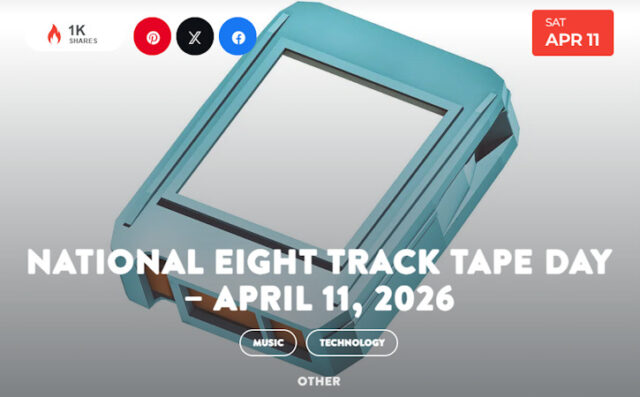
National Eight Track Tape Day on April 11 is a great day to bust out your old eight track tape and explain to the confused millennials and Gen Zs what it is. You know it was the hottest technology from the mid-1960s to the early 1980s, and you love remembering all the sweet jams you listened to with your eight track from that era.
- 1962 – Broadcast engineer George Eash’s Fidelipac “cart” tape for radio automation popularizes endless-loop cartridges that later inspire consumer eight-track systems.
- 1964 – Inventor and Lear Jet founder Bill Lear completes the Stereo 8 cartridge system, refining the endless-loop design into a compact eight-track format for consumer use.
- 1965 – William Powell Lear, who was famous for developing jet planes, created the first eight track.
- 1965 – Ford Motor Company introduces factory-installed Stereo 8 players in selected 1966 models, bringing continuous-play prerecorded music into the mainstream American car market.
- 1966 – Record companies like RCA, Columbia, and Capitol begin issuing popular albums on eight-track, rapidly expanding the catalog and turning the cartridge into a mass-market music format.
- 1967 – the eight track was already on the rise, having seen over 65,000 eight track players sold.
- 1970 – U.S. sales of prerecorded eight-track cartridges reach their high point, with millions of units sold annually and strong presence in both car and home audio systems.
- 1970 – eight track manufacturing was brought to Europe. Though the attempt was largely unsuccessful and the company failed in just four short years, vintage eight tracks can still be found in the United Kingdom, West Germany, Italy, and more.
- 1979 – Sony releases the Walkman portable cassette player, helping cement compact cassettes as the preferred portable format and hastening the decline of bulky eight-track cartridges.
- 1982 – Past their prime and eclipsed by new forms of listening technology, eight track tape players ceased to be manufactured or retailed.
- 1988 – Fleetwood Mac’s Greatest Hits compilation was the last big-name release on an eight track.
- 2009 – While 8-track tapes were obsolete by the early 80s, some artists, like Cheap Trick, released albums on 8-track as late as 2009.
- 2019 – Gary Hiezman, of Illinois, had a total of 93,337 tapes, which took up much of the space in his basement and his entire garage.
- Not all eight-tracks disappeared. Thrift stores, flea markets, and online sellers still carry them, sometimes with rare finds tucked away. Whether searching for a beloved classic or a bizarre novelty recording, tracking one down can feel like unearthing buried treasure.
- Over time, new formats replaced eight-track tapes. Cassettes offered better sound quality and the ability to rewind. Compact discs followed, making earlier music formats less common
- Beyond standard stereo, eight-track technology was adapted in the early 1970s for quadraphonic sound, delivering four discrete audio channels for a more immersive listening experience.
- Eight-tracks were well suited to automotive use because the cartridges were relatively robust, easy to insert, and did not need flipping or manual rewinding.
- The endless-loop design ensured continuous playback, and factory-installed players from major automakers in the late 1960s and 1970s helped standardize the format.
- Eight-tracks were well suited to automotive use because the cartridges were relatively robust, easy to insert, and did not need flipping or manual rewinding.
- The endless-loop design ensured continuous playback, and factory-installed players from major automakers in the late 1960s and 1970s helped standardize the format.
- The “Click”: When switching between the four programs, a distinctive “k-klunk” sound occurs because a metallic splice on the tape passes a sensor, causing the head to move and potentially interrupting songs.
- No Rewind/Fast Forward: 8-tracks typically only offered play and fast-forward; you couldn’t easily rewind to a previous song.
- Hot Car Artifacts: Because they were often left in hot dashboards, many surviving 8-tracks have bubbled, sun-damaged labels.
- Record clubs, like Columbia House, offered eight-track tapes well into the 1980s.
- Madonna’s early albums, as well as Michael Jackson’s “Thriller,” were offered to Columbia House club members on an eight-track!
- The Most Valuable 8 Track is Sinatra Jobim By Frank Sinatra and Antonio Carlos Jobim. This limited-release album was only produced in 8-track format. Only 3,500 copies were made and sold before the artists ultimately decided to call it quits on the project. Today, a copy of Sinatra Jobim can go for $5,000 or more.
Sources:

Disclaimer
Artificial Intelligence Disclosure & Legal Disclaimer
AI Content Policy.
To provide our readers with timely and comprehensive coverage, South Florida Reporter uses artificial intelligence (AI) to assist in producing certain articles and visual content.
Articles: AI may be used to assist in research, structural drafting, or data analysis. All AI-assisted text is reviewed and edited by our team to ensure accuracy and adherence to our editorial standards.
Images: Any imagery generated or significantly altered by AI is clearly marked with a disclaimer or watermark to distinguish it from traditional photography or editorial illustrations.
General Disclaimer
The information contained in South Florida Reporter is for general information purposes only.
South Florida Reporter assumes no responsibility for errors or omissions in the contents of the Service. In no event shall South Florida Reporter be liable for any special, direct, indirect, consequential, or incidental damages or any damages whatsoever, whether in an action of contract, negligence or other tort, arising out of or in connection with the use of the Service or the contents of the Service.
The Company reserves the right to make additions, deletions, or modifications to the contents of the Service at any time without prior notice. The Company does not warrant that the Service is free of viruses or other harmful components.