As the gates of Augusta National Golf Club swing open for the 2026 Masters Tournament, the buzz among the galleries and the hushed whispers at the practice range are focused on more than just the speed of the greens or the height of the pin-tucks on the Sunday pin at sixteen. This year, the primary protagonist of the week is the sky itself. For the first time in a generation, the world’s most prestigious golf tournament is facing a forecast that promises to be as unwavering as the club’s tradition.
For decades, the narrative of the Masters has often been defined by the unpredictability of a Georgia spring. We have seen tournaments paused by thunderous downpours, greens softened by midnight deluges, and the iconic pines of Augusta swaying precariously in the face of sudden atmospheric shifts. However, as the 2026 edition unfolds, the umbrellas are staying in the trunks of cars and the rain gear remains sealed in the players’ lockers. According to the latest data, Augusta is on the verge of a historic weather event: a completely dry tournament.
“The weather looks to be beautiful this year,” AccuWeather Meteorologist Alex DaSilva noted in a recent update. “High pressure locked in overhead will allow for plenty of sunshine and warming temperatures.” This atmospheric stability is not just a pleasant backdrop for television cameras; it is a seismic shift in the tournament’s competitive landscape.
A Fifteen-Year Milestone
To understand the significance of the 2026 forecast, one must look back to 2011. That was the last time the Masters Tournament completed all four rounds without a single drop of recorded rainfall. In the years since, the tournament has grappled with everything from freezing morning starts to the dramatic weather-shortened sessions of 2023. The return to a “bone-dry” Augusta National means the course will play exactly as the architects and the greens committee intended—fast, firm, and unforgiving.

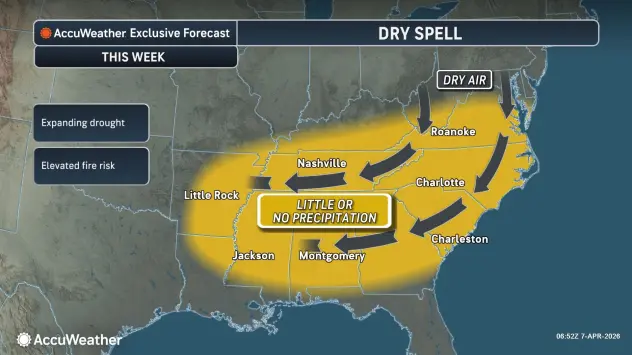
According to AccuWeather, the likelihood of this year’s tournament remaining rain-free from the opening honorary starter’s drive on Thursday morning to the final putt on Sunday evening is the highest it has been in fifteen years. While other parts of the Southeast, particularly Florida, are contending with spring storm systems and moisture-rich air, a stubborn ridge of high pressure has parked itself directly over the Peach State. This “dome” of stability acts as a shield, deflecting the moisture and keeping the humidity levels remarkably low for this time of year in the Deep South.
The Day-by-Day Outlook
The progression of the tournament will see a steady climb in both the temperature and the stakes. As the pressure builds on the leaderboard, the mercury in the thermometers will follow suit.
Thursday and Friday: The Foundation The opening rounds will begin under what many consider to be “perfection.” High temperatures are expected to settle in the mid-70s. These moderate temperatures, combined with the low humidity, will prevent the players from the physical exhaustion that often accompanies the humid Georgia heat. However, the lack of moisture in the air means that the ball will travel with consistent predictability. Without the heavy, moisture-laden atmosphere that can “knock down” a shot, players will find their distance control to be a matter of pure calculation rather than guesswork.
The Weekend: The Heat Is On As the cut is made and the field thins, the intensity of the sun will increase. Saturday and Sunday are forecasted to see highs climbing into the mid-80s. This ten-degree jump is significant. Under the intense Georgia sun, the turf at Augusta National will continue to dry out. The “Augusta Green” will remain visually stunning, but the ground underneath will become increasingly firm. AccuWeather RealFeel® temperatures could push even higher, reaching the high 80s or low 90s in the direct sun of the fairways, making hydration a key factor for both the athletes and the thousands of patrons walking the hilly terrain.
The Impact on the Course: Firm, Fast, and Fearsome
The weather is the silent architect of Augusta National. When the course is wet, it is long; the ball hits the fairway and stops, and the greens become “dartboards” where players can fire directly at the pins. But when the course is dry, as AccuWeather predicts for 2026, Augusta National transforms into a completely different beast.
Firm conditions reward the strategist and punish the aggressive. A drive that might typically stop in the middle of the fairway in a damp year may now catch a downslope and run into the pine straw. A long iron that lands on the front of the green might skip all the way over the back. This is where the Masters is won or lost—in the ability to judge the “bounce.”
The legendary Sub-Air system, a marvel of engineering buried beneath the greens at Augusta, is designed to suck moisture out of the soil to keep the putting surfaces firm even during rain. In 2026, the system might find itself with little work to do regarding drainage. Instead, the grounds crew will likely be using it sparingly to manage the oxygen levels and root temperatures of the grass as they battle the drying effects of the sun and wind.
The Patron Experience: Sunscreen over Rain Ponchos
For the thousands of patrons who descend upon the grounds, the 2026 weather forecast is a dream come true. The vibrant azaleas and dogwoods will be highlighted by “plenty of sunshine,” providing the quintessential Masters aesthetic. However, the conditions come with their own set of requirements.
“Patrons should consider sunscreen and sunglasses,” DaSilva added. The clarity of the air under high pressure means the UV index will be remarkably high. With very little cloud cover expected over the four days, those standing at the edge of Amen Corner or perched on the hills of the 16th hole will be exposed to hours of direct sunlight. The absence of the typical Georgia humidity might make the heat feel more bearable, but the risk of dehydration and sunburn is actually heightened because the cooling effect of perspiration is more efficient in dry air, often masking how much fluid a person is losing.
Historical Context: Lessons from 2011
Looking back at 2011, the last dry year, we saw one of the most exciting Sundays in history. Charl Schwartzel birdied the final four holes to win, but the story of the week was the speed of the course. Without rain to soften the slopes, the players had to navigate a course that felt like it was “moving” under their feet. We saw spectacular eagles and heartbreaking three-putts.
The 2026 forecast suggests a similar trajectory. When Augusta National is dry, the margins for error are razor-thin. The “glass-like” quality of the greens becomes the primary talking point. If the wind picks up even slightly in the afternoons—a common occurrence as the land heats up relative to the surrounding forests—the challenge becomes nearly insurmountable. High pressure systems often bring calm mornings, but as the sun reaches its zenith, thermal gusts can swirl through the trees at the 12th hole, making club selection a high-stakes gamble.
The Science of the “Dry” Masters
Meteorologically, the 2026 Masters is a case study in atmospheric blocking. When a high-pressure system becomes “locked in,” as AccuWeather describes, it creates a stagnant air mass. This is why we see the steady increase in temperature each day. Without a front to move the air along, the sun’s energy is absorbed by the ground and the lower atmosphere day after day, leading to the “warming trend” forecasted for the weekend.
For the golfers, this means the course they play on Thursday will be fundamentally different from the course they play on Sunday. Every hour of sunlight without rain further desiccates the clay-heavy soil of Georgia, making the ground harder. The ball speed off the turf will increase, meaning longer drives but also more difficult approach shots.
Conclusion: A Masterpiece in the Sun
As we look toward the final round, the 2026 Masters is shaping up to be a test of endurance and precision. The lack of rain removes the “luck of the draw” that often plagues outdoor sports. No one will be stuck on the wrong side of a storm front; no one will have to finish a round in a drenching gale. Instead, the field will face the same consistent, baking sun and the same firm, fast conditions.
The 2026 tournament will likely be remembered as the “Golden Masters”—a week where the weather stayed out of the way of the golf, while simultaneously making the golf harder than ever. As the sun sets over the clubhouse on Sunday, and the Green Jacket is presented on the terrace, the winner will have conquered not just the best golfers in the world, but a course that was allowed to reach its full, dry, and terrifying potential.
For those heading to the grounds or watching from home, the message is clear: enjoy the view, respect the sun, and prepare for a masterpiece of a tournament defined by the brilliant, unyielding Georgia sky.
Sources Used:
- AccuWeather: 2026 Masters at Augusta National weather forecast
Disclaimer
Artificial Intelligence Disclosure & Legal Disclaimer
AI Content Policy.
To provide our readers with timely and comprehensive coverage, South Florida Reporter uses artificial intelligence (AI) to assist in producing certain articles and visual content.
Articles: AI may be used to assist in research, structural drafting, or data analysis. All AI-assisted text is reviewed and edited by our team to ensure accuracy and adherence to our editorial standards.
Images: Any imagery generated or significantly altered by AI is clearly marked with a disclaimer or watermark to distinguish it from traditional photography or editorial illustrations.
General Disclaimer
The information contained in South Florida Reporter is for general information purposes only.
South Florida Reporter assumes no responsibility for errors or omissions in the contents of the Service. In no event shall South Florida Reporter be liable for any special, direct, indirect, consequential, or incidental damages or any damages whatsoever, whether in an action of contract, negligence or other tort, arising out of or in connection with the use of the Service or the contents of the Service.
The Company reserves the right to make additions, deletions, or modifications to the contents of the Service at any time without prior notice. The Company does not warrant that the Service is free of viruses or other harmful components.