TEHRAN/WASHINGTON — In a dramatic escalation of the ongoing conflict in West Asia, United States Central Command (CENTCOM) launched a massive wave of precision airstrikes against Iranian military installations on Kharg Island early Tuesday morning. The strikes, which focused exclusively on military assets while ostensibly sparing the island’s critical oil export infrastructure, coincided with a sweeping Israeli military campaign targeting transportation networks and “infrastructure sites” across mainland Iran.
U.S. Navy fighter jets take off from USS Abraham Lincoln (CVN 72) during Operation Epic Fury. U.S. forces continue to conduct strikes against military targets inside of Iran. pic.twitter.com/eqcyAoASv5
— U.S. Central Command (@CENTCOM) April 7, 2026
In a brazen act of aggression, US-Israeli enemies launched a deadly airstrike on a civilian railway in Karaj, Iran. pic.twitter.com/8bGbydlxsi
— Tasnim News Agency (@Tasnimnews_EN) April 7, 2026

מצדיע ללוחמים שלנו שממשיכים לכתוש את איראן וחיזבאללה. חג שמח לכל אזרחי ישראל! pic.twitter.com/sq07nYHgNg
— Benjamin Netanyahu – בנימין נתניהו (@netanyahu) April 7, 2026
The twin offensives mark a pivotal moment in the “2026 Iran War,” now entering its second month. As global energy markets reel from the continued closure of the Strait of Hormuz, the joint US-Israeli actions suggest a shift toward a “maximum degradation” strategy intended to cripple the Islamic Republic’s defensive capabilities and economic leverage without—as of yet—triggering a total environmental or energy catastrophe.
The Siege of Kharg Island
Kharg Island, often referred to as Iran’s “oil lifeline,” houses the terminal through which nearly 90% of the country’s crude oil exports pass. However, according to senior US officials, the target list for Tuesday’s operation was strictly limited to the military garrison and defense systems that protect the facility.
Reports from the ground, verified by satellite imagery and local media, indicate that US bombers and sea-launched cruise missiles struck dozens of targets. These included:
- Advanced Radar Stations: Key nodes of Iran’s early-warning network in the Persian Gulf.
- Ammunition Storage Facilities: Underground bunkers used to house anti-ship missiles and naval mines.
- Surface-to-Air Missile (SAM) Batteries: S-300 and domestically produced Bavar-373 systems designed to protect the island’s airspace.
- Naval Support Facilities: Hardened docks used by the Islamic Revolutionary Guard Corps (IRGC) Navy for fast-attack craft.
A senior American official briefed the press shortly after the strikes, stating that the primary objective was to “neutralize the threat to commercial shipping and US naval assets in the region.” The official emphasized that the docking piers and oil storage tanks were not “intentionally targeted,” though they warned that any Iranian attempt to launch retaliatory strikes from the vicinity of these terminals would meet with an immediate response.
Despite the stated restraint, the presence of American “boots on the ground” or the total neutralization of Kharg’s defenses has led many analysts to speculate that a full occupation of the island may be the ultimate goal. Such a move would grant the US direct control over Iran’s primary source of government revenue.
Israel’s Multi-Front “Infrastructure Wave”
Simultaneously, the Israel Defense Forces (IDF) announced the completion of a “broad wave of strikes” targeting dozens of infrastructure sites across the Iranian mainland. Unlike the US strikes on Kharg, which focused on immediate military hardware, the Israeli operation appeared designed to paralyze the nation’s internal logistics and command structures.
In a chilling series of warnings issued via social media, the IDF instructed Iranian civilians to avoid the country’s railway networks until late Tuesday evening. Following these warnings, reports emerged of strikes on key transport hubs:
- Railway Lines and Bridges: A major bridge outside the city of Qom was reportedly destroyed by “Zionist projectiles,” severing a critical communication and transport line south of Tehran.
- Airports: Strikes were reported at three major Iranian airports, effectively grounding civilian and military aviation in several provinces.
- Petrochemical Facilities: Israeli Defense Minister Israel Katz confirmed that strikes had hit several petrochemical sites, warning the Iranian regime that “continued aggression” would lead to “deepening economic and strategic damage.”
- Assassinations: The IDF also reported the successful elimination of the IRGC’s head of intelligence and a senior Quds Force commander, continuing a pattern of high-level decapitation strikes that began at the war’s onset in February.
The Geopolitical and Economic Fallout
The combined strikes have sent shockwaves through the international community. The UN Security Council is expected to meet later today to vote on a resolution regarding the protection of commercial shipping in the Strait of Hormuz. However, the resolution remains “watered-down” following opposition from China, which has reportedly been accepting oil payments in Chinese yuan from Iran despite the blockade.
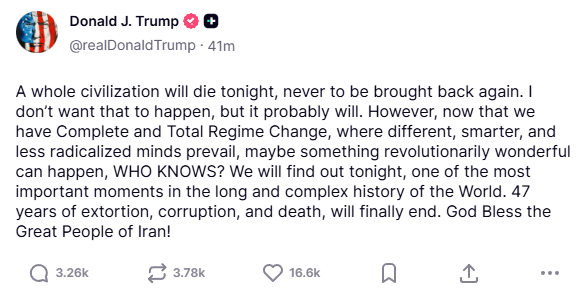
In the United States, President Donald Trump has remained defiant. In statements released on social media, the President claimed that the US had “obliterated” military targets on Kharg Island while choosing not to “wipe out” the oil infrastructure—offering the Iranian leadership a final chance to reopen the Strait of Hormuz.
The global economy, however, is struggling to absorb the shock. Oil prices have surged to record highs as the prospect of a prolonged disruption to Gulf supply becomes a reality. The US has attempted to mitigate this by temporarily easing sanctions on other producers, including limited Russian shipments, but the “2026 Iran War” has already incurred costs exceeding $18 billion for the US military alone.
A Region on the Brink
The Iranian response has been one of fierce defiance. The IRGC warned on Tuesday that if the United States crosses further “red lines,” the Iranian response will extend “beyond the region.” Retaliatory drone and missile strikes have already been reported against Israeli communities and US bases in Bahrain, Qatar, and Jordan.
In Lebanon, the conflict has merged with a full-scale war between Israel and Hezbollah. The IDF reported today that it has completed its “forward deployment” along a defense line in southern Lebanon, signaling that the ground war there is likely to intensify in tandem with the strikes on Iran.
As the sun sets over the Persian Gulf, the fires on Kharg Island and the severed bridges of Qom serve as a stark reminder of the scale of this conflict. With both sides dug in and the “2026 Iran War” entering a more destructive phase, the international community watches with bated breath, fearing that the “tragedy” warned of by regional diplomats is only just beginning.
Sources Used and Links:
- The Media Line: “US Hits Air Defenses on Iran’s Kharg Island” (April 7, 2026) https://themedialine.org/headlines/us-hits-air-defenses-on-irans-kharg-island/
- Council on Foreign Relations: “Kharg Island: Iran’s Oil Lifeline and a Tempting U.S. Target” (April 6, 2026) https://www.cfr.org/articles/kharg-island-irans-oil-lifeline-and-a-tempting-u-s-target
- International Crisis Group: “Israel 6 April 2026 #1” (April 6, 2026) https://www.crisisgroup.org/content/israel-6-april-2026-1
- The Hindu: “Iran-Israel war LIVE: A whole civilisation will die tonight… says Trump” (April 7, 2026) https://www.thehindu.com/news/international/iran-israel-war-west-asia-us-donald-trump-strait-of-hormuz-live-updates-on-april-7-2026/article70832715.ece
- The Guardian: “Middle East crisis live: Trump says he is ‘not at all’ worried about war crimes” (April 7, 2026) https://www.theguardian.com/world/live/2026/apr/07/iran-war-live-updates-trump-hormuz-threats-deadline-strikes-middle-east-conflict
- PBS News: “Kharg Island is key to Iran’s oil exports. Targeting it carries major risks” (March 30, 2026) https://www.pbs.org/newshour/world/kharg-island-is-key-to-irans-oil-exports-targeting-it-carries-major-risks
- India Today: “What US wants to achieve by invading Kharg island” (April 7, 2026) https://www.indiatoday.in/world/story/us-aims-cripple-iran-economy-seizing-kharg-island-oil-hub-conflict-boots-on-ground-2892822-2026-04-07
- The House of Commons Library: “US/Israel-Iran conflict 2026” (March 31, 2026) https://commonslibrary.parliament.uk/research-briefings/cbp-10521/
- Al Jazeera Centre for Studies: “Escalation Without Exit: Strategic Disorientation and Potential Scenarios” (April 1, 2026) https://studies.aljazeera.net/en/analyses/escalation-without-exit-strategic-disorientation-and-potential-scenarios-us%E2%80%93israeli-war
- Wikipedia: “2026 Iran war” (April 7, 2026) https://en.wikipedia.org/wiki/2026_Iran_war
Disclaimer
Artificial Intelligence Disclosure & Legal Disclaimer
AI Content Policy.
To provide our readers with timely and comprehensive coverage, South Florida Reporter uses artificial intelligence (AI) to assist in producing certain articles and visual content.
Articles: AI may be used to assist in research, structural drafting, or data analysis. All AI-assisted text is reviewed and edited by our team to ensure accuracy and adherence to our editorial standards.
Images: Any imagery generated or significantly altered by AI is clearly marked with a disclaimer or watermark to distinguish it from traditional photography or editorial illustrations.
General Disclaimer
The information contained in South Florida Reporter is for general information purposes only.
South Florida Reporter assumes no responsibility for errors or omissions in the contents of the Service. In no event shall South Florida Reporter be liable for any special, direct, indirect, consequential, or incidental damages or any damages whatsoever, whether in an action of contract, negligence or other tort, arising out of or in connection with the use of the Service or the contents of the Service.
The Company reserves the right to make additions, deletions, or modifications to the contents of the Service at any time without prior notice. The Company does not warrant that the Service is free of viruses or other harmful components.