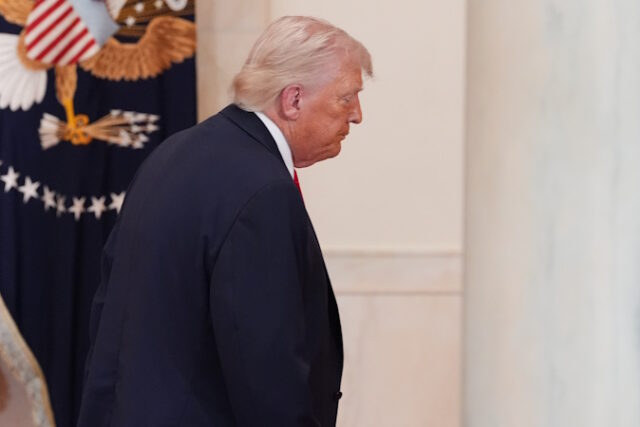
The geopolitical landscape shifted violently on the evening of April 1, 2026, as President Donald Trump delivered a primetime address that sent shockwaves from the halls of the White House to the trading floors of the world’s major financial hubs. Five weeks into Operation Epic Fury, the joint U.S.-Israeli military campaign against Iran, the President’s rhetoric moved from tactical reporting to a broader, more combative stance that has left investors, allies, and adversaries scrambling to assess a new reality.
The fallout was immediate. By the close of business on April 2, 2026, the Dow Jones Industrial Average slipped further into the red, while Brent Oil prices—driven by a lethal combination of supply fear and rhetoric—soared to levels not seen since the global energy crisis of 2008. But the economic impact, while staggering, is only one facet of a rapidly darkening picture that now includes reports of child soldier recruitment in Iran, direct missile strikes on Tel Aviv, and a burgeoning naval war for control of the Strait of Hormuz.
The Speech: Redefining “Epic Fury”
In a 20-minute address from the White House Cross Hall, President Trump signaled a significant escalation in the ongoing conflict. While he claimed that Iranian offensive capabilities were “essentially decimated,” he simultaneously promised that the United States would strike “extremely hard” over the next two to three weeks.
The President’s threat to target Iran’s power grid and his blunt suggestion that other nations must “fend for themselves” regarding security in the Strait of Hormuz acted as a catalyst for market panic. The “mixed signals” problem—praising progress while expanding the target list—has created a vacuum of certainty that the global economy is finding impossible to fill.

Energy Markets: The 2008 Ghost Returns
The most visceral reaction to the speech occurred in the energy sector. On Thursday, April 2, Dated Brent crude—the benchmark for physical oil supplies—hit $141.37 per barrel. This represents the highest price level since the historic peaks of 2008, surpassing even the volatility seen during the initial months of the Russia-Ukraine conflict in 2022.
The International Energy Agency (IEA) has labeled this the “most severe supply shock in oil market history.” The widening gap between “paper” futures and physical “Dated” oil reflects a desperate scramble for immediate barrels as the reality of a shuttered Strait of Hormuz sinks in. WTI crude followed suit, briefly touching $113.93, as short-sellers were forced into rapid liquidations following the President’s hardline remarks.
The Fight for the Strait of Hormuz
The Strait of Hormuz, a narrow waterway responsible for the transit of roughly one-fifth of the world’s oil supply, is now a theater of active maritime warfare. Following the President’s “fend for themselves” directive, the security situation has deteriorated. Reports have surfaced of a Kuwaiti oil tanker being hit by Iranian drones near Dubai and a QatarEnergy-chartered tanker struck by a missile off the coast of Qatar.
The disruption has not only spiked prices but has fundamentally altered global trade routes. Shipping insurance premiums have entered “war risk” territory, making transit through the Persian Gulf nearly impossible for commercial vessels without direct military escort—an escort the U.S. executive has suggested may no longer be a guarantee for all.
Iran’s “For Iran” Campaign: The Recruitment of Children
As the conventional military pressure on Tehran intensifies, the Islamic Revolutionary Guard Corps (IRGC) has turned to increasingly desperate measures. Human Rights Watch and various international monitors have confirmed that Iran has launched a nationwide campaign titled “Homeland Defending Combatants for Iran.”
“There is no excuse for a military recruitment drive that targets children to sign up, much less 12-year-olds,” said Bill Van Esveld, associate children’s rights director at Human Rights Watch. “Iranian authorities are apparently willing to risk children’s lives for some extra manpower.”
The Houthi Front: Missile Attacks on Israel
The conflict is no longer contained within the borders of the Islamic Republic. On April 2, the Houthi movement in Yemen claimed their fourth direct missile attack on Israel since the escalation began. Houthi spokesperson Yahya Saree announced a “barrage of ballistic missiles” targeting “vital sites” in the Tel Aviv area, a move coordinated with Iran and Hezbollah.
While the Israeli Defense Forces (IDF) reported the successful interception of a missile launched from Yemen, the psychological and economic impact of a multi-front war is mounting. The Houthis have vowed further escalation, signaling that they will mirror the intensity of the U.S.-Israeli campaign in Iran.
Investment Fallout: A Shift in the Global Portfolio
For investors, the April 1st speech was a turning point. The initial optimism for a quick ceasefire has evaporated, replaced by a “war footing” mentality.
- Flight to Safety: Gold and Treasury yields have seen increased volatility as investors pull back from riskier assets.
- Defense and Energy: While the broader Dow fell, defense contractors and domestic energy producers have seen a surge in interest as the “long war” scenario becomes the base case for analysts.
- Inflationary Pressure: With oil at $140, Bank of America economists are forecasting a period of “stagflation” for the remainder of 2026, with average U.S. petrol prices already exceeding $4 per gallon and poised to climb higher.
- Tech Resilience: Interestingly, the Nasdaq and S&P 500 have shown some resilience, bolstered by strong corporate earnings and the continued AI revolution, though this optimism is increasingly decoupled from the geopolitical reality on the ground.
Conclusion
The events of early April 2026 mark a definitive end to the post-pandemic economic recovery and the beginning of a era defined by “Operation Epic Fury.” With the President doubling down on military objectives and Iran resorting to the recruitment of children to bolster its defenses, the path to de-escalation appears increasingly narrow. As the Dow struggles and oil prices haunt the memory of 2008, the world waits to see if the “two to three weeks” promised by Washington will lead to the promised decimation of the threat—or the further destabilization of the global order.
Sources and Links
- VT Markets: Trump’s Iran Speech Leaves Markets With More Questions
- TradingKey: Spot Brent Oil Price Hits $140 for First Time Since 2008 on Trump Rhetoric
- UNN (Kyiv): Dated Brent oil price exceeds $140 for the first time since 2008
- Human Rights Watch: Iran: Military Stepping Up Child Recruitment
- ITV News: Children as young as 12 can now join war effort in Iran
- Middle East Eye: Houthis claim missile attack on Israel, vow further escalation
- SpaceWar: Yemen’s Houthis announce fourth missile attack on Israel
- CBS News: Stocks erase early losses as investors monitor Iran war developments
- PBS NewsHour: Stocks drop after Trump ramps up new tariffs and investors dump potential AI losers
Disclaimer
Artificial Intelligence Disclosure & Legal Disclaimer
AI Content Policy.
To provide our readers with timely and comprehensive coverage, South Florida Reporter uses artificial intelligence (AI) to assist in producing certain articles and visual content.
Articles: AI may be used to assist in research, structural drafting, or data analysis. All AI-assisted text is reviewed and edited by our team to ensure accuracy and adherence to our editorial standards.
Images: Any imagery generated or significantly altered by AI is clearly marked with a disclaimer or watermark to distinguish it from traditional photography or editorial illustrations.
General Disclaimer
The information contained in South Florida Reporter is for general information purposes only.
South Florida Reporter assumes no responsibility for errors or omissions in the contents of the Service. In no event shall South Florida Reporter be liable for any special, direct, indirect, consequential, or incidental damages or any damages whatsoever, whether in an action of contract, negligence or other tort, arising out of or in connection with the use of the Service or the contents of the Service.
The Company reserves the right to make additions, deletions, or modifications to the contents of the Service at any time without prior notice. The Company does not warrant that the Service is free of viruses or other harmful components.