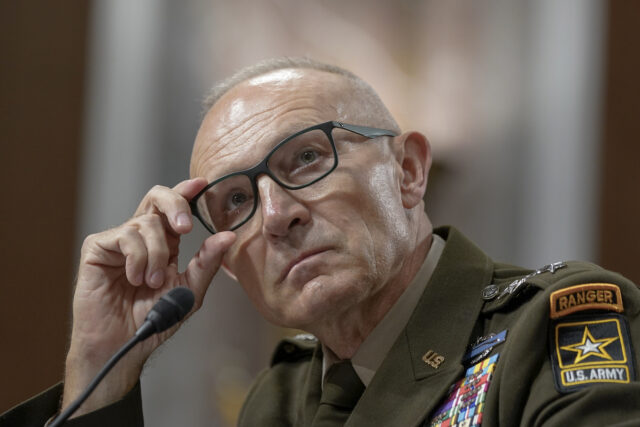
The landscape of the American military leadership underwent a seismic shift on April 2, 2026, as Defense Secretary Pete Hegseth officially requested the immediate retirement of General Randy George, the 41st Chief of Staff of the Army. The move, which ends George’s tenure nearly eighteen months ahead of schedule, marks the most significant escalation to date in Hegseth’s campaign to radically restructure the Department of Defense.
The Immediate Dismissal
The announcement came through a terse statement from Pentagon spokesperson Sean Parnell, who confirmed that General George would be retiring “effective immediately.” While the official rhetoric expressed gratitude for George’s “decades of service,” the reality on the ground was far more abrupt. General George, a West Point graduate and decorated infantry officer with a career spanning from the Gulf War to Afghanistan, was reportedly asked to step down to make way for leadership more closely aligned with the current administration’s “warrior ethos.”
The dismissal was not limited to George alone. In a coordinated sweep, Hegseth also removed:
- General David Hodne: The head of the Army’s Training and Transformation Command.
- Major General William Green Jr.: The Chief of Army Chaplains.
A Pattern of Purging
Since taking office in early 2025, Pete Hegseth has dismantled the traditional hierarchy of the Joint Chiefs of Staff. General George is the latest in a long line of high-ranking officers to be shown the door, joining the likes of former Chairman of the Joint Chiefs Gen. C.Q. Brown, Chief of Naval Operations Adm. Lisa Franchetti, and Air Force Vice Chief Gen. James Slife.

Critics argue that these removals are politically motivated, noting that George served as the senior military assistant to former Defense Secretary Lloyd Austin during the Biden administration. Hegseth has frequently criticized “woke” military culture and leaders who he perceives as prioritizing diversity over combat readiness. By installing loyalists—most notably Lt. Gen. Christopher LaNeve, a former military aide to Hegseth who will now serve as acting Chief of Staff—Hegseth is centralizing power within the Pentagon to a degree rarely seen in modern history.
The Strategic Vacuum
The timing of George’s removal has raised eyebrows across Washington. The U.S. is currently engaged in heightening tensions with Iran, with thousands of soldiers deployed to the Middle East for potential ground operations. Dismissing the Army’s top officer during a period of active conflict is a move that many veteran observers call “unprecedented” and “risky.”
General George had been navigating the Army through a significant recruiting crisis and spearheading the “Transformation in Contact” initiative, designed to integrate new technologies into the force at a rapid pace. With his sudden exit, these programs face an uncertain future as the “Department of War”—a term Hegseth has revived—realigns its priorities toward conventional warfare and political loyalty.
Conclusion
The firing of General Randy George is more than just a change in personnel; it is a declaration of intent. As Pete Hegseth continues to reshape the military in his image, the fundamental relationship between civilian leadership and the professional officer corps is being rewritten. Whether this “warrior culture” shift results in a more lethal force or a more fractured institution remains the most pressing question for the future of American national security.
Sources Used and Links:
- Breaking Defense: Hegseth fires Army’s top officer, Gen. Randy George
- The Washington Post: Hegseth forces out Army’s top general, two other senior officers
- CBS News: Hegseth ousts Army Chief of Staff Gen. Randy George
- The Guardian: Top US army officer steps down after Hegseth reportedly demanded removal
- Washington Examiner: Hegseth removes Army chief of staff Gen. Randy George
- WCNC-TV (Associated Press): Hegseth asks Gen. Randy George, Army’s top uniformed officer, to step down
- Quiver Quantitative: Defense Secretary Pete Hegseth Removes Army Chief Gen. Randy George in Leadership Shakeup
Disclaimer
Artificial Intelligence Disclosure & Legal Disclaimer
AI Content Policy.
To provide our readers with timely and comprehensive coverage, South Florida Reporter uses artificial intelligence (AI) to assist in producing certain articles and visual content.
Articles: AI may be used to assist in research, structural drafting, or data analysis. All AI-assisted text is reviewed and edited by our team to ensure accuracy and adherence to our editorial standards.
Images: Any imagery generated or significantly altered by AI is clearly marked with a disclaimer or watermark to distinguish it from traditional photography or editorial illustrations.
General Disclaimer
The information contained in South Florida Reporter is for general information purposes only.
South Florida Reporter assumes no responsibility for errors or omissions in the contents of the Service. In no event shall South Florida Reporter be liable for any special, direct, indirect, consequential, or incidental damages or any damages whatsoever, whether in an action of contract, negligence or other tort, arising out of or in connection with the use of the Service or the contents of the Service.
The Company reserves the right to make additions, deletions, or modifications to the contents of the Service at any time without prior notice. The Company does not warrant that the Service is free of viruses or other harmful components.