The Incident on Jupiter Island
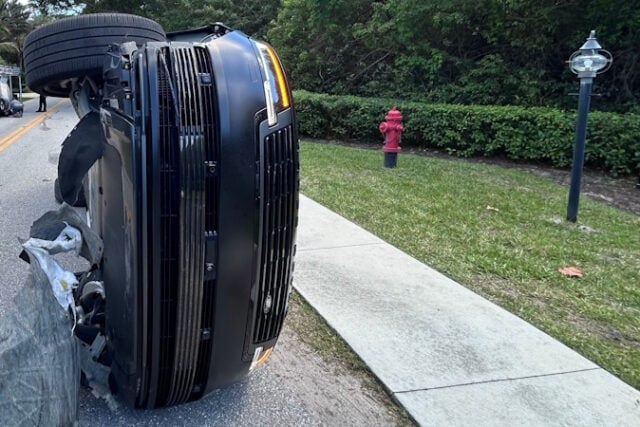
On the afternoon of Friday, March 27, 2026, the quiet, affluent enclave of Jupiter Island, Florida, became the scene of a familiar and distressing sight: Tiger Woods, the greatest golfer of his generation, standing beside a mangled vehicle. According to reports from the Martin County Sheriff’s Office, Woods was traveling at a high rate of speed in his Land Rover when he attempted to pass a pressure-cleaning truck on a narrow, two-lane road. The maneuver ended in disaster as Woods clipped the rear of the truck’s trailer, causing his SUV to lose control and roll onto its side.
Miraculously, Woods and the driver of the truck, identified as Jeromy Bullard, emerged from the wreckage without serious injuries. However, the physical safety of the participants was quickly overshadowed by the observations of the responding officers. Deputy Tatiana Levenar, who arrived at the scene shortly after 2:00 PM ET, noted that Woods appeared “lethargic and slow” in his movements. Despite the cool air of the patrol vehicle, Woods was reportedly sweating profusely. When he removed his sunglasses, his eyes were described as bloodshot and glassy, with pupils that were “extremely dilated.”
What Was Found: Investigation and Evidence
The police report provides a granular look at the moments following the crash. During a search of Woods’ person, deputies discovered two white pills in his pants pocket. These were later identified by markings as hydrocodone, a potent opioid typically prescribed for severe chronic pain. Woods admitted to taking “a few” prescription medications earlier that morning, citing a long history of physical ailments, including seven back surgeries and over 20 operations on his leg—the latter being the result of his near-fatal 2021 crash in California.
Perhaps most telling were Woods’ own admissions regarding his state of mind at the time of the collision. He told investigators that he was looking down at his cellphone and attempting to change the radio station when the impact occurred. While he cooperated with a breathalyzer test, which showed a 0.00% blood alcohol content, he refused to submit to a urine test. This refusal, combined with the physical signs of impairment and the discovery of the hydrocodone, led to his arrest on charges of driving under the influence (DUI) with property damage.

A Public Commitment to Health

Four days after the accident, on Tuesday, March 31, Woods entered a written plea of not guilty through his legal counsel. Simultaneously, he broke his silence on social media, releasing a statement that resonated with both contrition and a plea for understanding.
— Tiger Woods (@TigerWoods) March 31, 2026
He emphasized that his goal is to return in a “healthier, stronger, and more focused place,” both personally and professionally. This decision means Woods will miss the upcoming Masters tournament, an event where he has won five times and which often serves as the barometer for his competitive standing.
The Shadow of the Past: A Pattern of Pain
To understand the gravity of the 2026 incident, one must look at the historical context of Woods’ struggles with pain management and vehicle-related incidents. This is not the first time the golfer has been found impaired behind the wheel.
- 2017 Arrest: In May 2017, Woods was found asleep at the wheel of his car in Jupiter, Florida, with the engine running and the blinker on. Toxicology reports later revealed a “cocktail” of drugs in his system, including Vicodin, Xanax, and Ambien. Woods attributed the incident to an “unexpected reaction to prescribed medications” following spinal fusion surgery.
- 2021 California Crash: In February 2021, Woods survived a horrific single-vehicle rollover in Rancho Palos Verdes, California. He was traveling at nearly double the speed limit when he struck a median and a tree. That accident resulted in “open fractures” to his tibia and fibula, requiring the insertion of a rod into his leg and screws and pins into his foot and ankle.
The 2021 accident, in particular, fundamentally changed Woods’ life. While he made a “miracle” return to competitive golf at the 2022 Masters, his gait has remained labored, and his ability to practice has been severely limited. Sources close to the golfer, including President Donald Trump, have noted that Woods lives in a state of “tremendous physical pressure” and constant pain.
The Medical Reality of Hydrocodone
The discovery of hydrocodone in Woods’ pocket brings the issue of chronic pain management back to the forefront. For an athlete who has undergone dozens of surgeries, the line between therapeutic use and dependency can often become blurred. Hydrocodone, an opioid, is highly effective at blocking pain signals, but it also carries significant side effects, including drowsiness, slowed reaction times, and impaired judgment—all of which are consistent with the details in the Martin County police report.
The lethargy and “glassy eyes” noted by Deputy Levenar are textbook indicators of opioid influence. For Woods, the struggle appears to be a dual battle: managing the physical wreckage of his body while navigating the neurological and psychological toll of long-term medication use.
Reaction from the Golf World
The PGA Tour has been swift to offer support, prioritizing the man over the myth. “Tiger is a legend of our sport, but above all else, Tiger is a person,” the Tour said in an official statement. “Our focus is on his health and well-being. He continues to have our full support as he takes this important step.”
Fellow players have expressed a mixture of concern and empathy. Many in the industry recognize that the version of Tiger Woods the public sees—the stoic competitor—is often a mask for a man dealing with significant internal and external trauma. His decision to “step away” is seen by many as the most responsible course of action he has taken in years, acknowledging that the path to recovery cannot be paved with golf trophies alone.
The Road Ahead
As Tiger Woods enters treatment, the future of his career remains an open question. At 50 years old, the physical demands of professional golf are already a monumental hurdle. When coupled with the need for comprehensive rehabilitation for substance use or pain management, the prospect of another comeback seems more distant than ever.
However, the “lasting recovery” Woods spoke of in his statement suggests a shift in priorities. For decades, Woods’ identity was forged in the fires of competition. This latest incident serves as a stark reminder that even the most resilient figures have breaking points. The goal now is not a green jacket, but a sustainable, healthy life away from the sirens and the wreckage.
Sources and Links
- TSN.ca: Police report from Tiger Woods’ car crash shows why he was arrested on suspicion of DUI
- Golf Channel: Sheriff’s report released after Tiger Woods’ arrest for suspicion of DUI
- Local 10 News: Tiger Woods says he’ll seek treatment after pleading not guilty to DUI
- JNY Law: Tiger Woods Arrested After Another DUI Crash
- Golf.com: Tiger Woods’s latest car accident leads back to same difficult conclusion
- Enjuris: Tiger Woods California Car Crash: What Caused the Accident?
- PGA Tour: Tiger Woods announces he’s stepping away from golf to seek treatment, focus on his health
- Variety Australia: Tiger Woods ‘Stepping Away to Seek Treatment’ After Car Crash
- The Economic Times: Tiger Woods pleads not guilty, is stepping away to seek treatment
- Times of India: “He does have pain”: Donald Trump drops cryptic update on Tiger Woods after Florida crash
Disclaimer
Artificial Intelligence Disclosure & Legal Disclaimer
AI Content Policy.
To provide our readers with timely and comprehensive coverage, South Florida Reporter uses artificial intelligence (AI) to assist in producing certain articles and visual content.
Articles: AI may be used to assist in research, structural drafting, or data analysis. All AI-assisted text is reviewed and edited by our team to ensure accuracy and adherence to our editorial standards.
Images: Any imagery generated or significantly altered by AI is clearly marked with a disclaimer or watermark to distinguish it from traditional photography or editorial illustrations.
General Disclaimer
The information contained in South Florida Reporter is for general information purposes only.
South Florida Reporter assumes no responsibility for errors or omissions in the contents of the Service. In no event shall South Florida Reporter be liable for any special, direct, indirect, consequential, or incidental damages or any damages whatsoever, whether in an action of contract, negligence or other tort, arising out of or in connection with the use of the Service or the contents of the Service.
The Company reserves the right to make additions, deletions, or modifications to the contents of the Service at any time without prior notice. The Company does not warrant that the Service is free of viruses or other harmful components.