Living in Port St. Lucie, FL has its benefits, including coastal breezes, warm weather, and year-round outdoor living. However, there is a lesser-known factor that quietly affects homes and buildings throughout the area: salt air.
Most people associate salt exposure with beachfront properties, but salt particles actually travel inland and settle on exterior surfaces. Over time, this results in a thin, nearly invisible layer that interacts with moisture, heat, and organic debris. The result isn’t always obvious at first, but it has a significant impact on how surfaces age and how they should be cleaned. This is where a more thoughtful approach to pressure cleaning in Port St Lucie, FL becomes important.
The Hidden Layer You Don’t Notice
Salt residue does not behave like regular dirt. It adheres to surfaces and attracts moisture, even during dry spells. This continuous cycle of absorption and evaporation generates micro-conditions that affect materials differently.
- Painted surfaces might lose adhesion faster.
- Concrete can exhibit subtle surface weakening.
- Metal fixtures are more likely to oxidize.
- Glass and windows exhibit persistent haze or spotting.
What makes this difficult is that standard visual inspection frequently overlooks early buildup. By the time it becomes visible, the surface beneath it may have already been affected.

Why Traditional Cleaning Timing Does Not Always Work.
Many homeowners follow seasonal cleaning routines, such as spring cleaning or pre-summer washing. While this works in some areas, coastal environments such as Port St. Lucie do not follow the same rules.
Salt accumulation is not seasonal; it is continuous.
Waiting for visible dirt or staining can result in:
- Uneven surface wear.
- Later on, cleaning intensity increased.
- Reduced durability of exterior finishes
Rather than thinking about “when it looks dirty,” a better approach is to understand environmental exposure cycles, particularly after periods of high humidity, storms, or strong coastal winds.
Surface-Specific Responses To Coastal Conditions
Salt and humidity affect materials differently. Cleaning methods should reflect this.
1. Driveway and Walkway
Concrete surfaces are known to trap fine particles. When salt reacts with organic debris such as leaves or pollen, it can cause subtle discoloration patterns that become more difficult to remove over time.
2. Roof edges and gutters.
These areas frequently collect airborne residue first. Salt buildup combined with standing moisture can hasten wear in ways that are not immediately apparent from the ground.
3. Fences and outdoor structures.
The way wood and composite materials absorb environmental elements differs. Without proper cleaning cycles, they may develop uneven tones or premature fading.
4. Pool decks and patios.
Constant exposure to water already stresses these surfaces. When you add salt air to the mix, you increase the likelihood of surface film buildup, which affects both appearance and texture.
The importance of technique over pressure
A common misconception is that higher pressure results in better cleaning. In reality, technique is far more important than force, particularly in coastal environments.
Applying excessive pressure to salt-affected surfaces can:
- Strip the protective coatings.
- Push the residue deeper into porous materials.
- Create micro-damage to accelerate wear.
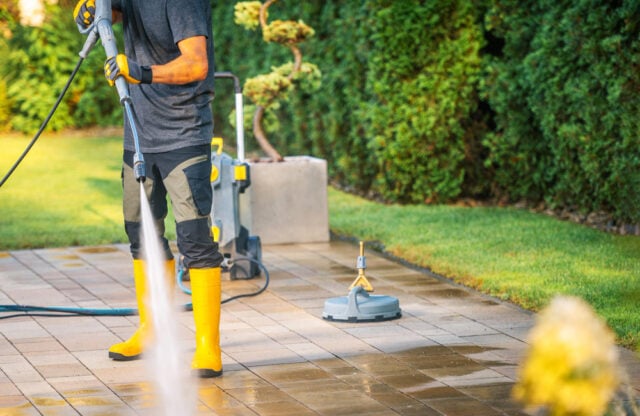
Professionals who understand the local environment concentrate on controlled cleaning methods, varying pressure, water temperature, and treatment approach based on the surface and level of exposure.
Companies like Great White Pressure Cleaning take this tailored approach, recognizing that homes in Port St. Lucie require different handling compared to inland properties.
Why Location-Specific Experience Matters
Not all cleaning services have the same level of environmental awareness. What works in a dry inland city may not be applicable in a coastal Florida climate.
Local expertise matters in areas such as:
- Identifying early-stage salt accumulation
- Changing cleaning frequency according to weather patterns
- Choosing methods that maintain surface integrity
- Preventing long-term damage rather than reacting to it
This is especially important for homeowners who want to ensure not only appearance but also material longevity.
Subtle Signs Your Exterior Needs Attention.
Because salt buildup is not always visible, it is useful to look for indirect indicators:
- Surfaces feel slightly rough or chalky.
- Windows lose clarity quickly after cleaning.
- Faint streaks appear after rain.
- Outdoor fixtures are dulling faster than expected.
These signs frequently indicate underlying residue rather than surface dirt alone.
Rethinking Exterior Maintenance in Coastal Florida.
Exterior cleaning in Port St. Lucie is about more than just looking good; it’s also about adapting to a specific environment.
A more effective approach would involve:
- Understand how coastal elements interact with your property.
- Changing cleaning schedules based on exposure, not just appearance.
- Using techniques to protect surfaces over time.
That is why hiring experienced pressure cleaning professionals in Port St Lucie, FL can make a significant difference—not only in how your property looks today, but also in how well it holds up over time.
Final Thought
Salt air is one of those factors that most people overlook until the consequences become apparent. Cleaning is frequently more time-consuming than necessary by this point. A smarter strategy is proactive, surface-aware, and location-specific. Because in coastal environments like Port St. Lucie, what you don’t see on your exterior surfaces can be as important as what you do.
Disclaimer
Artificial Intelligence Disclosure & Legal Disclaimer
AI Content Policy.
To provide our readers with timely and comprehensive coverage, South Florida Reporter uses artificial intelligence (AI) to assist in producing certain articles and visual content.
Articles: AI may be used to assist in research, structural drafting, or data analysis. All AI-assisted text is reviewed and edited by our team to ensure accuracy and adherence to our editorial standards.
Images: Any imagery generated or significantly altered by AI is clearly marked with a disclaimer or watermark to distinguish it from traditional photography or editorial illustrations.
General Disclaimer
The information contained in South Florida Reporter is for general information purposes only.
South Florida Reporter assumes no responsibility for errors or omissions in the contents of the Service. In no event shall South Florida Reporter be liable for any special, direct, indirect, consequential, or incidental damages or any damages whatsoever, whether in an action of contract, negligence or other tort, arising out of or in connection with the use of the Service or the contents of the Service.
The Company reserves the right to make additions, deletions, or modifications to the contents of the Service at any time without prior notice. The Company does not warrant that the Service is free of viruses or other harmful components.