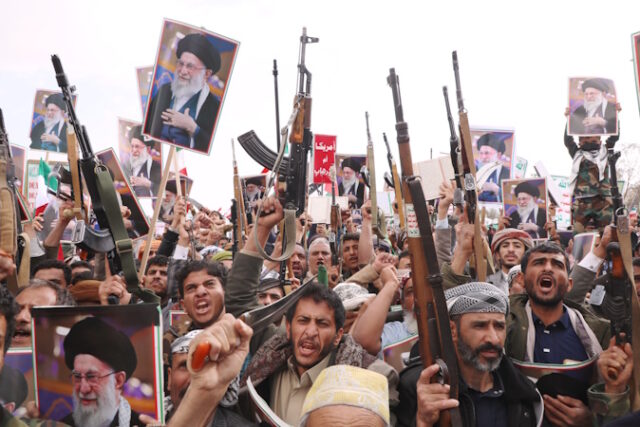
RIYADH / JERUSALEM / WASHINGTON — On the one-month anniversary of the most significant regional escalation in decades, the conflict dubbed “Operation Epic Fury” has mutated from a targeted US-Israeli air campaign into a multi-front war of attrition. Saturday brought a dramatic widening of the theater as Yemen’s Houthi rebels officially joined the hostilities, launching their first direct missile strikes against Israel, while a devastating Iranian barrage on a joint US-Saudi air base highlighted the growing fragility of regional defenses.
U.S. Sailors and Marines aboard USS Tripoli (LHA 7) arrived in the U.S. Central Command area of responsibility, March 27. The America-class amphibious assault ship serves as the flagship for the Tripoli Amphibious Ready Group / 31st Marine Expeditionary Unit composed of about… pic.twitter.com/JFWiPBbkd2
— U.S. Central Command (@CENTCOM) March 28, 2026

As of March 28, 2026, the strategic map of the Middle East is being redrawn by fire. With the Strait of Hormuz still under an Iranian “toll-enforced” blockade and the Red Sea shipping lanes now officially in the Houthis’ crosshairs, the global economy is bracing for a supply chain shock that makes the disruptions of 2024 look like a minor logistical hiccup.
The Houthi Entry: A New Front Opens
After four weeks of relative silence from Sanaa, the Iran-aligned Houthis have decisively entered the war. Early Saturday morning, sirens wailed across southern Israel, specifically near the sensitive nuclear research center in Dimona and the city of Beer Sheba.
Brigadier General Yahya Saree, the Houthi military spokesperson, announced in a televised address that the group had fired a “barrage of ballistic missiles” targeting “sensitive military sites” deep within Israel. While the Israel Defense Forces (IDF) confirmed the interception of a missile launched from Yemen, the psychological and economic impact was immediate.
The Houthi entry is more than a symbolic gesture of solidarity with Tehran. It signifies a direct threat to the Bab al-Mandeb Strait, a vital maritime chokepoint through which approximately 12% of global trade passes. Analysts warn that if the Houthis resume their 2024-style campaign against commercial shipping, the Red Sea will become a “no-go zone,” forcing ships to take the long and costly route around the Cape of Good Hope. This comes at a time when the Strait of Hormuz is already effectively closed by the Islamic Revolutionary Guard Corps (IRGC), which on Saturday reportedly turned back three container ships attempting to transit the waterway.
The Strike on Prince Sultan Air Base: US Casualties Mount
While the world’s attention was on Yemen, a far more lethal strike was unfolding in central Saudi Arabia. Late Friday night, Iran launched a coordinated attack involving six ballistic missiles and nearly 30 one-way attack drones against the Prince Sultan Air Base (PSAB).
The base, located outside Riyadh, serves as a critical hub for U.S. and Saudi aerial operations. According to Pentagon officials and satellite imagery confirmed by OSINT analysts, the attack was pinpoint-accurate. At least 12 U.S. service members were wounded, two of them seriously, in what has become the costliest single engagement for American personnel since the war began on February 28.
The damage to the equipment was equally severe. Initial reports indicate that at least one U.S. Air Force KC-135 Stratotanker—a vital aerial refueling aircraft—was destroyed on the apron, with three others significantly damaged. A photo circulating on social media, later verified by military experts, showed a U.S. E-3 Sentry AWACS (Airborne Warning and Control System) plane with major shrapnel damage to its fuselage.
The strike at PSAB is a stark reminder that despite the U.S. and Israel hitting over 11,000 targets in Iran over the last 30 days, Tehran’s “deep magazine” of mobile missile launchers remains a potent threat.
The Interceptor War: Israel’s Defense Dilemma
In Israel, a different kind of crisis is brewing. The “Iron Dome” and “Arrow” systems, long the gold standard of air defense, are facing a math problem they cannot win.
A leaked Wall Street Journal report suggests that the IDF has begun “rationing” its most advanced interceptors. The Arrow 3 system, designed to intercept ballistic missiles outside the atmosphere, costs approximately $2.5 million per launch. With Iran launching near-daily barrages, Israeli military planners are reportedly being forced to make agonizing choices: which missiles to intercept and which to let fall in open areas.
This rationing has already had consequences. Last week, two Iranian ballistic missiles scored direct hits on the towns of Dimona and Arad. While the IAF claimed the hits were due to technical errors in the David’s Sling system—a medium-range alternative being used to conserve Arrow missiles—the incident has rattled the Israeli public.
“We are in an interceptor war of attrition,” noted one defense analyst. “Iran can produce drones and short-range missiles for a fraction of the cost it takes us to shoot them down. We are trading expensive, high-tech ‘silver bullets’ for cheap, mass-produced ‘lead’ from Tehran.”
US Reinforcements: The Arrival of the USS Tripoli
In response to the escalating threats, the Biden-Trump transition-era buildup has reached a new peak. On Saturday, U.S. Central Command (CENTCOM) announced the arrival of more than 3,500 U.S. troops in the region.
Leading the reinforcement is the USS Tripoli (LHA 7), an America-class amphibious assault ship carrying the 31st Marine Expeditionary Unit (MEU). The Tripoli, often described as a “lightning carrier,” carries a potent squadron of F-35B stealth fighters and MV-22B Ospreys. These assets are specifically designed for “contested environments,” sparking rumors that the U.S. is preparing for a ground operation to seize Iranian-held islands in the Gulf, such as Kharg Island, which handles 90% of Iran’s oil exports.
Secretary of State Marco Rubio, speaking from Washington, maintained that the U.S. intends to meet its objectives “without any ground troops,” but he added a significant caveat: “The President must be prepared for multiple contingencies to give him maximum optionality.”
The Economic Toll and the Road Ahead
As “Operation Epic Fury” enters its second month, the global fallout is becoming unbearable for many nations. Gas prices in the United States have spiked, and G7 foreign ministers issued a stern joint statement on Saturday calling for the “absolute necessity” to restore freedom of navigation in the Strait of Hormuz.
The Trump administration has reportedly delivered a 15-point “action list” to Tehran, offering a ceasefire in exchange for the total dismantling of Iran’s nuclear infrastructure and the reopening of the shipping lanes. However, with the Houthis now active and the IRGC digging in for a “protracted confrontation,” the window for diplomacy appears to be closing as fast as the shipping lanes themselves.
For the residents of Tel Aviv, Riyadh, and Tehran, the “weeks, not months” timeline promised by some Western officials feels increasingly like a fantasy. The war on Iran has become a regional wildfire, and today, more than ever, the world is waiting to see who gets burned next.
Sources and References
- Israel Rationing Interceptors as Iran’s Missile Barrages Persist | The Wall Street Journal (March 27, 2026) https://www.wsj.com/world/middle-east/israel-missile-defense-rationing-iran-war-2026
- U.S. troops injured in attack on Saudi base as the war reaches one month | OPB News (March 28, 2026) https://www.opb.org/article/2026/03/28/u-s-troops-injured-in-saudi-base-as-the-war-reaches-one-month/
- US Forces at Saudi Air Base Suffer Iranian Attack | Air & Space Forces Magazine (March 27, 2026) https://www.airandspaceforces.com/us-forces-saudi-arabia-iran-attack/
- Iranian Attack on Prince Sultan Air Base Reportedly Struck U.S. KC-135s, E-3 Sentry | The Aviationist (March 27, 2026) https://theaviationist.com/2026/03/27/iranian-attack-on-prince-sultan-air-base/
- At least 10 U.S. troops wounded in Iranian attack on Saudi air base | The Washington Post (March 27, 2026) https://www.washingtonpost.com/national-security/2026/03/27/iran-wounds-us-troops-saudi-base/
- Yemen’s Houthis claim first missile attack on Israel since war began | PBS News (March 28, 2026) https://www.pbs.org/newshour/world/yemens-houthis-claim-first-missile-attack-on-israel-since-war-began
- Israel scales back use of top missile interceptors as Iran barrages persist | The Jerusalem Post (March 28, 2026) https://www.jpost.com/middle-east/article-891460
- Israel is running critically low on interceptors, US officials say | Semafor (March 14, 2026) https://www.semafor.com/article/03/14/2026/israel-is-running-critically-low-on-interceptors-us-officials-say
- One month of war: Assessing military strength of US, Israel, Iran | Anadolu Agency (March 28, 2026) https://www.aa.com.tr/en/middle-east/one-month-of-war-assessing-military-strength-of-us-israel-iran/3882816
- More than 3,500 U.S. Troops arrive in Middle East as Iran war strikes intensify | CBS News (March 28, 2026) https://www.cbsnews.com/news/us-troops-uss-tripoli-centcom-middle-east-arrive-iran/
- US Sends Another 2,500 Marines to Iran as Ground Option Emerges in War | Military.com (March 20, 2026) https://www.military.com/daily-news/headlines/2026/03/20/us-send-another-2500-marines-ground-option-emerges-iran-war.html
- 2026 United States military buildup in the Middle East | Wikipedia https://en.wikipedia.org/wiki/2026_United_States_military_buildup_in_the_Middle_East
Disclaimer
Artificial Intelligence Disclosure & Legal Disclaimer
AI Content Policy.
To provide our readers with timely and comprehensive coverage, South Florida Reporter uses artificial intelligence (AI) to assist in producing certain articles and visual content.
Articles: AI may be used to assist in research, structural drafting, or data analysis. All AI-assisted text is reviewed and edited by our team to ensure accuracy and adherence to our editorial standards.
Images: Any imagery generated or significantly altered by AI is clearly marked with a disclaimer or watermark to distinguish it from traditional photography or editorial illustrations.
General Disclaimer
The information contained in South Florida Reporter is for general information purposes only.
South Florida Reporter assumes no responsibility for errors or omissions in the contents of the Service. In no event shall South Florida Reporter be liable for any special, direct, indirect, consequential, or incidental damages or any damages whatsoever, whether in an action of contract, negligence or other tort, arising out of or in connection with the use of the Service or the contents of the Service.
The Company reserves the right to make additions, deletions, or modifications to the contents of the Service at any time without prior notice. The Company does not warrant that the Service is free of viruses or other harmful components.