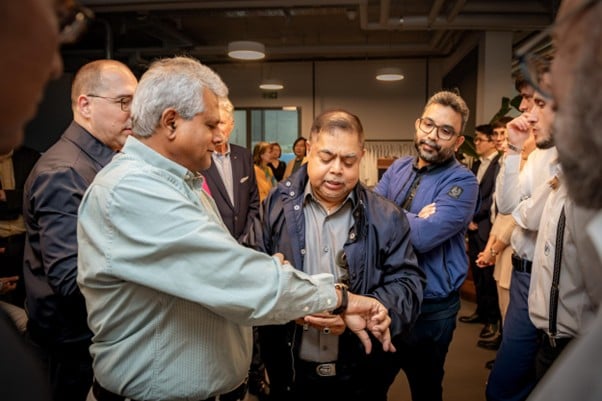
Business leader and QI Group Executive Chairman Vijay Eswaran is calling for stronger ASEAN integration, arguing that recent U.S. tariffs have exposed weaknesses in regional cooperation while also creating an opening for transformation.
Writing in the aftermath of the April 2025 trade disruptions, Eswaran contends that ASEAN now faces its greatest test of unity since the 1997 financial crisis. The United States imposed new tariffs of 24 percent on Malaysia, 32 percent on Indonesia, and 46 percent on Vietnam, triggering a flurry of bilateral negotiations that weakened collective bargaining power.
“The tariff shockwaves of 2025 have presented ASEAN with its most significant test of unity since the 1997 financial crisis and also its greatest opportunity for transformation,” Eswaran writes. He argues that the moment reveals both the bloc’s vulnerabilities and its potential to evolve.
Payment Systems Offer a Blueprint for Regional Independence
Eswaran points to Malaysia’s Regional Payment Connectivity initiative as evidence that practical solutions are proving more effective than symbolic gestures. The Malaysia–Cambodia QR payment linkage, launched in April, allows instant cross-border transactions in local currencies, bypassing the U.S. dollar entirely. Similar systems now connect eight ASEAN members through standardized QR codes, creating what he describes as an interoperable regional ecosystem that functions independently of Western financial infrastructure.

This progress stands in contrast to BRICS’ largely aspirational de-dollarization initiatives. While BRICS members have issued symbolic alternative currency notes, ASEAN has already executed millions of live transactions through its payment systems. “This is not theoretical de-dollarization; it is already influencing millions of daily transactions across the region,” Eswaran notes.
The difference, he explains, lies in ASEAN’s origins. Formed from economic necessity rather than political ideology, the bloc has always prioritized functionality over rhetoric. Its pragmatism, similar to APEC’s cooperative model, has enabled ASEAN to maintain momentum even when achieving consensus is difficult.
Multi-Alignment Over Non-Alignment
At the core of Eswaran’s argument is a strategy he calls “strategic multi-alignment.” Unlike Cold War non-alignment, which sought to avoid great-power entanglements, multi-alignment focuses on cultivating diverse partnerships to maximize leverage and minimize dependence.
The results speak for themselves. In 2024, ASEAN’s trade with China increased 15 percent, trade with the United States rose 12 percent, and commerce with the European Union expanded 18 percent. Singapore exemplifies the approach, signing $8.2 billion in agreements with China while strengthening defense ties with Washington and deepening trade cooperation with Brussels.
“Within ASEAN boardrooms, the question has shifted from how to avoid taking sides to how to benefit from all sides,” Eswaran says. He cites Malaysian Prime Minister Anwar Ibrahim’s recent visit to Moscow, which secured $10 billion in energy and technology agreements while preserving Malaysia’s $80.2 billion trade relationship with the United States, as a model of portfolio diversification rather than diplomatic fence-sitting.
China’s April diplomatic tour of Malaysia, Cambodia, and Vietnam during the tariff crisis highlighted both ASEAN’s divisions and its strategic value. With a collective economy of $3.6 trillion and a population of 680 million, the region remains indispensable to the supply chains and market strategies of every major power.
Reforming Institutions for Regional Autonomy
Eswaran believes ASEAN’s consensus-based decision-making model has reached its limits. Unlike the European Union, which grants certain supranational powers to its institutions, ASEAN’s principles of consensus and non-interference slow responses and often prioritize national over regional interests. Vietnam’s unilateral negotiations during the tariff crisis, he argues, illustrated how fragile trust can become under stress.
He calls for operational integration that makes unity profitable and fragmentation costly. Malaysia’s 15 Priority Economic Deliverables for 2025, including the ASEAN Trade in Goods Agreement upgrade and the Digital Economy Framework Agreement, represent a concrete roadmap. Together they aim to create what Eswaran describes as “functional multipolarity,” meaning economic integration that protects regional interests while keeping ASEAN connected to global markets.
The region’s underlying resilience supports this vision. ASEAN’s economy grew 4.3 percent in 2024 and is projected to maintain near 4 percent growth through 2025, outpacing both the United States and the European Union. The ASEAN–GCC partnership is expected to add $50 billion in new trade flows by 2027, while the region’s digital economy is on track to reach $1 trillion by 2030.
Beyond manufacturing, ASEAN continues to expand its maritime industries, which contribute $2.4 trillion annually to regional GDP. Investments from Gulf sovereign wealth funds and other non-traditional sources underscore a growing capacity for self-directed development that no longer depends on Western or Chinese dominance alone.
A Model for Regional Cooperation
“The lesson extends beyond Southeast Asia,” Eswaran concludes. “Regional blocs from the African Union to Mercosur face similar dilemmas. By embedding digital trade frameworks, interoperable financial systems, and collective mechanisms, ASEAN can set a precedent for how regions preserve autonomy in a multipolar era.”
The coming years will determine whether the bloc can turn crisis into catalyst. For Eswaran, who has built companies and invested across ASEAN markets for more than 25 years, the stakes go beyond trade balances or tariff negotiations. They touch on a larger question that now faces middle powers everywhere: whether they can shape the global order rather than simply adapt to it.
Disclaimer
Artificial Intelligence Disclosure & Legal Disclaimer
AI Content Policy.
To provide our readers with timely and comprehensive coverage, South Florida Reporter uses artificial intelligence (AI) to assist in producing certain articles and visual content.
Articles: AI may be used to assist in research, structural drafting, or data analysis. All AI-assisted text is reviewed and edited by our team to ensure accuracy and adherence to our editorial standards.
Images: Any imagery generated or significantly altered by AI is clearly marked with a disclaimer or watermark to distinguish it from traditional photography or editorial illustrations.
General Disclaimer
The information contained in South Florida Reporter is for general information purposes only.
South Florida Reporter assumes no responsibility for errors or omissions in the contents of the Service. In no event shall South Florida Reporter be liable for any special, direct, indirect, consequential, or incidental damages or any damages whatsoever, whether in an action of contract, negligence or other tort, arising out of or in connection with the use of the Service or the contents of the Service.
The Company reserves the right to make additions, deletions, or modifications to the contents of the Service at any time without prior notice. The Company does not warrant that the Service is free of viruses or other harmful components.