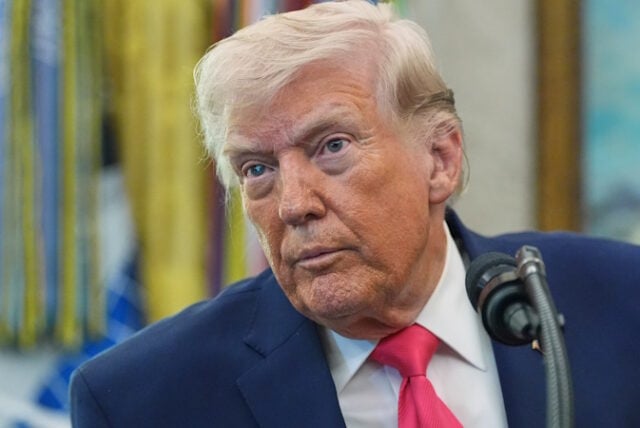
The landscape of the Middle East, and by extension the American political theater, has shifted dramatically over the past twenty-four days. On Wednesday, March 25, 2026, President Donald Trump stood before a packed ballroom of Republican members of Congress and donors, delivering a speech that was equal parts war-room update and campaign-style rally. With his characteristic blend of bravado and unconventional diplomacy, the President insisted that the ongoing conflict with Iran was nearing a “speedy end,” all while labeling the Republican Party as the “Hot Party”—the only political movement, he claimed, capable of navigating the world through the brink of a third world war.
The Mirage of Negotiations: “Major Points of Agreement”
The centerpiece of Trump’s address was the assertion that the United States and Iran are in the midst of “very good and productive conversations.” This claim comes at a time when the world has been bracing for a total regional explosion. Trump told the crowd that his envoys, including Steve Witkoff and Jared Kushner, have been working behind the scenes to secure a ceasefire that would stabilize global energy markets and prevent further escalation.
“We have points, major points of agreement,” Trump declared from the podium. “I would say, almost all points of agreement. We’re giving it five days, and then we’re going to see where that takes us. And I would say at the end of this period, it could very well end up being a very good deal for everybody.”
However, this narrative of diplomatic progress stands in stark contrast to the official word from Tehran. The Iranian Foreign Ministry and the Islamic Revolutionary Guard Corps (IRGC) have been quick to issue stinging rebukes. A spokesperson for Iran’s foreign ministry stated flatly that no talks had been held with the U.S. since the joint U.S.-Israeli bombing campaign began three weeks ago. The IRGC went further, dismissing Trump’s claims as “psychological operations” designed to manipulate financial and oil markets.

Trump had a ready explanation for this discrepancy. He suggested that Iranian negotiators are essentially operating in the shadows out of fear for their lives. “They are negotiating, by the way, and they want to make a deal so badly,” Trump told the dinner attendees. “But they’re afraid to say it, because they figure they’ll be killed by their own people.”
The “Hot Party” Branding and Midterm Momentum
Beyond the geopolitical updates, Trump used the March 25 gathering to rebrand the Republican Party for the 2026 midterm cycle. Casting aside traditional policy labels, he repeatedly referred to the GOP as the “Hot Party.” “Look at the energy in this room. Look at the polls,” Trump said. “The Democrats are the party of high prices and endless wars they don’t know how to win. We are the Hot Party. We’re the party of winning, we’re the party of strength, and we’re the party people actually want to be seen with again.”
This branding appears to be an attempt to capitalize on a perceived shift in the national mood. Despite a YouGov poll showing that 55% of Americans disapprove of his handling of the Iran conflict, Trump’s base remains remarkably solidified. The “Hot Party” moniker is intended to project a sense of inevitability and cultural dominance, framing the Republican platform as the only “modern” and “dynamic” choice for voters worried about a collapsing international order.
The Energy Gamble: “I Thought Gas Prices Would Have Gone Higher”
Perhaps the most surprising admission of the night concerned the domestic impact of the conflict: the price of gasoline. As the war entered its fourth week, the national average for a gallon of gas has seen significant volatility, yet Trump expressed surprise that the market hadn’t reacted more violently.
“I’ll be honest with you,” Trump told the audience, “I thought gas prices would have gone higher. Much higher. But we’ve managed it. We’ve released the reserves, we’ve talked to the right people, and because of my announcement about the talks, the prices actually tumbled.”
Indeed, oil futures saw a dramatic spike just minutes before Trump’s social media posts on Monday, leading to concerns from market experts about potential insider trading. Once the President’s post about “productive talks” hit the internet, oil prices dropped, and the Dow Jones Industrial Average surged more than 1,000 points.
Critics, however, point to a different reality. Analysts at Chatham House note that while Trump promised to halve energy prices within twelve months of taking office, the Iran war and the subsequent disruption of LNG production in Qatar have led to European and Asian natural gas prices doubling. Domestically, while the “drill, baby, drill” rhetoric remains high, the U.S. energy infrastructure remains vulnerable, and many Americans (69% according to YouGov) feel that the conflict is raising gas prices “a lot.”
The Kharg Island Flashpoint: Seizure or Sovereignty?
While the President speaks of peace, the military reality on the ground—and in the water—paints a different picture. Satellite imagery from March 14, 2026, revealed significant damage to Iran’s Kharg Island, the primary hub for the country’s oil exports. Reports have surfaced that the Trump administration is seriously considering a ground operation to seize the island to end Iran’s blockade of the Strait of Hormuz.
Kharg Island is a strategic crown jewel; approximately 90% of Iran’s crude oil exports pass through its facilities, with the majority destined for China. The Pentagon has reportedly accelerated the deployment of the USS Boxer Amphibious Readiness Group to the region.
Iran’s response has been an ultimatum of its own. The Iranian defense council warned that any attempt to seize their islands or coasts would lead to the “mining of all access routes and communication lines in the Persian Gulf.” This “swimmer mine” threat has raised the stakes to an existential level for global shipping, as a mined Gulf would effectively shut down a significant portion of the world’s energy supply for “extended periods.”
Troop Movements: The 82nd Airborne and the “No Boots” Pledge
In one of the most significant military escalations of the conflict, the Pentagon has ordered up to 3,000 paratroopers from the 82nd Airborne Division to deploy to the Middle East. This move, combined with the movement of two Marine Expeditionary Units, could bring the total U.S. ground presence in close proximity to Iran to nearly 8,000 troops.
This deployment creates a messaging challenge for the President, who has repeatedly stated he does not want “boots on the ground” or to “leave early.” During his Kentucky speech on March 11, Trump seesawed on the issue, saying, “We don’t want to leave early, do we? We got to finish the job.” Yet, by March 24, he was telling reporters in the Oval Office that “the war has been won” and that only the “fake news” wants to keep it going.
The deployment of elite paratroopers suggests the administration is preparing for a “contingency,” whether that be the seizure of Kharg Island or a rapid response to an Iranian “surprise attack” on the U.S. homeland—a threat the FBI recently warned could involve unmanned aerial vehicles launched from vessels off the coast of California.
Conclusion: A High-Stakes Five-Day Window
As President Trump’s self-imposed five-day deadline for “productive conversations” ticks away, the world remains in a state of suspended animation. The President is betting his “Hot Party” brand on the idea that he can bluster, threaten, and negotiate his way out of a regional war that many experts believe has only just begun.
Whether the “speedy end” is a genuine diplomatic breakthrough or a tactical pause in a larger campaign for regime change remains to be seen. For now, the “Hot Party” holds the reins, and the world—from the gas pumps in Ohio to the oil terminals on Kharg Island—is watching to see if the dealmaker can truly deliver the “very good deal for everybody” he has promised.
Sources and Links
- The Guardian: Trump news at a glance: President touts ‘strong talks’ with Iran that Iran says have not happened. https://www.theguardian.com/us-news/2026/mar/23/trump-news-latest-updates-today
- The Jerusalem Post: Donald Trump on Iran: We won, but don’t want to leave early. https://www.jpost.com/middle-east/iran-news/article-889651
- Al Arabiya: Trump says Iran negotiators fear being ‘killed by own people’ https://english.alarabiya.net/News/united-states/2026/03/26/trump-says-iran-negotiators-fear-being-killed-by-own-people-
- CBS News: Iran war rages with Pentagon expected to send 82nd Airborne troops to Middle East https://www.cbsnews.com/live-updates/iran-war-trump-tehran-denies-talks-israel-oil-prices-stocks-react/
- The Jerusalem Post: US considers ground operation to seize Iran’s Kharg Island amid tensions https://www.jpost.com/international/article-890834
- Chatham House: US energy prices were set to rise long before the Iran war https://www.chathamhouse.org/2026/03/us-energy-prices-were-set-rise-long-iran-war
- YouGov: Nearly all Americans say the conflict with Iran is raising gas prices, but few expect Trump to back down https://yougov.com/en-us/articles/54392-nearly-all-americans-say-conflict-with-iran-is-raising-gas-prices-few-expect-donald-trump-to-back-down-march-20-23-2026-economist-yougov-poll
- OPB / NPR: The Pentagon orders troops from the 82nd Airborne Division to deploy to the Middle East https://www.opb.org/article/2026/03/25/pentagon-orders-thousands-of-troops-to-deploy-to-middle-east/
Disclaimer
Artificial Intelligence Disclosure & Legal Disclaimer
AI Content Policy.
To provide our readers with timely and comprehensive coverage, South Florida Reporter uses artificial intelligence (AI) to assist in producing certain articles and visual content.
Articles: AI may be used to assist in research, structural drafting, or data analysis. All AI-assisted text is reviewed and edited by our team to ensure accuracy and adherence to our editorial standards.
Images: Any imagery generated or significantly altered by AI is clearly marked with a disclaimer or watermark to distinguish it from traditional photography or editorial illustrations.
General Disclaimer
The information contained in South Florida Reporter is for general information purposes only.
South Florida Reporter assumes no responsibility for errors or omissions in the contents of the Service. In no event shall South Florida Reporter be liable for any special, direct, indirect, consequential, or incidental damages or any damages whatsoever, whether in an action of contract, negligence or other tort, arising out of or in connection with the use of the Service or the contents of the Service.
The Company reserves the right to make additions, deletions, or modifications to the contents of the Service at any time without prior notice. The Company does not warrant that the Service is free of viruses or other harmful components.