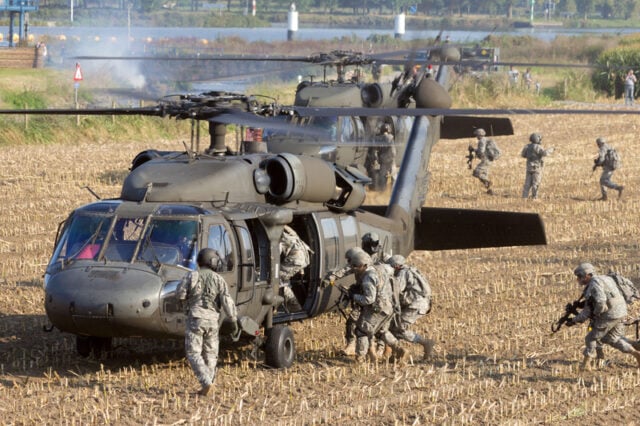
WASHINGTON — In a move that signals both a potential escalation and a strategic “top cover” for diplomatic maneuvers, the Pentagon has ordered approximately 1,000 paratroopers from the elite 82nd Airborne Division to the Middle East. The deployment, confirmed by defense officials on Tuesday, March 24, 2026, comes as the conflict between the United States, Israel, and Iran enters a critical fourth week, with the global economy reeling from a choked Strait of Hormuz and a mounting human toll.
U.S. forces have destroyed more than 9,000 military targets inside Iran, significantly removing the Iranian regime’s combat capability. pic.twitter.com/7w1ZCS0JGn
— U.S. Central Command (@CENTCOM) March 24, 2026
While the Trump administration maintains that it is actively pursuing a “15-point peace plan” to wind down the war, the arrival of the 82nd Airborne—the Army’s premier rapid-response force—suggests that Washington is preparing for all contingencies, including the possibility of ground operations or the securing of vital infrastructure inside contested territory.

The Tip of the Spear: 82nd Airborne Deployment
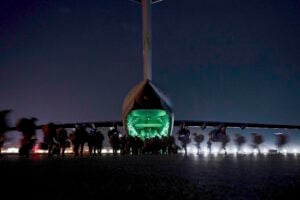
The deployment includes a battalion from the 1st Brigade Combat Team of the 82nd Airborne Division, based at Fort Liberty (formerly Fort Bragg), North Carolina. Accompanying the paratroopers is the division’s commander, Major General Brandon Tegtmeier, along with key division staff. Unlike the Marines recently dispatched to the region, who are primarily trained for embassy security and civilian evacuation, the “All-American” division is specialized in forced-entry operations—parachuting into hostile environments to seize airfields and establish bridgeheads.
The move follows the earlier deployment of thousands of Marines and sailors aboard the USS Boxer Amphibious Ready Group and the USS Tripoli. Together with the 11th and 31st Marine Expeditionary Units (MEUs), the total additional American force posture in the region is expected to swell by nearly 10,000 personnel, supplementing the 50,000 troops already stationed across various CENTCOM bases.
A Regional Tinderbox: The Iran War of 2026
The current conflict, which began with massive joint U.S.-Israeli strikes on February 28, 2026—dubbed Operation Epic Fury—was initiated following intelligence reports that Tehran intended to launch drone attacks against the U.S. homeland. Since then, the war has seen a rapid exchange of missile and drone barrages. On Tuesday alone, Israeli airstrikes targeted sites deep within Iran, while Iranian-aligned groups launched retaliatory strikes into northern Israel, Lebanon, and even a British air base in Cyprus.
The casualty count is growing. Reports indicate that over 1,300 Iranians have been killed since the start of the war, including the former Supreme Leader Ali Khamenei. On the American side, the Pentagon confirmed that 290 U.S. troops have been wounded to date, with 13 killed in combat. Of the wounded, approximately 35 remain out of action, with 10 in serious condition.
The 81st Brigade and the Modernization Factor
While the 82nd Airborne takes the headlines for its immediate deployment, the broader U.S. military posture is also being shaped by the 81st Stryker Brigade Combat Team of the Washington Army National Guard. In a parallel development, the 81st is currently serving as a test case for the “Army Transformation Initiative.” Under President Trump’s leadership, the 81st is transitioning into a Mobile Brigade Combat Team (MBCT), swapping its heavy Stryker vehicles for lighter, high-tech Infantry Squad Vehicles (ISVs) and integrated drone systems.
While the 81st is not currently listed as part of the immediate March 24 deployment to the Iran theater, its transformation underscores a shift toward the “agile and lethal” forces that the administration believes are necessary for multi-domain conflicts like the one currently unfolding in the Persian Gulf.
Economic Stranglehold: The Hormuz Crisis
The most immediate threat to global stability remains the Strait of Hormuz. President Trump has set a deadline for Friday, March 27, for Iran to fully reopen the waterway, which Tehran has effectively closed via minefields and drone patrols. The closure has sent oil prices into a tailspin of volatility and disrupted international shipping, prompting the International Energy Agency to warn of a “major threat” to the global economy.
In a characteristic blend of “maximum pressure” and deal-making, Trump claimed on Tuesday that Iran is “eager for a deal” and that “great progress” is being made. He even alluded to an oil-related “present” from Tehran, though Iranian officials have publicly denied that any formal negotiations are taking place.
Internal Fractures: The Artesh vs. the IRGC
Intelligence reports suggest that the U.S. military buildup may be designed to support a growing internal schism within Iran. The Artesh (Iran’s regular army) has increasingly distanced itself from the Islamic Revolutionary Guard Corps (IRGC). Specifically, the Artesh 81st Armored Division in Kermanshah has reportedly oriented its tank turrets away from civilian zones, effectively “caging” local IRGC units. This “Great Annulment” suggests that segments of the Iranian military may be unwilling to sacrifice the nation for the sake of the IRGC’s remaining leadership.
The Diplomatic “15-Point Plan”
Behind the scenes, a high-level team including Vice President JD Vance, Secretary of State Marco Rubio, and envoys Steve Witkoff and Jared Kushner is reportedly pushing a 15-point peace plan. The plan’s objectives include:
- The permanent dismantling of Iran’s nuclear program.
- A cessation of ballistic missile testing.
- The protection of U.S. allies in the Middle East (a recently added fifth “core objective”).
- The reopening of the Strait of Hormuz.
- Regional cooperation on energy security.
Pakistan has offered to host diplomatic talks, but the situation remains fragile. French Army Chief General Fabien Mandon criticized the U.S. as an “unpredictable ally,” noting that Washington had engaged in military operations without sufficiently notifying its European partners.
Conclusion
As the 82nd Airborne prepares to land in the theater, the world watches to see if this surge of “boots on the ground” will be the final lever that forces a diplomatic breakthrough or the spark that ignites a broader regional conflagration. With the Friday deadline looming and the 81st Brigade’s modernization proving the template for a new era of American warfare, the next 72 hours may well determine the geopolitical map of the Middle East for the next decade.
Sources Used and Links
- Associated Press (AP): “At least 1,000 US troops from 82nd Airborne set to deploy to Mideast”
- The Guardian: “Middle East crisis live: Oil prices drop after reports of Trump peace plan”
- CBS News: “Live Updates: Iran war rages with Pentagon expected to send 82nd Airborne”
- The Star / AP: “US prepares to deploy 1,000 airborne troops to Middle East”
- Turkiye Today / Reuters: “US to send thousands of additional troops to Middle East”
- Militarnyi: “American Stryker Brigade Abandoning Armored Vehicles in Favor of Lighter Alternatives”
- RealClearDefense: “The Great Annulment: How the Iranian People are Setting Up House for Survival”
- 19FortyFive: “Invading Iran ‘Is Not the Act of Sane Men'”
- Washington Military Department: “History of the 81st Brigade Combat Team”
Disclaimer
Artificial Intelligence Disclosure & Legal Disclaimer
AI Content Policy.
To provide our readers with timely and comprehensive coverage, South Florida Reporter uses artificial intelligence (AI) to assist in producing certain articles and visual content.
Articles: AI may be used to assist in research, structural drafting, or data analysis. All AI-assisted text is reviewed and edited by our team to ensure accuracy and adherence to our editorial standards.
Images: Any imagery generated or significantly altered by AI is clearly marked with a disclaimer or watermark to distinguish it from traditional photography or editorial illustrations.
General Disclaimer
The information contained in South Florida Reporter is for general information purposes only.
South Florida Reporter assumes no responsibility for errors or omissions in the contents of the Service. In no event shall South Florida Reporter be liable for any special, direct, indirect, consequential, or incidental damages or any damages whatsoever, whether in an action of contract, negligence or other tort, arising out of or in connection with the use of the Service or the contents of the Service.
The Company reserves the right to make additions, deletions, or modifications to the contents of the Service at any time without prior notice. The Company does not warrant that the Service is free of viruses or other harmful components.