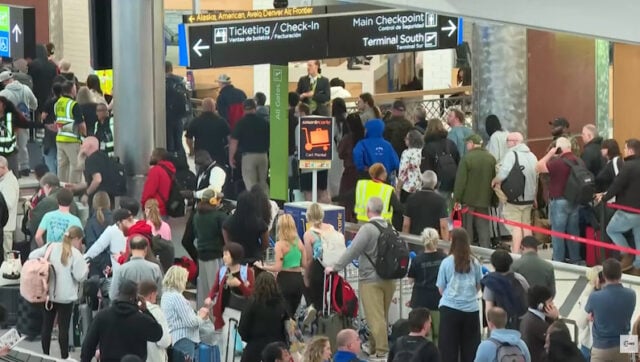
In a move that has sparked both logistical confusion and civil rights concerns, the Trump administration has officially begun deploying Immigration and Customs Enforcement (ICE) agents to major U.S. airports as of Monday, March 23, 2026. The deployment, overseen by White House border czar Tom Homan, is framed by the administration as a necessary measure to alleviate massive security delays caused by an ongoing partial government shutdown that has left Transportation Security Administration (TSA) officers working without pay.
A Security Stopgap or Enforcement Surge?
The presence of ICE at domestic travel hubs represents a significant shift in airport operations. While TSA is primarily tasked with aviation safety—detecting explosives and weapons—ICE’s mandate is to enforce federal immigration laws. President Trump announced the move via social media, stating that ICE would “help our wonderful TSA agents” who are facing staffing shortages as hundreds of officers call out or resign due to missed paychecks.
Administration officials, including Transportation Secretary Sean Duffy, have suggested that ICE agents could take over “non-specialized” roles, such as guarding exit lanes, managing crowds, and checking passenger identification. However, critics and union leaders have been quick to point out that ICE agents are not trained in specific aviation security protocols. Everett Kelley, president of the American Federation of Government Employees, emphasized that TSA officers spend months in specialized training that “armed, untrained agents” cannot simply replicate.
Legal Authority and the 100-Mile Zone
The legal basis for ICE’s presence in airports is rooted in federal statutes like 8 U.S.C. § 1357, which grants immigration officers the power to interrogate individuals about their right to be in the United States and to make warrantless arrests.

Furthermore, many of the nation’s busiest airports—including those in New York, Los Angeles, and Atlanta—fall within the “100-mile border zone.” In this jurisdiction, federal agents have expanded authorities to conduct searches and seizures that would otherwise require a warrant in the interior of the country.
Real-Time Biometrics and Data Sharing
Beyond physical presence, 2026 has seen a deepening of technical integration between the TSA and ICE. New directives allow the TSA to share passenger manifests and biometric data with ICE multiple times per week. This data is cross-referenced against removal databases in real-time.
With the nationwide rollout of “Touchless ID” facial recognition at 65 airports, travelers are increasingly interacting with biometric sensors that feed into a centralized DHS “matching engine.” While the TSA maintains that these scans are for identity verification only, privacy advocates warn that consolidating these platforms makes it easier for ICE to flag and intercept individuals with old deportation orders or expired status directly at the gate.
Impact on Travelers and “Know Your Rights”
The deployment has created a climate of uncertainty for non-citizens and “Dreamers.” Legal experts advise that while ICE agents may assist with line management, they retain their authority to question travelers about their immigration status.
Advocacy groups like the ACLU have issued alerts reminding travelers of their fundamental rights:
- The Right to Remain Silent: You are not required to answer questions about your immigration status or where you were born.
- Documentation: Non-citizens should carry valid proof of status (Green Cards, DACA approvals, or visas) at all times.
- Search Consent: You can politely decline a search of your electronic devices or belongings unless agents have a warrant or probable cause.
As the budget impasse continues in Washington, travelers are being advised to arrive at least three to four hours early for flights, as the integration of ICE personnel into security lines has yet to show a measurable decrease in wait times.
Sources Used
- ICE officers set to deploy to airports as delays mount, border czar Homan confirms – WHRO
- How Trump ICE Airport Security Efforts Affect You in 2026 – Vasquez Law Firm
- Immigration and Customs Enforcement (ICE) Presence FAQs – Phoenix Sky Harbor
- What Exactly Will ICE Do at Airports? – TIME
- Reported: DHS to consolidate facial-recognition and biometrics platforms – IPTP
- Community Alert: Immigration Arrests at Airports – NILC
- 100-Mile Border Enforcement Zone – Southern Border Communities Coalition
Disclaimer
Artificial Intelligence Disclosure & Legal Disclaimer
AI Content Policy.
To provide our readers with timely and comprehensive coverage, South Florida Reporter uses artificial intelligence (AI) to assist in producing certain articles and visual content.
Articles: AI may be used to assist in research, structural drafting, or data analysis. All AI-assisted text is reviewed and edited by our team to ensure accuracy and adherence to our editorial standards.
Images: Any imagery generated or significantly altered by AI is clearly marked with a disclaimer or watermark to distinguish it from traditional photography or editorial illustrations.
General Disclaimer
The information contained in South Florida Reporter is for general information purposes only.
South Florida Reporter assumes no responsibility for errors or omissions in the contents of the Service. In no event shall South Florida Reporter be liable for any special, direct, indirect, consequential, or incidental damages or any damages whatsoever, whether in an action of contract, negligence or other tort, arising out of or in connection with the use of the Service or the contents of the Service.
The Company reserves the right to make additions, deletions, or modifications to the contents of the Service at any time without prior notice. The Company does not warrant that the Service is free of viruses or other harmful components.