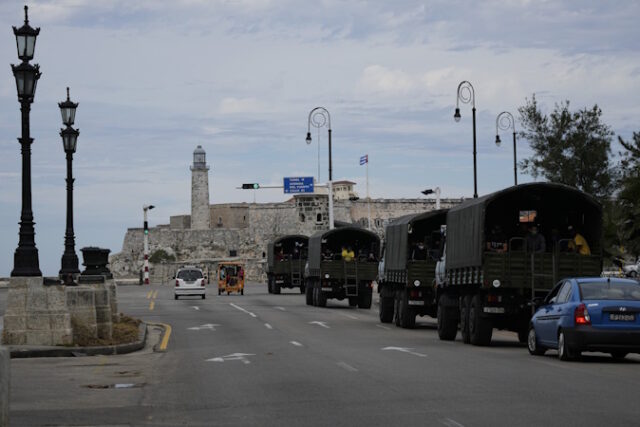
HAVANA — The island of Cuba has entered a state of heightened military alert, with top officials declaring the nation “ready” to defend its sovereignty against any potential military action from the United States. The escalation follows a series of provocative statements from U.S. President Donald Trump, who recently suggested he would have the “honor” of “taking Cuba in some form.”
Cuban Deputy Foreign Minister Carlos Fernández de Cossío delivered the most direct warning yet during a televised interview on Sunday. While acknowledging that Havana still views a full-scale military conflict as “improbable,” he emphasized that the Cuban Revolutionary Armed Forces are actively preparing for the possibility of aggression.
“Our military is always prepared, and in fact, it is preparing these days for the possibility of military aggression,” Fernández de Cossío told NBC’s Meet the Press. “We would be naive if, looking at what is happening around the world, we did not do that.”
A Peninsula on the Brink
The rhetoric between the two neighbors has soured rapidly in the early months of 2026. The friction is fueled by a crushing U.S. oil blockade that has plunged the island into a dire humanitarian crisis. Following the removal of Venezuelan leader Nicolás Maduro in January—a move facilitated by U.S. and allied forces—Cuba lost its primary supplier of subsidized petroleum. The Trump administration has since threatened secondary sanctions on any nation, including Mexico, that attempts to supply the island with fuel.

As a result, Cuba’s national power grid has collapsed multiple times in recent weeks, leaving millions in the dark. Public transport has ground to a halt, and over 100 bakeries have been forced to convert to wood-fire ovens to provide basic sustenance.
Despite the economic strangulation, the Cuban government has remained defiant. President Miguel Díaz-Canel, supervising recent tank exercises, framed the military readiness as a necessary deterrent.
“The best way to prevent aggression is for imperialism to have to calculate the price of attacking our country,” Díaz-Canel said during a broadcast from a military site. He reiterated that the defense of the island rests on the “War of the Entire People,” a strategic doctrine involving the mass mobilization of civilians alongside formal military units.
The “Honor” of Taking Cuba
The immediate trigger for Havana’s defensive posture was a comment made by President Trump last week. When asked about the worsening conditions on the island, Trump told reporters, “Taking Cuba in some form, yeah, taking Cuba—I mean, whether I free it, take it: I think I can do anything I want with it, you want to know the truth.”
The White House has framed the current pressure campaign as a “friendly takeover” intended to liberate the Cuban people from communist rule. Secretary of State Marco Rubio, who has been tapped to lead the administration’s Cuba policy, suggested that the current leadership “doesn’t know how to fix” the country’s problems and that “new people” must be put in charge.
Reports have circulated that the U.S. is seeking an “off-ramp” for President Díaz-Canel, potentially pressuring him to step down before his term ends in exchange for a relaxation of sanctions. However, Fernández de Cossío was categorical in his rejection of such terms: “Regime change is absolutely off the table.”
Mixed Signals from Washington
While the White House’s political rhetoric is at a fever pitch, the Pentagon has sought to dampen fears of an imminent invasion. Gen. Francis Donovan, head of U.S. Southern Command, recently informed Congress that American forces are not currently rehearsing for a takeover. Instead, he noted that military planning is focused on protecting the U.S. Embassy in Havana and preparing for a potential mass migration event should the economic situation continue to deteriorate.
Furthermore, a strange duality has emerged in the relationship. Even as Havana prepares for war, discreet diplomatic talks have reportedly taken place. President Díaz-Canel confirmed on March 13 that “sensitive” conversations were held to address bilateral differences, though he warned that any formal agreement remains in the “initial phases.”
The Shadow of the Past
The current standoff mirrors the most dangerous moments of the Cold War, yet it is set against a backdrop of modern geopolitical shifts. Cuba continues to host Russian intelligence facilities and has strengthened defense ties with China, factors that President Trump cited in a January executive order declaring a national emergency regarding the island.
For the residents of Havana, the geopolitical posturing translates to a grim daily reality. With hospitals postponing surgeries and schools closing due to power outages, the population is caught between a government that refuses to yield and a superpower that seems determined to force a collapse.
As the Cuban military conducts drills across the island, the Ministry of Foreign Affairs’ message remains a blend of defiance and a plea for sovereignty. “Cuba is a sovereign country and has the right to self-determination,” Fernández de Cossío said. “Cuba would not accept to become a vassal state.”
Sources Used and Links
- The Washington Examiner: Cuban military ‘preparing’ for US aggression, deputy foreign minister says
- NBC News / LiveMint: ‘Our military is prepared’: Havana’s stern warning to US amid Trump’s threats
- Reuters / KELO: Cuba is ready for any potential attack from US amid oil blockade, envoy says
- PBS NewsHour: Cuban president says talks were recently held with the U.S. to resolve differences
- The White House: Addressing Threats to the United States by the Government of Cuba
- SpaceWar: Cuba defends military drills as deterrent against US aggression
- CTV News: Cuba refuses to negotiate president’s term in talks with United States
Disclaimer
Artificial Intelligence Disclosure & Legal Disclaimer
AI Content Policy.
To provide our readers with timely and comprehensive coverage, South Florida Reporter uses artificial intelligence (AI) to assist in producing certain articles and visual content.
Articles: AI may be used to assist in research, structural drafting, or data analysis. All AI-assisted text is reviewed and edited by our team to ensure accuracy and adherence to our editorial standards.
Images: Any imagery generated or significantly altered by AI is clearly marked with a disclaimer or watermark to distinguish it from traditional photography or editorial illustrations.
General Disclaimer
The information contained in South Florida Reporter is for general information purposes only.
South Florida Reporter assumes no responsibility for errors or omissions in the contents of the Service. In no event shall South Florida Reporter be liable for any special, direct, indirect, consequential, or incidental damages or any damages whatsoever, whether in an action of contract, negligence or other tort, arising out of or in connection with the use of the Service or the contents of the Service.
The Company reserves the right to make additions, deletions, or modifications to the contents of the Service at any time without prior notice. The Company does not warrant that the Service is free of viruses or other harmful components.