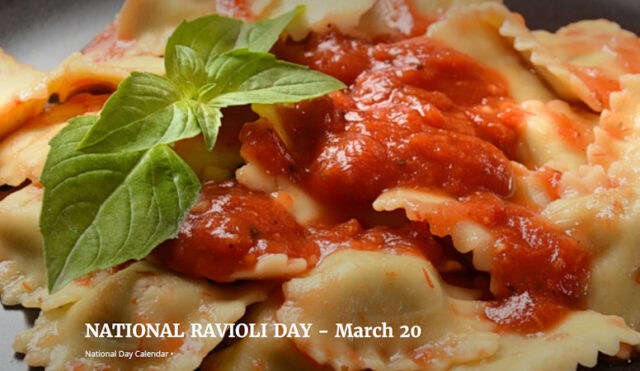
March 20th celebrates a fun-filled and versatile pasta. National Ravioli Day is a food holiday for pasta lovers! So pick your favorite filling and sauce and cook up a meal everyone will love!
- 14th Century – Ravioli first appears in the personal letters of Francesco di Marco Datini, a Prato merchant.
- 14th Century – King Richard II’s chefs mention ravioli in a British cookbook, referred to as “rauioles.”
- 14th Century – Early Venetian cookbooks, such as the “Libro per cuoco,” record recipes for “rafioli,” small pasta parcels filled with herbs, cheese, and eggs, boiled in broth and spiced, indicating that stuffed pasta was already established in northern Italy.
- 1570 – Papal chef Bartolomeo Scappi publishes “Opera dell’arte del cucinare,” with detailed recipes for ravioli- and tortelli-style pasta filled with spiced meats, cheese, and herbs, codifying stuffed pasta as a centerpiece of Renaissance high cuisine.
- 18th Century – Across regions such as Liguria, Emilia-Romagna, and Piedmont, local versions like agnolotti and pansotti emerge, filled with greens, meats, or cheeses, embedding ravioli-style pastas into distinct regional identities and holiday meals.
- 1940s – Toasted ravioli was invented in St. Louis, Missouri. A cook accidentally dropped ravioli into hot oil, creating the crispy version loved today. Despite its name, ravioli is deep-fried, not toasted, making it a unique local favorite.
- 2000 – Plankton, a “SpongeBob SquarePants” character, achieves internet meme status with his memorable quote: “Ravioli, ravioli, give me the formu-oli!”
- 2013 – The Guinness World Record was set in St. Petersburg, Russia, for the longest ravioli in the world. It was recorded to be 96 feet and 1 inch long, although only 6 centimeters wide. It was made with a chicken and onion filling.
- 2013 – The largest ravioli, created in Brazil in 2013, weighed 29.4 pounds. It measured several feet wide and was filled with ricotta and spinach.
- 2019 – After 94 years, landmark downtown San Francisco restaurant Lucca Ravioli announces plans to close.
- The word ravioli comes from the Italian word “riavvolgere” which means “to wrap.”
- Ravioli is a traditional type of Italian-filled pasta, made up of a filling sealed between two layers of thin egg pasta dough. The ravioli are usually served in either a broth or with a pasta sauce.
- Some of the fillings include cheese, meat, vegetables and seasonings.
- Served often as the main course, ravioli can also be a side dish or even an appetizer. Many popular recipes call for baking or deep-frying the ravioli. With chocolate added to the pasta or cream cheese stuffing and a caramel sauce, the dish quickly becomes a dessert!
- Canned ravioli gained fame during the post-war era as an easy meal for busy households. Chef Boyardee helped popularize it in the U.S. tomato, tomato-meat or tomato-cheese sauce.
- Large ravioli are called ravioloni.
- Small ravioli are called ravioletti.
Sources:

Disclaimer
Artificial Intelligence Disclosure & Legal Disclaimer
AI Content Policy.
To provide our readers with timely and comprehensive coverage, South Florida Reporter uses artificial intelligence (AI) to assist in producing certain articles and visual content.
Articles: AI may be used to assist in research, structural drafting, or data analysis. All AI-assisted text is reviewed and edited by our team to ensure accuracy and adherence to our editorial standards.
Images: Any imagery generated or significantly altered by AI is clearly marked with a disclaimer or watermark to distinguish it from traditional photography or editorial illustrations.
General Disclaimer
The information contained in South Florida Reporter is for general information purposes only.
South Florida Reporter assumes no responsibility for errors or omissions in the contents of the Service. In no event shall South Florida Reporter be liable for any special, direct, indirect, consequential, or incidental damages or any damages whatsoever, whether in an action of contract, negligence or other tort, arising out of or in connection with the use of the Service or the contents of the Service.
The Company reserves the right to make additions, deletions, or modifications to the contents of the Service at any time without prior notice. The Company does not warrant that the Service is free of viruses or other harmful components.