WASHINGTON, D.C. — In a high-stakes diplomatic encounter that underscored the volatility of the current global energy landscape, President Donald J. Trump welcomed Japanese Prime Minister Sanae Takaichi to the White House on Thursday. The meeting, ostensibly designed to reaffirm the ironclad U.S.-Japan security alliance, quickly pivoted to the urgent economic crisis gripping both nations: a paralyzing surge in global oil prices and the prospect of a strategic “pivot” regarding U.S. sanctions on Iran.
As the two leaders convened in the Oval Office, the economic indicators outside were grim. Crude oil prices have shattered records, with Brent crude surging past $115 a barrel this week—a 24% increase in just ten days. For American consumers, the impact is being felt immediately at the pump. The national average for a gallon of regular gasoline has climbed to $3.88, but in many regions, the “price at the pump” has jumped today to an average of $3.95, roughly 7 cents over the already-painful national average.
The escalating costs have forced the Trump administration into a difficult corner. While the President has maintained a posture of “Maximum Pressure” and military resolve through Operation Midnight Hammer, the sheer weight of energy inflation on the American voter has opened a door that many in Washington thought was closed: the potential lifting of sanctions on Iranian oil to stabilize the global market.
The Tokyo-Washington Energy Nexus
Prime Minister Takaichi, Japan’s first female leader and a hawk who has been dubbed the “Iron Lady” of the Pacific, arrived in Washington facing immense domestic pressure. Japan is the world’s fifth-largest importer of oil, and nearly 95% of its supply originates in the Middle East. With the Strait of Hormuz effectively a war zone following recent Iranian drone strikes and U.S. naval responses, Tokyo is watching its energy security evaporate.

“We are at a crossroads where the stability of the Indo-Pacific and the stability of the global energy market are inextricably linked,” Takaichi told reporters during a brief joint appearance. “Japan stands with our American allies in the pursuit of a free and open world, but the current price of energy is a burden that threatens the very foundations of our industrial economies.”
President Trump, while maintaining his signature bravado, acknowledged the pain being felt by American drivers. “We’re looking at everything,” the President said when asked about the possibility of easing sanctions. “We have the most powerful military in the world, and we have the most oil in the world. But right now, we have a situation in the Middle East that is driving prices to levels that are unacceptable. If we can make a deal that brings oil back into the market and protects our interests, we’ll look at it.”
The Sanctions “Grand Bargain”
The most explosive revelation of the summit was the admission from administration officials that the U.S. Treasury and State Department are reviewing the potential release of “stranded” Iranian oil. Currently, millions of barrels of Iranian crude are believed to be held in “shadow fleet” tankers or in storage facilities that are legally inaccessible due to the sweeping sanctions reimposed at the start of the Trump administration’s second term.
Economic advisors, including Treasury Secretary Scott Bessent, have reportedly suggested that allowing a controlled flow of Iranian oil back into the global market could immediately knock $15 to $20 off the price of a barrel. This move would be a sharp reversal of the administration’s earlier rhetoric, which focused on “zeroing out” Iranian exports following the intensification of Tehran’s nuclear enrichment program.
Critics on Capitol Hill were quick to react. “Lifting sanctions now would be a gift to a regime that is actively attacking our interests,” said one senior GOP senator who requested anonymity. “However, the President also knows that $4 gas is a political death sentence. He’s trying to find a way to flood the market without looking like he’s backing down.”
The $3.95 Reality: Pain at the Pump
For the average American, the geopolitical maneuvering in the Oval Office is secondary to the immediate financial strain. In states like Florida and Arizona, prices have hit the $3.95 mark today, a psychological threshold that is beginning to alter consumer behavior.
The 7-cent premium over the national average of $3.88 is largely attributed to logistics costs and regional supply bottlenecks exacerbated by the redirection of U.S. military assets to the Middle East. With the Pentagon moving Patriot missile batteries and carrier groups from the Pacific to the Arabian Sea to protect shipping lanes, the cost of securing global trade is being passed directly to the consumer.
“I used to fill my truck for $60; now it’s nearly $90,” said Marcus Thorne, a logistics driver in The Villages, Florida. “If they have to lift sanctions or talk to people they don’t like to get the price down, they should do it. We can’t afford to be the world’s policeman if we can’t afford to drive to work.”
Operation Midnight Hammer and the Strait of Hormuz
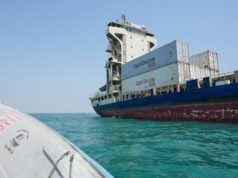
The backdrop to these economic discussions is the ongoing military conflict. Operation Midnight Hammer, the U.S.-led campaign to neutralize Iranian missile sites and drone manufacturing facilities, has entered its third week. While the administration claims “significant degradation” of Iran’s capabilities, the regime has responded by making the Strait of Hormuz virtually impassable for commercial tankers.
The threat of Iranian “swarm” tactics—using small, fast-attack boats and loitering munitions—has caused insurance premiums for tankers to skyrocket. This “war premium” is the primary driver of the $115 oil price. During the meeting, President Trump reportedly pressed Prime Minister Takaichi to contribute Japanese Maritime Self-Defense Force (MSDF) vessels to a “Maritime Task Force” to help escort tankers through the strait.
However, Japan’s pacifist constitution remains a significant hurdle. While Takaichi is more inclined toward a “proactive contribution to peace” than her predecessors, the deployment of Japanese warships into an active combat zone in the Middle East remains a deeply divisive issue in Tokyo.
A Strategy in Flux
The Trump-Takaichi summit represents a pivotal moment for the “America First” foreign policy. The administration is attempting to balance three competing interests:
- Energy Independence: Utilizing U.S. domestic production to offset global shortages, though refining capacity remains a bottleneck.
- Allied Stability: Ensuring that key partners like Japan do not collapse under the weight of an energy-induced recession.
- National Security: Preventing Iran from obtaining a nuclear weapon while simultaneously needing their oil to lower global inflation.
The potential lifting of sanctions is being framed by some as a “humanitarian and economic necessity” rather than a diplomatic concession. By allowing Iran to sell oil—likely with the proceeds held in restricted accounts for food and medicine—the U.S. hopes to create a “relief valve” for the global economy.
The Path Ahead
As the meeting concluded, no formal agreement on sanctions was announced, but the shift in tone was palpable. The joint statement issued by the White House emphasized a “shared commitment to stabilizing global energy markets using all available tools.”
For Prime Minister Takaichi, the visit was a success in that it secured a promise of “energy priority” for Japan from U.S. LNG and crude exports. For President Trump, the mission remains more complicated: he must convince a skeptical American public that a tactical retreat on Iran sanctions is a win for the American pocketbook.
In the coming days, markets will be watching for any signal from the Treasury Department regarding the “shadow fleet.” If the U.S. moves to allow even a portion of Iranian oil back into the fold, the $115 price tag may finally begin to recede. Until then, Americans will continue to watch the glowing numbers at the pump, where $3.95 is becoming the new, painful reality.
Sources
- Associated Press (AP): “Japan’s leader heads to Washington for a visit complicated by the Iran war fallout.” (March 18, 2026). https://apnews.com/article/japan-us-takaichi-trump-iran-security-e98099783b5ff39610c1b2dbe1b61369
- The Straits Times / Reuters: “US may remove sanctions on Iranian oil stranded in tankers, says Bessent.” (March 19, 2026). https://www.straitstimes.com/world/united-states/us-may-remove-sanctions-on-iranian-oil-stranded-in-tankers-bessent-says
- The Washington Post: “Japan’s leader heads to D.C. bearing gifts of peace for a president at war.” (March 18, 2026). https://www.washingtonpost.com/world/2026/03/18/japan-sanae-takaichi-trump-washington/
- The Times of Israel: “Crude oil prices spike above $115 a barrel as Iran conflict disrupts production, shipping.” (March 9, 2026). https://www.timesofisrael.com/crude-oil-prices-spike-above-115-a-barrel-as-iran-conflict-disrupts-production-shipping/
- AAA Gas Prices: “As Spring Equinox Arrives, Gas Prices Continue to Climb.” (March 19, 2026). https://newsroom.aaa.com/2026/03/as-spring-equinox-arrives-gas-prices-continue-to-climb/
- LendingTree: “US Gas Prices: See Where Your State Stacks Up.” (March 3, 2026). https://www.lendingtree.com/credit-cards/study/us-gas-prices/
- AAA Newsroom: “Jump at the Pump as National Average Goes Up Nearly 27 Cents.” (March 5, 2026). https://gasprices.aaa.com/jump-at-the-pump-as-national-average-goes-up-nearly-27-cents/
- NewsNow: “Latest US/Japan Relations News.” (March 18, 2026). https://www.newsnow.com/us/US/Foreign+Policy/US~Japan
Disclaimer
Artificial Intelligence Disclosure & Legal Disclaimer
AI Content Policy.
To provide our readers with timely and comprehensive coverage, South Florida Reporter uses artificial intelligence (AI) to assist in producing certain articles and visual content.
Articles: AI may be used to assist in research, structural drafting, or data analysis. All AI-assisted text is reviewed and edited by our team to ensure accuracy and adherence to our editorial standards.
Images: Any imagery generated or significantly altered by AI is clearly marked with a disclaimer or watermark to distinguish it from traditional photography or editorial illustrations.
General Disclaimer
The information contained in South Florida Reporter is for general information purposes only.
South Florida Reporter assumes no responsibility for errors or omissions in the contents of the Service. In no event shall South Florida Reporter be liable for any special, direct, indirect, consequential, or incidental damages or any damages whatsoever, whether in an action of contract, negligence or other tort, arising out of or in connection with the use of the Service or the contents of the Service.
The Company reserves the right to make additions, deletions, or modifications to the contents of the Service at any time without prior notice. The Company does not warrant that the Service is free of viruses or other harmful components.