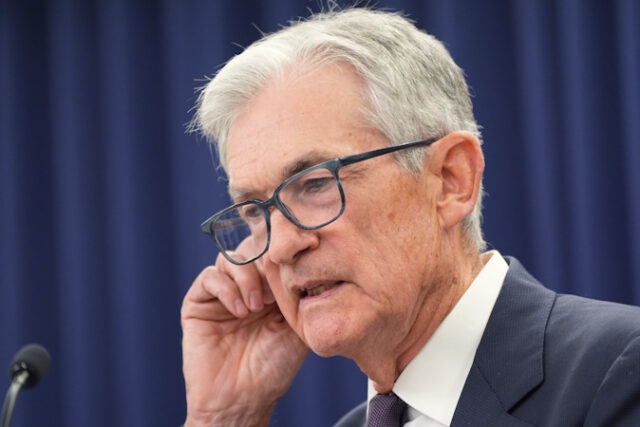
The Federal Open Market Committee (FOMC) convenes this Wednesday, March 18, 2026, amid a rapidly escalating conflict between the United States and Iran. What began as a debate over the timing of 2026 rate cuts has become a high-stakes crisis-management session. The Federal Reserve, led by Chair Jerome Powell in one of his final acts before his expected departure in May, now faces a “stagflationary” nightmare: a suddenly cooling labor market clashing with a massive, war-driven energy shock.
The Conflict and the Crude Catalyst
The primary driver of the Fed’s shifting calculus is the disruption in the Middle East, specifically involving the Strait of Hormuz. As of mid-March 2026, roughly 20% of the world’s oil and liquefied natural gas (LNG) supply is at risk. Iran’s closure of this critical chokepoint has sent Brent crude prices surging from pre-war levels in the low $70s to over $110 per barrel.
For the Federal Reserve, this is not just a geopolitical event; it is a direct threat to price stability. Economists estimate that for every $10 increase in the price of oil, U.S. headline inflation can rise by approximately 0.35% over the following quarter. With national gasoline prices crossing the $4.00 per gallon threshold for the first time since 2023, the Fed’s progress toward its 2% inflation target has effectively stalled.
A “Hawkish Hold” Expected
Market consensus is almost unanimous: the Fed will maintain the federal funds rate at its current range of 3.50% to 3.75%. However, the focus on Wednesday will be the updated Summary of Economic Projections (SEP), commonly known as the “dot plot.”

- Inflation Revisions: The Fed is expected to raise its 2026 PCE inflation forecasts from the previous 2.4% to potentially 2.8% or higher to account for the energy shock.
- Rate Path Reversal: In December, the committee signaled at least one rate cut for 2026. Following the Iran conflict, analysts expect the “median dot” to shift, with many officials now projecting zero cuts for the remainder of the year. Some hawkish members may even begin discussing the necessity of a rate hike if oil remains above $120.
- The Labor Dilemma: Complicating matters is the February jobs report, which showed a loss of 92,000 payrolls and an unemployment rate climbing to 4.4%. Normally, such weakness would trigger a rate cut to support growth. However, the “supply-side” nature of the Iran inflation shock means cutting rates now could unanchor inflation expectations, making the Fed’s job even harder in the long run.
Global Domino Effects
The Fed does not act in a vacuum. Overnight, the Reserve Bank of Australia (RBA) became the first major central bank to hike rates since the war began, citing “sustained higher fuel prices.” This move has put immense pressure on the Fed to maintain its restrictive stance to prevent the U.S. dollar from weakening, which would only make imported goods and energy even more expensive.
Looking Ahead: The Warsh Factor
Adding another layer of uncertainty is the transition of power. With Kevin Warsh nominated to succeed Powell in May, the market is scrutinizing Wednesday’s meeting for signals of how the “Warsh Fed” might handle a wartime economy. Warsh has historically been more skeptical of loose monetary policy, suggesting that the era of easy money may be over as long as the Middle East remains a tinderbox.
Ultimately, Wednesday’s decision will be a signal to the world: has the “soft landing” been aborted by the fog of war? While the Fed may want to support a flagging economy, the geopolitical reality of $100+ oil has effectively boxed them into a corner of “higher for longer.”
Sources and Links
- MarketPulse: FOMC Meeting Preview: A ‘hawkish hold’ as geopolitical risk & stagflation fears rise
- Mariemont Capital: FOMC March 2026 Preview: GDP Slows as 30-Year Treasury Nears 5%
- CBS News: Iran war is making it harder for the Federal Reserve to cut interest rates
- Goldman Sachs: How Will the Iran Conflict Impact Oil Prices?
- Wikipedia: Economic impact of the 2026 Iran war
- Resources Magazine: Energy and the Iran War: What We’re Watching
- University of Rhode Island: Cost of Iranian conflict likely to extend beyond energy prices
- Morgan Stanley: Iran Conflict: Seven Takeaways for Investors
- Allianz Trade: Warsh’s double dilemma when the Middle East rewrites the Fed’s playbook
- ThinkMarkets: Fed expected to hold at March FOMC meeting despite Middle East turmoil
- The Motley Fool: Is the Middle East War Decreasing the Chances of Fed Rate Cuts This Year?
Disclaimer
Artificial Intelligence Disclosure & Legal Disclaimer
AI Content Policy.
To provide our readers with timely and comprehensive coverage, South Florida Reporter uses artificial intelligence (AI) to assist in producing certain articles and visual content.
Articles: AI may be used to assist in research, structural drafting, or data analysis. All AI-assisted text is reviewed and edited by our team to ensure accuracy and adherence to our editorial standards.
Images: Any imagery generated or significantly altered by AI is clearly marked with a disclaimer or watermark to distinguish it from traditional photography or editorial illustrations.
General Disclaimer
The information contained in South Florida Reporter is for general information purposes only.
South Florida Reporter assumes no responsibility for errors or omissions in the contents of the Service. In no event shall South Florida Reporter be liable for any special, direct, indirect, consequential, or incidental damages or any damages whatsoever, whether in an action of contract, negligence or other tort, arising out of or in connection with the use of the Service or the contents of the Service.
The Company reserves the right to make additions, deletions, or modifications to the contents of the Service at any time without prior notice. The Company does not warrant that the Service is free of viruses or other harmful components.