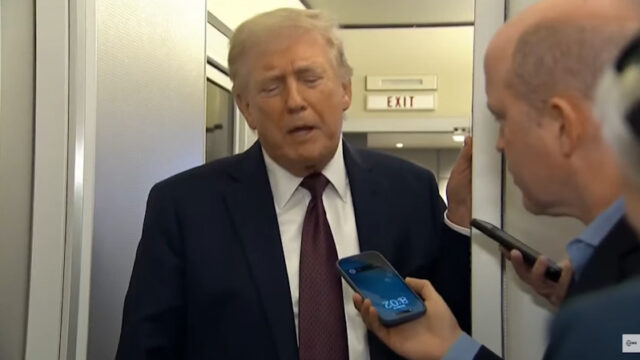
ABOARD AIR FORCE ONE — Stepping into the press cabin of the world’s most famous aircraft, President Donald Trump delivered a sweeping, combative, and characteristically blunt assessment of the ongoing conflict in the Middle East. As the engines of Air Force One hummed over the Atlantic, the President spent over an hour detailing the progress of Operation Epic Fury, dismissing the military capabilities of the Iranian regime, and issuing a stern ultimatum to international allies he believes are “freeloading” on American military might.
The Information War: AI and “Fake Wins”
One of the more striking portions of the President’s remarks centered on the digital battlefield. President Trump alleged that the Iranian regime is increasingly relying on Artificial Intelligence (AI) to manufacture a narrative of military success that does not exist on the ground.
“They’re using the AI to make it look like they’re winning,” Trump told reporters, leaning over the back of a seat. “You see these videos, they look very real, but they’re total fakes. They show missiles hitting things that aren’t being hit. They show their navy—what’s left of it—doing things it can’t do. It’s a show. It’s a digital show because in the real world, they’re getting decimated.”

The President’s comments align with recent reports from tech transparency groups and intelligence agencies suggesting a surge in deepfake technology used by state-sponsored actors to boost morale within Iran and sow confusion among the global public. Trump warned that while the AI-generated propaganda might look impressive on social media, it would not save the regime from “unyielding resolve” and “precision strikes” that have already targeted over 90 military installations, including the critical Kharg Island naval facilities.
The Coalition of Seven: Opening the Strait of Hormuz
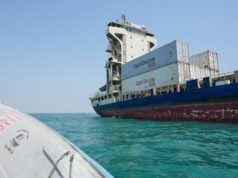
Turning to the economic heart of the conflict, the President addressed the continued closure of the Strait of Hormuz. The waterway, which facilitates roughly 20% of the world’s traded oil, has been a primary flashpoint. While the U.S. and Israel have conducted extensive strikes to dismantle Iranian naval capabilities, the passage remains treacherous due to mines and asymmetrical threats.
President Trump revealed he has been in direct contact with the leaders of seven specific countries—though he declined to name all of them—demanding they contribute warships to a multi-national policing coalition.
“I’m demanding that these countries come in and protect their own territory, because it is their own territory,” Trump asserted. He specifically noted that countries like China, France, Japan, South Korea, and the United Kingdom rely heavily on the oil flowing through that strait, whereas the United States is now largely energy independent.
When asked what the response has been from these seven nations, the President was candid. “They’re thinking about it. They’re ‘considering’ it. But I told them, if you don’t help open it, don’t come crying to us when your gas prices are $15 a gallon. We have our own oil. They don’t.”
A “Very Bad Future” for NATO
The President did not reserve his criticism solely for Asian and Middle Eastern partners. He launched a fresh broadside against NATO, repeating long-standing grievances that the North Atlantic Treaty Organization is outdated and unfairly balanced against American taxpayers.
“NATO allies are facing a very bad future if they don’t step up,” Trump warned. He expressed frustration that European nations have been slow to offer maritime support in the Persian Gulf despite the potential for a global energy crisis to wreck European economies. “They want the protection of the U.S. military, but they don’t want to put their own skin in the game. I told them very clearly: the ‘protection’ is a two-way street. If they aren’t there for us in Hormuz, we have to look at whether we’re going to be there for them.”
This rhetoric marks a significant escalation in the administration’s “America First” foreign policy, essentially tying European security guarantees to their participation in the current Middle Eastern theater.
Military Progress and the “I Don’t Get Bored” Factor
Addressing critics who have suggested the administration might lose focus if the conflict drags on, Trump was defiant. “Somebody said today, ‘Oh, the President wants to do it quickly, he’ll get bored.’ I don’t get bored,” he insisted. “We projected four to five weeks, but we have the capability to go far longer than that. We’ll do it for as long as it takes to ensure they never have a nuclear weapon and they stop being the number one sponsor of terror.”
The President claimed that the Iranian Air Force has been “wiped out entirely” and that their naval forces are “at the bottom of the sea.” While independent verification of the total destruction of the Iranian Air Force is difficult, Pentagon briefings have confirmed that major radar installations and airbases have been hit repeatedly since February 28, 2026.
Humanitarian Concerns and Global Markets
The briefing on Air Force One also touched upon the humanitarian and economic fallout. With the Strait of Hormuz effectively closed to “enemy” ships, global oil prices have spiked, and countries like India are facing severe shortages of cooking gas and fertilizer feedstocks.
President Trump appeared unmoved by the suggestion that U.S. actions were responsible for the market volatility. “Iran started this. They attacked. We’re finishing it,” he said. He did, however, mention that he had spoken with several world leaders about humanitarian corridors, provided those nations “participate in the security of those corridors.”
Conclusion
As Air Force One descended toward Washington, the President’s message was clear: the United States is prepared for a prolonged campaign, but the era of the U.S. acting as the world’s sole “maritime policeman” without compensation or coalition support is over. Whether the “seven countries” respond to his “demands” remains to be seen, but the President has set the stage for a dramatic shift in how global trade routes are secured during wartime.
Sources Used and Links
- Associated Press: “Trump says that he’s asked ‘about 7’ countries to join coalition to police Iran’s Strait of Hormuz” – Link
- The Guardian: “Trump’s call for allied deployment to strait of Hormuz meets muted response” – Link
- Iran International: “Trump says US prepared for prolonged Iran campaign” – Link
- The Hindu: “Trump says talks with Cuba ongoing, action possible after Iran” – Link
- Economic Times: “Trump warns NATO, presses China to help reopen Strait of Hormuz: Report” – Link
- CGTN: “Trump says Iran’s Air Force is wiped out entirely” – Link
- Times of Israel: “March 4: Trump says US in ‘very strong position’ on Iran” – Link
Disclaimer
Artificial Intelligence Disclosure & Legal Disclaimer
AI Content Policy.
To provide our readers with timely and comprehensive coverage, South Florida Reporter uses artificial intelligence (AI) to assist in producing certain articles and visual content.
Articles: AI may be used to assist in research, structural drafting, or data analysis. All AI-assisted text is reviewed and edited by our team to ensure accuracy and adherence to our editorial standards.
Images: Any imagery generated or significantly altered by AI is clearly marked with a disclaimer or watermark to distinguish it from traditional photography or editorial illustrations.
General Disclaimer
The information contained in South Florida Reporter is for general information purposes only.
South Florida Reporter assumes no responsibility for errors or omissions in the contents of the Service. In no event shall South Florida Reporter be liable for any special, direct, indirect, consequential, or incidental damages or any damages whatsoever, whether in an action of contract, negligence or other tort, arising out of or in connection with the use of the Service or the contents of the Service.
The Company reserves the right to make additions, deletions, or modifications to the contents of the Service at any time without prior notice. The Company does not warrant that the Service is free of viruses or other harmful components.