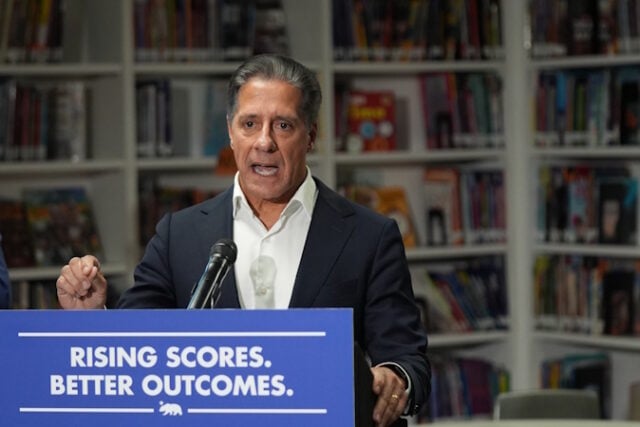
LOS ANGELES — The Los Angeles Unified School District (LAUSD) has been plunged into a period of profound uncertainty following the unanimous decision by the Board of Education to place Superintendent Alberto Carvalho on paid administrative leave. The move, finalized late last week after grueling closed-door sessions, comes in the wake of a dramatic escalation in a federal investigation that saw FBI agents execute search warrants at Carvalho’s San Pedro home and the district’s downtown headquarters.
The raids, which occurred on Wednesday, were part of a coordinated effort that also extended to Florida, where Carvalho served as the longtime head of Miami-Dade County Public Schools before arriving in Los Angeles in 2022. While the underlying affidavits for the warrants remain sealed, law enforcement sources have indicated that the probe is centered on allegations of financial kickbacks involving a business entity during Carvalho’s tenure in Miami.
In a report detailing the fallout, The New York Times noted the gravity of the situation for a district already reeling from pandemic recovery: “The suspension of Mr. Carvalho, one of the most prominent and polished figures in American education, marks a stunning reversal for a leader who arrived in Los Angeles promising to ‘standardize excellence’ but whose tenure has been increasingly overshadowed by technical failures and federal scrutiny.”
A Rapid Fall from Grace
For many in Los Angeles, the image of federal agents carrying boxes out of the “Beaudry” headquarters was a jarring contrast to the carefully curated public persona Carvalho maintained. Known for his bespoke suits, silver-tongued oratory, and prolific social media presence, Carvalho was initially hailed as a “superstar” hire capable of navigating the complex politics of a district serving over 500,000 students.

However, the “polish” described by The New York Times began to tarnish as early as 2024. The district’s ambitious $6 million investment in an AI-driven student chatbot named “Ed” became a symbol of administrative overreach when the providing company, AllHere, collapsed into bankruptcy just months after the launch. While Carvalho denied personal involvement in the vendor selection, critics pointed to his long-standing ties to Florida-based consultants involved in the deal.
The current FBI probe appears to go even further back. Sources familiar with the investigation suggest that federal authorities are looking into whether Carvalho received improper benefits from technology or service vendors while leading the Miami-Dade district. “The investigation predates the current administration and is a probe into allegations that Carvalho may have received kickbacks from a business while still superintendent of the Miami school district,” reported local news outlets, a sentiment echoed by national observers who have followed Carvalho’s career for decades.
A Culture of Silence?
Beyond the financial allegations, the atmosphere within LAUSD under Carvalho’s leadership has come under intense scrutiny. Whistleblowers within the district’s Office of the Inspector General (OIG) and various virtual school programs have alleged a culture of retaliation.
According to reports from The Current Report and other local watchdogs, veteran educators documented concerns that sick and disabled students were being underserved in unlawfully structured programs. These whistleblowers allege that rather than addressing the instructional failures, Carvalho’s administration responded with “retaliation, isolation, and silence.”
One veteran teacher described the environment as “pay to work,” where educators were allegedly docked pay when caseloads fluctuated, a practice whistleblowers claim was used to mask declining enrollment and secure state funding under false pretenses. As The New York Times observed, “The federal activity has acted as a catalyst, emboldening internal critics who say the superintendent’s focus on public relations came at the expense of operational transparency and whistleblower protections.”
The Florida Connection
The investigation’s expansion to Florida has also resurrected older scandals that Carvalho had largely managed to leave behind. Social media and news outlets have recirculated reports of a 2008 controversy involving leaked emails between Carvalho and a journalist covering the education beat in Miami. While that incident did not result in criminal charges at the time, it underscored a career-long pattern of blurring the lines between personal relationships and professional conduct.
In Los Angeles, the board’s decision to place him on leave was described as a necessary step to maintain the “steady focus and commitment” of the district’s employees. Board President Jackie Goldberg, in a brief statement following the vote, emphasized that “the District continues normal operations across all schools and offices,” though she declined to comment on the specifics of the FBI’s interest.
The Road Ahead
The vacuum at the top of the nation’s second-largest district comes at a precarious time. LAUSD is currently grappling with the expiration of federal COVID-relief funds, a looming budget deficit, and a series of climate-related disruptions—including a much-criticized response to recent wildfires that left parents and unions frustrated by poor communication.
For now, the district is being managed by a team of deputy superintendents, but the shadow of the FBI remains. The “sealed” nature of the warrants suggests that the Department of Justice is building a significant case, one that could potentially lead to the first criminal prosecution of a major metropolitan school chief in recent history.
Reflecting on the broader implications for urban education, The New York Times wrote, “The Carvalho era in Los Angeles, which began with high-octane promises of a digital revolution and educational equity, now risks being remembered as a cautionary tale of how the cult of personality can obscure systemic fractures in the nation’s largest public institutions.”
As the investigation continues, the focus remains on the students. Community groups and parent organizations have expressed a mixture of anger and exhaustion. “We were told we were getting a leader who would put kids first,” said one parent at a recent board rally. “Instead, we got search warrants and scandals.”
Carvalho, for his part, has maintained his innocence through legal counsel, asserting that he has always acted in the best interest of the students he serves. Whether that defense holds up under the weight of a federal indictment remains the defining question for the future of Los Angeles schools.
Source: The New York Times
Disclaimer
Artificial Intelligence Disclosure & Legal Disclaimer
AI Content Policy.
To provide our readers with timely and comprehensive coverage, South Florida Reporter uses artificial intelligence (AI) to assist in producing certain articles and visual content.
Articles: AI may be used to assist in research, structural drafting, or data analysis. All AI-assisted text is reviewed and edited by our team to ensure accuracy and adherence to our editorial standards.
Images: Any imagery generated or significantly altered by AI is clearly marked with a disclaimer or watermark to distinguish it from traditional photography or editorial illustrations.
General Disclaimer
The information contained in South Florida Reporter is for general information purposes only.
South Florida Reporter assumes no responsibility for errors or omissions in the contents of the Service. In no event shall South Florida Reporter be liable for any special, direct, indirect, consequential, or incidental damages or any damages whatsoever, whether in an action of contract, negligence or other tort, arising out of or in connection with the use of the Service or the contents of the Service.
The Company reserves the right to make additions, deletions, or modifications to the contents of the Service at any time without prior notice. The Company does not warrant that the Service is free of viruses or other harmful components.