

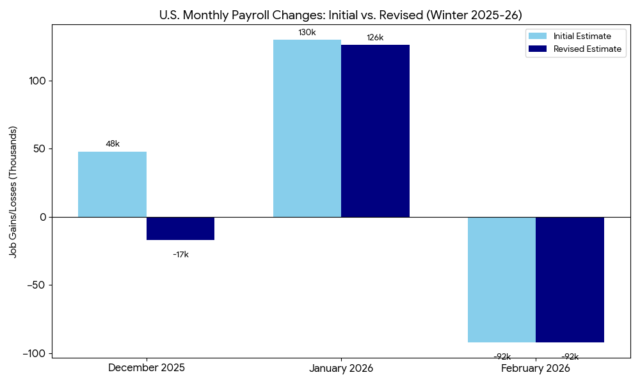
The American labor market, which appeared to be finding its footing at the start of the year, took a sharp and unexpected turn into the red this February. According to the latest data released today by the Bureau of Labor Statistics (BLS), total nonfarm payroll employment fell by 92,000 in February. This contraction blindsided economists, who had generally forecasted a modest gain of approximately 60,000 jobs.
The report also saw the national unemployment rate edge up to 4.4%, a slight increase from January’s 4.3%. While the uptick is marginal, it reflects a broader softening in a labor market that is increasingly described by analysts as “bifurcated” and “under strain.”
A Swing from Strength to Slump
February’s disappointing figures stand in stark contrast to January, which initially offered hope of a 2026 rebound. In January, the economy added a revised 126,000 jobs. However, even that silver lining has been dulled by the BLS’s latest revisions.
The Bureau noted that employment in December and January combined was 69,000 lower than previously reported. December, once thought to be a month of modest growth, was revised downward from a gain of 48,000 to a loss of 17,000. January’s robust 130,000 figure was also trimmed to 126,000. These persistent downward revisions suggest that the “low-hire, low-fire” environment of late 2025 has transitioned into a more precarious state of genuine contraction.

Sector Breakdown: Strikes and Structural Declines
The headline loss of 92,000 jobs was driven largely by volatility in sectors that have historically been the economy’s backbone:
- Healthcare: After serving as the primary driver of growth for years, healthcare saw a sharp swing, losing 28,000 jobs in February. This decline was largely attributed to significant strike activity, specifically at Kaiser Permanente facilities in California and Hawaii. Within the sector, physician offices lost 37,000 roles, while hospitals added 12,000.
- Information & Government: The Information sector continued its long-term slide, shedding 11,000 jobs. Meanwhile, federal government employment continued to trend downward, losing 10,000 jobs in February. This follows a massive contraction in the federal workforce over the past year, with over 320,000 positions lost since January 2025.
- Construction & Manufacturing: Manufacturing employment fell by 12,000, while construction remained essentially flat, hampered by frigid February weather in several regions.
The Context of 2025: A “Year of the Snail”
To understand why today’s report is so jarring, one must look at the newly finalized benchmark revisions for 2025. The BLS recently revealed that 2025 was the weakest year for job growth outside of a recession in decades. Initial reports for 2025 suggested the economy added 584,000 jobs; however, the final revisions slashed that figure to 181,000—an average of only 15,000 jobs per month.
By comparison, 2024 saw the addition of 1.5 million jobs. The drop-off in 2025 was dramatic, and today’s February data suggests that the momentum has not yet returned.
Wages and the “K-Shaped” Reality
Despite the loss in total payrolls, those who remained employed saw modest wage growth. Average hourly earnings rose by 15 cents, or 0.4%, to $37.32. Over the past 12 months, wages have increased by 3.8%.
However, economists warn of a widening gap. Data from private institutions, such as Bank of America, suggest that while high-income wage growth remains resilient at 4.2% year-over-year, lower- and middle-income workers are seeing their wage growth stall to near 1%. This “K-shaped” recovery is creating economic malaise for a large portion of the workforce, even as stock markets remain near record highs.
Geopolitical Headwinds
The timing of this report is particularly sensitive. The labor market was already struggling with the lingering effects of high interest rates and trade uncertainties when the recent escalation in the Middle East conflict added a new layer of volatility. Surging oil prices and the resulting spike in transportation costs are expected to weigh heavily on hiring decisions in the coming months.
“Just when it looked like the labor market was stabilizing, this report delivers a knock-down blow to that view,” noted Olu Sonola, head of U.S. economics at Fitch Ratings. “It’s bad news whichever way you look at it.”
What’s Next for the Federal Reserve?
The Federal Reserve now finds itself in a classic “double bind.” Traditionally, a weakening labor market would trigger a series of interest rate cuts to stimulate the economy. However, with the Iran conflict threatening a new surge in energy-driven inflation, the Fed may be forced to stay on the sidelines.
Investors are now looking toward the March meeting with increased anxiety. If the unemployment rate continues to “break to the upside”—specifically if it nears the 4.6% mark—the calls for aggressive intervention will become deafening. For now, the U.S. worker is left in a state of “low-hire, low-fire” uncertainty, waiting to see if the February freeze is a temporary chill or the start of a long winter.
Data Summary: February 2026 vs. Prior Months
| Metric | February 2026 | January 2026 (Revised) | December 2025 (Revised) |
| Nonfarm Payrolls | -92,000 | +126,000 | -17,000 |
| Unemployment Rate | 4.4% | 4.3% | 4.4% |
| Avg. Hourly Earnings | $37.32 | $37.17 | $37.05 |
| Labor Participation | 62.0% | 62.5% | 62.4% |
Sources and links
- U.S. Bureau of Labor Statistics (BLS) – February 2026 Employment Situation
- The Guardian – US Lost 92,000 Jobs in February
- Morningstar – February US Jobs Report: Fall in Payrolls Far Worse Than Expected
- Forbes – U.S. Lost 92,000 Jobs Last Month As Unemployment Rose
- Indeed Hiring Lab – January 2026 Jobs Report & 2025 Revisions Analysis
- Economic Policy Institute (EPI) – #JobsDay Analysis
Disclaimer
Artificial Intelligence Disclosure & Legal Disclaimer
AI Content Policy.
To provide our readers with timely and comprehensive coverage, South Florida Reporter uses artificial intelligence (AI) to assist in producing certain articles and visual content.
Articles: AI may be used to assist in research, structural drafting, or data analysis. All AI-assisted text is reviewed and edited by our team to ensure accuracy and adherence to our editorial standards.
Images: Any imagery generated or significantly altered by AI is clearly marked with a disclaimer or watermark to distinguish it from traditional photography or editorial illustrations.
General Disclaimer
The information contained in South Florida Reporter is for general information purposes only.
South Florida Reporter assumes no responsibility for errors or omissions in the contents of the Service. In no event shall South Florida Reporter be liable for any special, direct, indirect, consequential, or incidental damages or any damages whatsoever, whether in an action of contract, negligence or other tort, arising out of or in connection with the use of the Service or the contents of the Service.
The Company reserves the right to make additions, deletions, or modifications to the contents of the Service at any time without prior notice. The Company does not warrant that the Service is free of viruses or other harmful components.






