In a dramatic escalation of the multi-year investigation into the life and crimes of Jeffrey Epstein, the House Oversight and Accountability Committee voted on March 4, 2026, to subpoena United States Attorney General Pam Bondi. The 24–19 vote saw five Republicans break ranks to join Democrats, signaling a rare moment of bipartisan frustration with the Department of Justice (DOJ) under the Trump administration. The subpoena compels Bondi to provide a closed-door deposition regarding the agency’s handling of millions of pages of Epstein-related documents, which critics across the political spectrum have labeled as “sloppy,” “incomplete,” and “intentionally obstructive.”
The “Epstein Files” Breaking Point
The catalyst for this legal showdown is the Epstein Files Transparency Act (EFTA), a law passed with near-unanimous support in late 2025. The Act mandated that the DOJ release all investigative materials related to Epstein, including flight logs, interview summaries, and correspondence with powerful associates. However, since the December 2025 deadline, the rollout has been marred by scandal.
Lawmakers allege that the DOJ, under Bondi’s leadership, has:
- Withheld nearly half of the 6 million documents collected by investigators.
- Inadvertently leaked survivors’ identities and nude photographs of victims due to poor redaction processes.
- Redacted the names of high-profile associates while claiming the need to protect “ongoing investigations.”
- Omitted interview summaries involving uncorroborated allegations against political figures, including President Trump.
Representative Nancy Mace (R-S.C.), who introduced the motion to subpoena Bondi, was blunt in her assessment: “The Epstein case is one of the greatest cover-ups in American history. His global sex trafficking network is larger than what is being revealed. Videos are missing. Audio is missing. Logs are missing.”

A Heated Congressional Rivalry
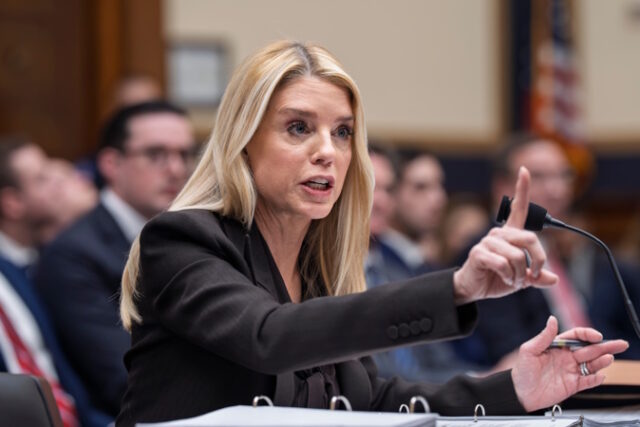
The subpoena follows a combative House Judiciary Committee hearing in February 2026, where Bondi sparred with lawmakers in sessions that frequently devolved into personal insults. During that testimony, Bondi defended the DOJ’s work, noting that staff had reviewed millions of pages in a compressed timeframe. “We’ve released more than 3 million pages… all to the public, while doing our very best to protect victims,” she told the committee.
However, the hearing became a flashpoint when photojournalists captured Bondi holding a “burn book” titled “Jayapal Pramila Search History,” which appeared to be a log of Representative Pramila Jayapal’s (D-Wash.) private searches through the DOJ’s unredacted Epstein database. Jayapal accused the Attorney General of illegal surveillance, calling it a gross violation of the separation of powers.
Bipartisan Defection
The March 4 vote was particularly notable for the five Republicans who joined the Democratic minority: Nancy Mace, Lauren Boebert, Tim Burchett, Michael Cloud, and Scott Perry. These members have historically been allies of the administration but have grown increasingly vocal about what they perceive as a lack of transparency regarding Epstein’s “client list.”
Representative Scott Perry (R-Pa.) stated that his constituents “demanded accountability,” while Representative Robert Garcia (D-Calif.) argued that Bondi’s refusal to provide unredacted files raised “serious questions about the powerful men they’re protecting.”
What Comes Next?
The subpoena requires Bondi to sit for a closed-door deposition, a setting designed to prevent the “theatrics” of public hearings and force the Attorney General to answer specific questions under oath. The Committee is expected to focus on:
- Missing FBI Interview Summaries: Specifically, those involving a woman who claimed she was assaulted by both Epstein and Trump.
- Lutnick and Bannon Connections: Newly released files suggest Commerce Secretary Howard Lutnick and former strategist Steve Bannon had more frequent contact with Epstein than previously disclosed.
- The “Missing” 3 Million Documents: The DOJ claims these are tied to active investigations, but the EFTA contains provisions that limit such withholdings.
As of March 2026, the Justice Department has not confirmed whether Bondi will comply with the subpoena or seek to block it through executive privilege—a move that would likely trigger a constitutional crisis and further fuel public suspicion regarding the secrets buried in the Epstein files.
Sources and Links
- House Oversight Democrats: Ranking Member Robert Garcia & Congresswoman Summer Lee Demand AG Pam Bondi Comply with Oversight Subpoena
- Associated Press: House committee votes to subpoena Attorney General Bondi to answer questions over the Epstein files
- The Guardian: Pam Bondi subpoenaed by US House in Jeffrey Epstein investigation
- CBS News: House Oversight Committee votes to subpoena Attorney General Pam Bondi to testify in Epstein probe
- Democracy Docket: GOP-controlled House Oversight Committee votes to subpoena Bondi over Epstein Files
- FOX43 News: Rep. Scott Perry votes to subpoena AG Pam Bondi over handling of Epstein files
Disclaimer
Artificial Intelligence Disclosure & Legal Disclaimer
AI Content Policy.
To provide our readers with timely and comprehensive coverage, South Florida Reporter uses artificial intelligence (AI) to assist in producing certain articles and visual content.
Articles: AI may be used to assist in research, structural drafting, or data analysis. All AI-assisted text is reviewed and edited by our team to ensure accuracy and adherence to our editorial standards.
Images: Any imagery generated or significantly altered by AI is clearly marked with a disclaimer or watermark to distinguish it from traditional photography or editorial illustrations.
General Disclaimer
The information contained in South Florida Reporter is for general information purposes only.
South Florida Reporter assumes no responsibility for errors or omissions in the contents of the Service. In no event shall South Florida Reporter be liable for any special, direct, indirect, consequential, or incidental damages or any damages whatsoever, whether in an action of contract, negligence or other tort, arising out of or in connection with the use of the Service or the contents of the Service.
The Company reserves the right to make additions, deletions, or modifications to the contents of the Service at any time without prior notice. The Company does not warrant that the Service is free of viruses or other harmful components.