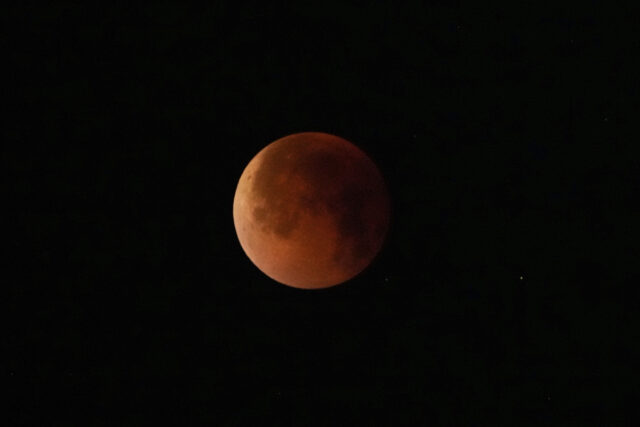
The year 2026 has wasted no time in delivering a masterclass in celestial mechanics. Over the course of just two weeks, the Earth, Moon, and Sun have engaged in a cosmic dance that has painted the sky with both fire and blood. This Tuesday, March 3, 2026, the grand finale arrives in the form of a total lunar eclipse—famously known as a “Blood Moon.” This event follows hot on the heels of the “Ring of Fire” solar eclipse that occurred on February 17, marking a rare “eclipse season” where the alignment of our solar system’s three major players becomes almost perfectly linear.
The Science of the Blood Moon
While the term “Blood Moon” sounds like something out of a gothic novel, its cause is purely atmospheric. A total lunar eclipse occurs when the Earth moves directly between the Sun and the Moon, casting its shadow (the umbra) across the lunar surface.
If Earth were a simple solid block without an atmosphere, the Moon would simply disappear into pitch-black darkness. However, our planet is wrapped in a thin, gas-filled envelope. As sunlight passes through the edges of Earth’s atmosphere, the shorter blue and violet wavelengths of light are scattered away. The longer red and orange wavelengths, however, are bent (or refracted) inward toward the Moon.
Astronomers describe a Blood Moon as the projection of every sunrise and sunset on Earth onto the face of the Moon at once. This Tuesday, the Moon will spend approximately 58 minutes fully immersed in this copper-hued shadow, a spectacle that won’t be repeated in its totality until New Year’s Eve in 2028.

Peak Viewing Times for Florida
For residents of the Sunshine State, the “Blood Moon” is a morning event. Because Florida is on the eastern edge of the visibility zone, the Moon will be quite low in the western sky during the most dramatic phases. To see the deep red color, you will need a clear, unobstructed view of the western horizon.
| Phase of Eclipse | Time (Eastern Standard Time) | What to Look For |
| Penumbral Begins | 3:44 AM | A subtle, dim shading begins to cover the Moon. |
| Partial Begins | 4:50 AM | A dark “bite” appears; the Moon begins to look red. |
| Totality Begins | 6:04 AM | The Moon is fully in shadow; the “Blood Moon” begins. |
| Maximum Eclipse | 6:33 AM | The deepest red hue; Moon is very low in the West. |
| Moonset (Florida) | ~6:40 AM – 6:55 AM | The Moon sets while still in total or partial eclipse. |
Note: In the Florida Panhandle (Central Time), subtract one hour from these times.
The Precursor: The February 17 “Ring of Fire”
The path to Tuesday’s Blood Moon was paved two weeks ago during an annular solar eclipse. While a total solar eclipse blocks the Sun entirely, an annular eclipse occurs when the Moon is at a farther point in its orbit (apogee). Because it appears slightly smaller, it leaves a brilliant “Ring of Fire” visible around its edges.
This specific event was one of the most remote in history, sweeping across East Antarctica and the Southern Indian Ocean. The proximity of these two events—a solar eclipse followed by a lunar eclipse—is a result of the “eclipse season.” This occurs twice a year when the Moon’s orbit crosses the “ecliptic” (the plane of Earth’s orbit around the Sun), allowing shadows to fall perfectly on their targets.
Atmospheric Clarity and Color
The exact shade of Tuesday’s Moon can vary. If the Earth’s atmosphere is clear, the Moon may appear a bright, coppery orange. However, if there have been recent major volcanic eruptions or large-scale wildfires, the extra dust in the stratosphere can cause the Moon to appear a much darker brick-red. By measuring this color, scientists can gather data about the current state of Earth’s upper atmosphere.
Looking Ahead: The “Great European Eclipse”
If you find yourself clouded out this Tuesday, the year 2026 still has its biggest card to play. On August 12, 2026, a total solar eclipse will sweep across the Arctic, Greenland, Iceland, and Spain. It will be the first total solar eclipse visible from continental Europe in over two decades.
For now, Florida turns its eyes to the West. As the Moon slips into our shadow this Tuesday morning, it serves as a silent, glowing reminder of the precise celestial clockwork that governs our universe.
News Sources and Links
- NASA Science: March 2026 Total Lunar Eclipse Guide
- Time and Date: Local Times for March 3 Eclipse in Florida
- Space.com: The Last Blood Moon Until 2028
- The Old Farmer’s Almanac: 2026 Eclipse Calendar
- News4JAX: Lunar Eclipse to Grace Northeast Florida
Disclaimer
Artificial Intelligence Disclosure & Legal Disclaimer
AI Content Policy.
To provide our readers with timely and comprehensive coverage, South Florida Reporter uses artificial intelligence (AI) to assist in producing certain articles and visual content.
Articles: AI may be used to assist in research, structural drafting, or data analysis. All AI-assisted text is reviewed and edited by our team to ensure accuracy and adherence to our editorial standards.
Images: Any imagery generated or significantly altered by AI is clearly marked with a disclaimer or watermark to distinguish it from traditional photography or editorial illustrations.
General Disclaimer
The information contained in South Florida Reporter is for general information purposes only.
South Florida Reporter assumes no responsibility for errors or omissions in the contents of the Service. In no event shall South Florida Reporter be liable for any special, direct, indirect, consequential, or incidental damages or any damages whatsoever, whether in an action of contract, negligence or other tort, arising out of or in connection with the use of the Service or the contents of the Service.
The Company reserves the right to make additions, deletions, or modifications to the contents of the Service at any time without prior notice. The Company does not warrant that the Service is free of viruses or other harmful components.