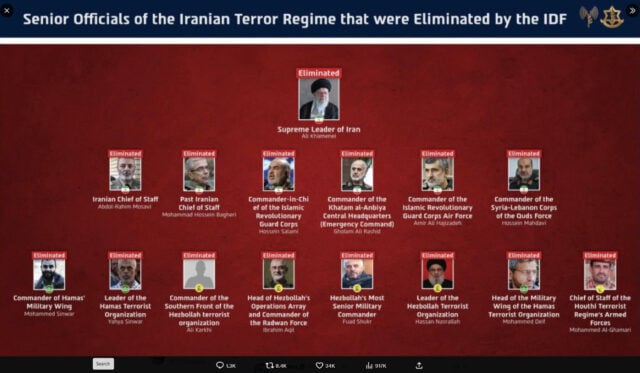
In a dramatic escalation of “Operation Epic Fury,” President Donald Trump announced via Truth Social on Sunday that United States military forces have “destroyed and sunk” nine Iranian naval vessels. The President’s statement, characterized by his signature bluntness and a warning of further strikes, comes as the Middle East reels from a weekend of unprecedented conflict that has reportedly claimed the life of Iran’s Supreme Leader, Ayatollah Ali Khamenei.
Last night, U.S. B-2 stealth bombers, armed with 2,000 lb. bombs, struck Iran’s hardened ballistic missile facilities. No nation should ever doubt America’s resolve. pic.twitter.com/6JpG73lHYW
— U.S. Central Command (@CENTCOM) March 1, 2026
The Iranian Islamic Revolutionary Guard Corps (IRGC) killed more than 1,000 Americans over the past 47 years. Yesterday, a large-scale U.S. strike cut off the head of the snake. America has the most powerful military on earth, and the IRGC no longer has a headquarters. pic.twitter.com/WdpN7JBECr
— U.S. Central Command (@CENTCOM) March 1, 2026

“Floating at the Bottom of the Sea”
The President’s post, shared early Sunday morning, sent shockwaves through international markets and diplomatic circles.
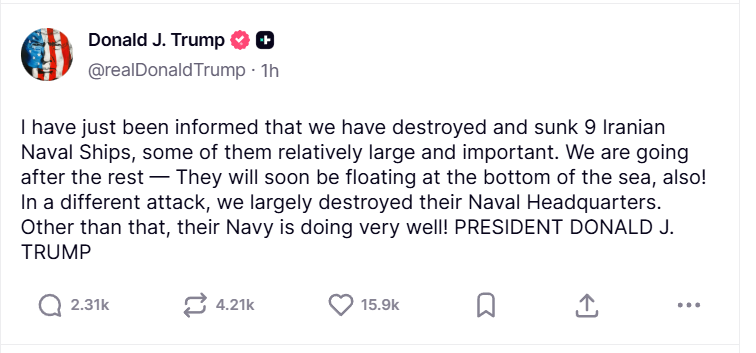
“I have just been informed that we have destroyed and sunk 9 Iranian Naval Ships, some of them relatively large and important,” Trump wrote. “We are going after the rest — They will soon be floating at the bottom of the sea, also! In a different attack, we largely destroyed their Naval Headquarters. Other than that, their Navy is doing very well!”
The announcement followed a series of overnight strikes by U.S. and Israeli forces targeting Iranian military infrastructure. According to U.S. Central Command (CENTCOM), the naval engagement included the sinking of a Jamaran-class corvette at a pier in Chah Bahar. CENTCOM officials reinforced the President’s message on social media, urging members of the Islamic Revolutionary Guard Corps (IRGC) to “abandon ship” and lay down their weapons.
Operation Epic Fury: The Context
The naval strikes are part of a broader campaign that began on February 28, 2026. President Trump, in an eight-minute video address, framed the operation as a “preemptive” necessity to eliminate imminent threats from the Iranian regime, citing its continued nuclear ambitions and its long-standing role as a state sponsor of terrorism.
The conflict has already resulted in significant casualties and tectonic shifts in regional power:
- Death of the Supreme Leader: Iranian state media confirmed on March 1 that Supreme Leader Ayatollah Ali Khamenei was killed in the opening salvos of the strikes.
- Naval Headquarters Decimated: Reports indicate that the nerve center of Iran’s maritime operations has been rendered inoperable.
- U.S. Casualties: The Pentagon confirmed that three U.S. service members were “killed in action” and five others were seriously wounded during the operation.
Regional Retaliation and Global Fallout
Tehran has not remained silent. The IRGC claimed to have targeted the USS Abraham Lincoln with ballistic missiles, though CENTCOM dismissed these reports as a “lie,” stating the missiles “didn’t even come close.”
The ripples of the conflict are being felt across the globe. Gulf states including the UAE, Saudi Arabia, and Qatar have reported intercepting Iranian drones and missiles. Major travel hubs in Dubai and Doha have suspended operations, and oil prices have seen sharp volatility as tensions rise near the Strait of Hormuz—a vital artery for 20% of the world’s oil.
Domestically, the strikes have drawn a polarized response. While some lawmakers offered condolences for the fallen troops and supported the “maximum pressure” tactic, a recent Reuters/Ipsos poll suggests that only 27% of Americans approve of the strikes, with many expressing concern over the potential for an all-out regional war.
What Lies Ahead
President Trump has signaled that the operations are “ahead of schedule” and will continue “as long as necessary.” In a separate phone interview with Axios, he remarked, “I can go long and take over the whole thing, or end it in two or three days.”
As of Sunday evening, two further explosions were reported in Tehran, suggesting that the “Epic Fury” campaign shows no signs of slowing.
Sources & Links
- Military Times: 9 Iranian naval ships have been destroyed and sunk, Trump says
- CBS News: Live updates: U.S. confirms 3 troops killed in Iran war as Trump says operation is “ahead of schedule”
- The Guardian: US-Israel war on Iran live: Trump says operation ‘moving along rapidly’
- CTV News: Trump says 9 Iranian warships have been sunk as Iran vows revenge
- The Hindu: Iran-Israel conflict LIVE: Trump says nine Iran navy ships ‘destroyed and sunk’
- JINSA (Jewish Institute for National Security of America): Operations Epic Fury and Roaring Lion: 3/1/26 Update
- Bluewin: Trump: Nine Iranian warships sunk
- New Indian Express: LIVE | Iran conflict: Trump agrees to talks with Iran’s new leadership
- The Economic Times: Trump says 9 Iranian warships have been sunk
- Council on Foreign Relations (CFR): Iran’s Conflict With Israel and the United States
- Wikipedia: 2026 Iran–United States crisis
Disclaimer
Artificial Intelligence Disclosure & Legal Disclaimer
AI Content Policy.
To provide our readers with timely and comprehensive coverage, South Florida Reporter uses artificial intelligence (AI) to assist in producing certain articles and visual content.
Articles: AI may be used to assist in research, structural drafting, or data analysis. All AI-assisted text is reviewed and edited by our team to ensure accuracy and adherence to our editorial standards.
Images: Any imagery generated or significantly altered by AI is clearly marked with a disclaimer or watermark to distinguish it from traditional photography or editorial illustrations.
General Disclaimer
The information contained in South Florida Reporter is for general information purposes only.
South Florida Reporter assumes no responsibility for errors or omissions in the contents of the Service. In no event shall South Florida Reporter be liable for any special, direct, indirect, consequential, or incidental damages or any damages whatsoever, whether in an action of contract, negligence or other tort, arising out of or in connection with the use of the Service or the contents of the Service.
The Company reserves the right to make additions, deletions, or modifications to the contents of the Service at any time without prior notice. The Company does not warrant that the Service is free of viruses or other harmful components.