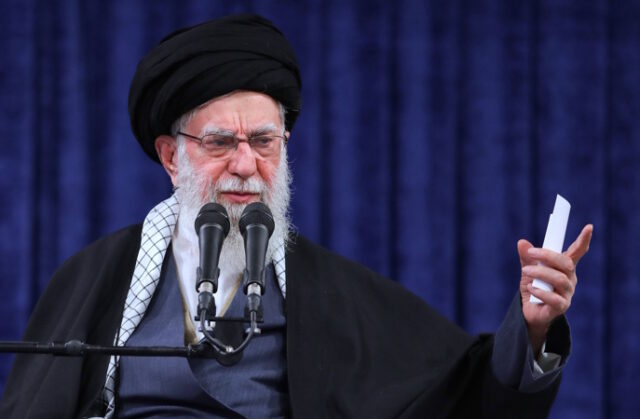
The geopolitical landscape of the Middle East shifted on its axis on February 28, 2026. Following months of escalating tensions, stalled nuclear negotiations, and a massive military buildup, a joint operation by the United States and Israel—dubbed Operation Epic Fury—successfully targeted and killed the Supreme Leader of the Islamic Republic of Iran, Ayatollah Ali Khamenei. While initial reports from Tehran were conflicting, Iranian state media officially confirmed the death early on Sunday morning, marking the end of an era for the theocratic regime and plunging the region into a period of profound uncertainty.
Watch before, and after, bombs dropped on Khamenei compound
🚨 It’s amazing what 30 bunker busters can do. pic.twitter.com/vcJK4cE67I
— Mossad Commentary (@MOSSADil) February 28, 2026
Multi Camera views in the Middle East by InquizeX OSINT
The Strike and Official Confirmation
The operation began with a coordinated barrage of precision airstrikes and missile launches targeting strategic command centers, air defense networks, and high-value leadership compounds across Iran. Satellite imagery released shortly after the initial wave showed catastrophic damage to Khamenei’s secure compound in Tehran.

In the immediate aftermath, Iranian Foreign Ministry officials dismissed reports of the Supreme Leader’s death as “psychological warfare.” However, as the dust settled over the capital, the narrative changed. By the early hours of Sunday, Iranian state television and the semi-official Fars news agency confirmed the “martyrdom” of the 86-year-old leader, who had ruled Iran since 1989. State media also confirmed that several of Khamenei’s family members, including his daughter and granddaughter, were killed in the strikes.
U.S. President Donald Trump, speaking from Washington, characterized the operation as a strike for global peace and a “greatest chance” for the Iranian people to reclaim their sovereignty. Israeli Prime Minister Benjamin Netanyahu echoed these sentiments, noting that the strikes also eliminated several key figures responsible for Iran’s nuclear and ballistic missile programs.
The Immediate Aftermath: Retaliation and Chaos
The vacuum left by Khamenei’s death was instantly filled by fire. Iran’s military apparatus, primarily the Islamic Revolutionary Guard Corps (IRGC), launched immediate retaliatory strikes. Ballistic missiles and suicide drones were directed at U.S. military installations across the Gulf, including the Fifth Fleet headquarters in Bahrain.
In Israel, the “Iron Dome” and “Arrow” defense systems were pushed to their limits as Iranian projectiles targeted residential areas in Tel Aviv and Haifa. Reports indicate at least one fatality in Tel Aviv and scores of injuries across the country. The conflict also spilled into neighboring territories; strikes were reported near the Fairmont Hotel in Dubai and high-rise buildings in Bahrain, highlighting the fragility of regional stability.
What’s Next for Iran: The Battle for Succession
For the first time in nearly four decades, Iran faces a succession crisis without a clear, pre-ordained heir. Under the Iranian constitution, the Assembly of Experts is tasked with selecting a new Supreme Leader. However, the political reality is far more complex.
- The IRGC Consolidation: Analysts suggest the IRGC may move to bypass traditional clerical oversight to establish a more direct military-industrial rule. Having lost several top commanders in the same strikes that killed Khamenei, the remaining hardline leadership is expected to prioritize internal security and the preservation of the “Revolution” over any immediate diplomatic overtures.
- Civil Unrest: The news of Khamenei’s death triggered spontaneous celebrations in some quarters of Tehran and other major cities. Following the brutal crackdown on protests in early 2026—which left thousands dead—the sudden absence of the regime’s figurehead could embolden the domestic opposition. The primary question remains whether a fragmented opposition can coalesce into a viable political alternative before the security forces can re-establish control.
What’s Next for Israel: Security at a High Cost
Israel’s primary objective—the neutralization of the Iranian “head of the snake”—has been achieved, but at the cost of entering what could become a prolonged regional war.
- Degrading the Nuclear Threat: Prime Minister Netanyahu has signaled that the military campaign will continue until Iran’s nuclear infrastructure is completely dismantled. With the Supreme Leader gone, Israel may seek to capitalize on the confusion to strike deep-buried facilities like Fordow and Natanz.
- The Multi-Front Challenge: Israel must now contend with “the ring of fire”—the network of proxies including Hezbollah in Lebanon and various militias in Syria and Iraq. These groups, though potentially demoralized by the loss of their primary patron, remain capable of inflicting significant damage on northern Israel.
What’s Next for the United States: Regime Change or Stalemate?
The Trump administration has explicitly linked these strikes to a policy of regime change, calling on the Iranian military to lay down their arms and the public to “take back their country.”
- Operation Epic Fury: The U.S. Department of Defense has characterized the ongoing mission as a long-term engagement. The objective is no longer just containment but the total incapacitation of Iran’s ability to project power in the Middle East.
- Diplomatic Fallout: The unilateral nature of the strikes, conducted without Congressional authorization according to some reports, has created a domestic political firestorm in Washington. Internationally, the U.S. faces a divided world stage. While some allies quietly welcome the removal of Khamenei, others fear the economic fallout of a shuttered Strait of Hormuz and the potential for a global energy crisis.
Geopolitical Repercussions
The removal of Ali Khamenei creates a ripple effect that extends far beyond the borders of the Middle East.
- Energy Markets: Oil prices spiked in the hours following the confirmation of the strikes. If the conflict escalates to a total blockade of the Persian Gulf, the global economy could face a recessionary shock not seen since the 1970s.
- The Russia-China Axis: Iran has become a critical partner for both Russia and China. How these superpowers react to a U.S.-backed attempt at regime change in Tehran will determine if this conflict remains regional or escalates into a broader global confrontation.
- The Future of Non-Proliferation: The failure of the Geneva talks in February 2026 led directly to this military escalation. This sets a stark precedent: in the absence of diplomatic breakthroughs, the world’s leading powers may increasingly return to “kinetic” solutions for nuclear proliferation.
Conclusion
The death of Ayatollah Ali Khamenei is not the end of the story; it is the beginning of a volatile new chapter. Iran is now a nation at a crossroads, torn between the possibility of a democratic resurgence and the iron grip of a wounded military elite. For Israel and the United States, the “success” of the assassination will ultimately be judged by what follows. If the result is a democratic, stable Iran, the mission may be seen as a historic turning point. If the result is a failed state or a more radicalized military junta, the world may look back on February 28, 2026, as the day the Middle East descended into a generation of darkness.
Sources and Links
- The Guardian: “Ayatollah Ali Khamenei killed by missile strike on Iran, state media confirm” (Feb 28, 2026) – https://www.theguardian.com/us-news/2026/feb/28/khamenei-likely-killed-us-israel-iran-strikes
- Associated Press (AP): “Iran’s supreme leader is dead following major attack by US and Israel” (Feb 28, 2026) – https://apnews.com/article/iran-us-explosion-tehran-c2f11247d8a66e36929266f2c557a54c
- Middle East Eye: “Iranian state TV announces death of Iran’s Supreme Leader Ali Khamenei” (Mar 1, 2026) – https://www.middleeasteye.net/news/iranian-state-tv-announces-death-irans-supreme-leader-ali-khamenei
- PBS NewsHour: “U.S. and Israel launch a major attack on Iran, Trump says Supreme Leader Khamenei killed” (Feb 28, 2026) – https://www.pbs.org/newshour/world/u-s-and-israel-launch-a-major-attack-on-iran-trump-says-supreme-leader-khamenei-killed
- The Independent: “Iran latest: Trump confirms supreme leader Ayatollah Khamenei killed in US-Israeli strikes” (Mar 1, 2026) – https://www.the-independent.com/news/world/middle-east/iran-israel-strikes-trump-live-updates-b2929362.html
- CBS News: “Iran’s Supreme Leader Ayatollah Ali Khamenei killed in strikes, led theocratic regime for decades” (Feb 28, 2026) – https://www.cbsnews.com/news/ayatollah-khamenei-dead-iranian-supreme-leader-us-israel-military-mission/
- Iran International: “Iran’s Supreme Leader Ali Khamenei is dead” (Feb 28, 2026) – https://iranintl.com/en/202602280738
- Al Jazeera: “Why are the US and Israel attacking Iran? What we know so far” (Feb 28, 2026) – https://www.aljazeera.com/news/2026/2/28/us-and-israel-attack-iran-what-we-know-so-far
- Wikipedia: “Assassination of Ali Khamenei” – https://en.wikipedia.org/wiki/Assassination_of_Ali_Khamenei
Disclaimer
Artificial Intelligence Disclosure & Legal Disclaimer
AI Content Policy.
To provide our readers with timely and comprehensive coverage, South Florida Reporter uses artificial intelligence (AI) to assist in producing certain articles and visual content.
Articles: AI may be used to assist in research, structural drafting, or data analysis. All AI-assisted text is reviewed and edited by our team to ensure accuracy and adherence to our editorial standards.
Images: Any imagery generated or significantly altered by AI is clearly marked with a disclaimer or watermark to distinguish it from traditional photography or editorial illustrations.
General Disclaimer
The information contained in South Florida Reporter is for general information purposes only.
South Florida Reporter assumes no responsibility for errors or omissions in the contents of the Service. In no event shall South Florida Reporter be liable for any special, direct, indirect, consequential, or incidental damages or any damages whatsoever, whether in an action of contract, negligence or other tort, arising out of or in connection with the use of the Service or the contents of the Service.
The Company reserves the right to make additions, deletions, or modifications to the contents of the Service at any time without prior notice. The Company does not warrant that the Service is free of viruses or other harmful components.