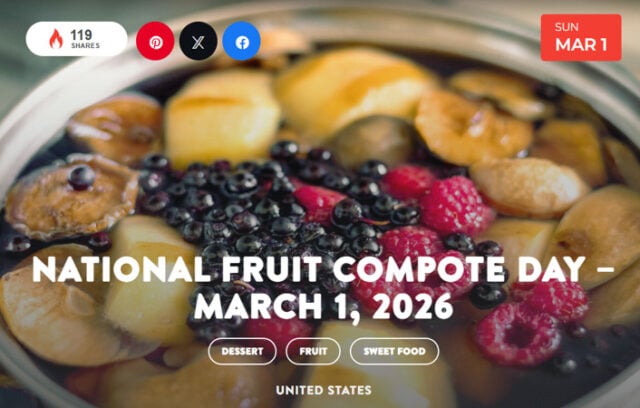
National Fruit Compote Day is on March 1, so you can indulge in this delicious mix of fruit and sugar. Fruit compote is enjoyed as a dessert or as a breakfast addition.
- 12th-15th Century – Fruit “compositum” in early European cookery. Medieval European cooks develop sweet fruit stews called compositum, precursors of compote, as a way to serve and preserve fruit with sugar or honey.
- In Medieval times, compote was known to have healing benefits for the body.
- 15th Century – The pear compote is made with cinnamon, sugar, and wine.
- 17th Century – A compote is a dessert that originated in 17th century France. It is made up of whole or pieces of fruit (a mixture) in sugar syrup. The whole fruits are cooked in water with added sugar and spices.
- 17th & 18th Centuries – Across early modern Europe, compote was served at the beginning of the final course with potage, and later chilled at the very end of grand Renaissance and Baroque feasts.
- 1876 – Tomato compote is a relish or side dish made with roasted or cooked tomatoes. In the United States, it has been prepared at least since 1876, when it appeared in the Little Dinners cookbook by Mary Hooper (1829–1904).
- 18th & 19th Centuries – Because it was inexpensive, flexible, and usually dairy-free, fruit compote became a staple of Ashkenazi Jewish kitchens in Europe, often accompanying breads, porridge, and Sabbath meals.
- 20th Century – Compote becomes a widespread delicacy.
- 2022 – Fruit Compote Day is celebrated on March 1, but the origins are unknown.
- The word compote is French for “mixture.”
- Compote originates from the Latin word for mixture, ‘compositus.’
- The seasonings that may be included in the syrup are vanilla, lemon peel, orange peel, cinnamon sticks, cinnamon powder, cloves, ground almonds, grated coconut, candied fruit or raisins. Fruit compote may be served either warm or cold.
- Compote was initially served as an afternoon snack with sour cream and biscuits. It was during the Renaissance that it was served chilled at the end of dinner.
- The Culinary Institute of America considers compote to be one of two types of fruit sauce: there’s coulis, made with smooth, pureed fruit, and then there’s compote, which is a chunky mixture.
- Compote conformed to the medieval belief that fruit cooked in sugar syrup balanced the effects of humidity on the body.
- Compotes are often (although not always) made and used immediately as components of dishes.
- It can be made from fresh, canned or dried fruit.
- Fruit compote is served either hot or cold.
- The fruit can be cooked whole or cut into pieces, and almost anything can be used – apples, pears, apricots, peaches, plums, figs, and berries.
- Western European compote is not directly related to the 300-year-old Eastern European punch-like fruit drink kompot, even though they share a similar name and ingredients.
- The Eastern European drink dates to the Ottoman Empire; it may even be the predecessor of the Western European dessert of the same name.
- Depending on the type of fruit used, the spicing and level of sweetness is usually adjusted to make the fruit compote’s flavor optimal.
- The length of cooking varies by individual taste, with some cooks preferring to briefly warm the fruit, while others stew it to a soft, even texture.
- In the crystal and glass world, a compote is usually a serving dish made to hold a culinary dish called compote.
- Fruit compote is different from jam or preserves because it is cooked briefly and meant to be eaten within a few days, while jam and preserves are cooked longer to achieve a gel-like texture and are designed for long-term storage. Compote usually has larger, distinct pieces of fruit in a light syrup, and it is not processed in jars for canning the way traditional preserves are.
Source:

Joy of Kosher
Just Fun Facts
Disclaimer
Artificial Intelligence Disclosure & Legal Disclaimer
AI Content Policy.
To provide our readers with timely and comprehensive coverage, South Florida Reporter uses artificial intelligence (AI) to assist in producing certain articles and visual content.
Articles: AI may be used to assist in research, structural drafting, or data analysis. All AI-assisted text is reviewed and edited by our team to ensure accuracy and adherence to our editorial standards.
Images: Any imagery generated or significantly altered by AI is clearly marked with a disclaimer or watermark to distinguish it from traditional photography or editorial illustrations.
General Disclaimer
The information contained in South Florida Reporter is for general information purposes only.
South Florida Reporter assumes no responsibility for errors or omissions in the contents of the Service. In no event shall South Florida Reporter be liable for any special, direct, indirect, consequential, or incidental damages or any damages whatsoever, whether in an action of contract, negligence or other tort, arising out of or in connection with the use of the Service or the contents of the Service.
The Company reserves the right to make additions, deletions, or modifications to the contents of the Service at any time without prior notice. The Company does not warrant that the Service is free of viruses or other harmful components.