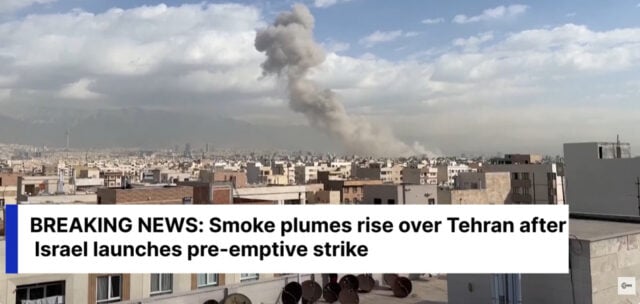
This morning, the geopolitical landscape of the Middle East underwent a seismic shift as the United States and Israel launched a massive, coordinated military campaign against the Islamic Republic of Iran. Codenamed “Operation Epic Fury” by the U.S. Department of Defense and “Roaring Lion” by the Israeli Defense Forces (IDF), the assault marks the most significant military intervention in Iran since the 1979 Revolution.

The Midnight Strikes: Targeting the Heart of Tehran
The operation commenced in the early morning hours with waves of airstrikes and cruise missile launches targeting critical infrastructure in Tehran, Isfahan, Qom, Karaj, and Kermanshah. Unlike previous limited engagements, “Epic Fury” appears designed for maximum impact on the regime’s leadership and its most sensitive military assets.
Initial reports from the ground and satellite imagery confirm that the strikes heavily damaged the compound of Supreme Leader Ayatollah Ali Khamenei in central Tehran. While Iranian state media initially claimed President Masoud Pezeshkian was “safe and sound,” the status of the 86-year-old Supreme Leader remains unknown, with some reports suggesting he was moved to a secure location prior to the bombardment.
The Pentagon confirmed that the strikes were carried out by a combination of carrier-based aircraft from the USS Gerald R. Ford and USS Abraham Lincoln, as well as long-range bombers and sea-launched Tomahawk missiles. The primary objectives, according to U.S. officials, are the total destruction of Iran’s nuclear enrichment facilities—specifically at Fordow and Natanz—and the elimination of its ballistic missile production capabilities.
A Call for Regime Change
Two hours after the first explosions rocked Tehran, President Donald Trump delivered an eight-minute televised address. In a stark departure from previous “America First” rhetoric regarding foreign wars, Trump framed the conflict as a necessary pre-emptive strike to prevent a nuclear-armed Iran from threatening the American homeland.
“This regime will soon learn that no one should challenge the strength and might of the United States Armed Forces,” Trump declared. “When we are finished, take over your government. It will be yours to take; this will be probably your only chance for generations.”
Trump explicitly offered immunity to members of the Islamic Revolutionary Guard Corps (IRGC) and regular military who lay down their arms, while warning those who resist of “certain death.” Israeli Prime Minister Benjamin Netanyahu echoed these sentiments, stating the joint operation aimed to create conditions for the Iranian people to “take their fate into their own hands.”
The Diplomatic Collapse
The strikes come at a moment of profound diplomatic irony. Only hours before the bombardment, Oman’s Foreign Minister, Badr Al-Busaidi, had announced a “breakthrough” in indirect nuclear negotiations in Geneva. According to Omani officials, Iran had allegedly agreed to a permanent end to uranium enrichment and full IAEA verification.
However, the Trump administration appeared skeptical of these last-minute overtures. During his State of the Union address on February 24, Trump had already accused Tehran of “sinister” ambitions and reviving its weapons program. U.S. officials now contend that the negotiations were being used by Tehran as a “stalling tactic” while they continued to harden their underground facilities.
Iran’s “Crushing Retaliation”
The response from Tehran was swift and geographically broad. The IRGC announced it had initiated “crushing retaliation,” launching dozens of ballistic missiles and drones at U.S. and Israeli assets across the region.
- Bahrain: Explosions were reported at the U.S. Navy’s 5th Fleet base.
- UAE & Qatar: State media in both nations reported interceptions of Iranian missiles, though shrapnel in Abu Dhabi reportedly caused at least one civilian fatality.
- Israel: Sirens blared across the country as the Iron Dome and Arrow defense systems engaged incoming threats.
- Jordan & Kuwait: Both nations closed their airspace and reported multiple interceptions of projectiles transiting their territory.
The humanitarian toll within Iran is also mounting. Reports from the Fars News Agency and The Guardian indicate that an Israeli strike hit an elementary girls’ school in the city of Minab, resulting in dozens of casualties. In Tehran, panicked residents have formed long queues at gas stations, and monitors like NetBlocks have reported a near-total internet blackout.
Global Economic and Security Fallout
The economic repercussions were instantaneous. Oil prices spiked as markets braced for a potential closure of the Strait of Hormuz, through which a third of the world’s sea-borne oil passes. In 2025, over 14 million barrels per day flowed through this narrow choke point, and the IRGC has long threatened to shut it in the event of a full-scale war.
In the U.S., the strike has sparked intense debate. While some lawmakers praised the “decisive action” to end a decades-long threat, others raised concerns about the legal authorization of the strikes and the risk of being bogged down in a “weeks-long sustained operation” that could spiral into a broader regional conflagration.
What Comes Next?
As “Operation Epic Fury” enters its second day, the world watches to see if the internal unrest that has plagued Iran since late 2025 will indeed turn into the popular uprising President Trump has called for. With U.S. officials indicating that this is not a “one-off” strike but the start of a sustained campaign, the Middle East stands on the precipice of its most transformative—and dangerous—era in modern history.
News Sources and Links
- PBS NewsHour: US and Israel launch a major attack on Iran
- The Guardian: US and Israel launch joint attack on Iran as Trump urges regime change
- Al Jazeera: US, Israel bomb Iran: A timeline of talks and threats
- Wikipedia: 2026 Israeli–United States strikes on Iran
- Hindustan Times: US, Israel launch joint attacks on Iran, strike buildings in heart of Tehran
- Associated Press: Live updates: Tehran launches retaliatory strikes
- Institute for the Study of War (ISW): Iran Update, February 26, 2026
Disclaimer
Artificial Intelligence Disclosure & Legal Disclaimer
AI Content Policy.
To provide our readers with timely and comprehensive coverage, South Florida Reporter uses artificial intelligence (AI) to assist in producing certain articles and visual content.
Articles: AI may be used to assist in research, structural drafting, or data analysis. All AI-assisted text is reviewed and edited by our team to ensure accuracy and adherence to our editorial standards.
Images: Any imagery generated or significantly altered by AI is clearly marked with a disclaimer or watermark to distinguish it from traditional photography or editorial illustrations.
General Disclaimer
The information contained in South Florida Reporter is for general information purposes only.
South Florida Reporter assumes no responsibility for errors or omissions in the contents of the Service. In no event shall South Florida Reporter be liable for any special, direct, indirect, consequential, or incidental damages or any damages whatsoever, whether in an action of contract, negligence or other tort, arising out of or in connection with the use of the Service or the contents of the Service.
The Company reserves the right to make additions, deletions, or modifications to the contents of the Service at any time without prior notice. The Company does not warrant that the Service is free of viruses or other harmful components.