by Christine Sexton, Florida Phoenix
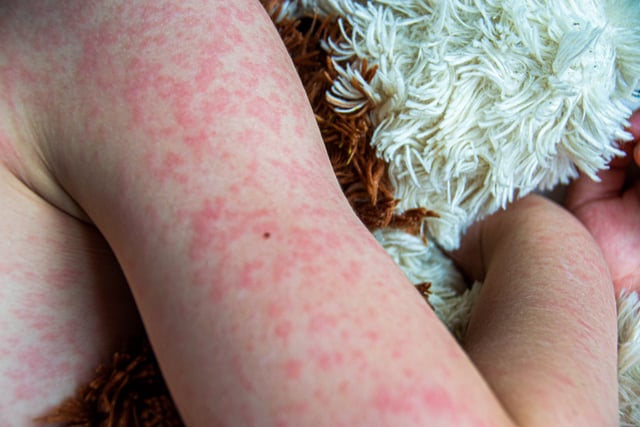
Florida ranks third in the number of confirmed measles cases across the country, new data published the U.S. Centers for Disease Control and Prevention show.
The CDC data, updated Friday, show 107 confirmed measles cases in Florida as of Feb. 26.
South Carolina leads the nation in confirmed measles cases — 653 — followed by Utah with 149.

Nationwide, there were 1,136 confirmed cases.
Although the CDC collects its data from states, the Florida Department of Health’s measles data differ.
DOH data, which include cases reported to the state health department through Feb. 21, show 104 confirmed measles cases in 11 counties: Alachua, Broward, Collier, Duval, Escambia, Hillsborough, Lee, Manatee, Miami-Dade, Pinellas, and St. Johns.
The number of DOH-reported measles cases jumps to 114 cases in 11 counties when including confirmed and suspected measles cases.
According to the CDC, measles spreads through the air when a sick person coughs or sneezes. The virus can stay in the air for two hours after the infected person leaves. It is so contagious that about nine out of 10 people who come near a person with measles will become infected if not vaccinated.

The CDC says the best way to avoid measles is with the measles, mumps, and rubella (MMR) vaccine.
An estimated 88.8% of kindergarteners in Florida had their MMR vaccine in academic year 2024-25, the latest available data.
To stop the spread of the measles virus and for a population to be considered safe from infection, referred to as herd immunity, 95% of the population should be vaccinated.
Collier County has the highest number of confirmed measles cases in the state with 73, followed by Duval County with six, Escambia and Pinellas counties each with five, and Manatee and St. Johns counties each with three.
Four counties — Alachua, Broward, Hillsborough and Lee — each have two cases and Miami-Dade County has one reported case.
Eighty-five of the 104 confirmed cases are in people between the ages of 15 and 24, with the 15-19-year-old age cohort accounting for 55% of the cases.
There are three confirmed measles cases in children between birth and age four and there is one confirmed case in the 40-44-year-old demographic.
The DOH information shows that 66 of the confirmed measles cases were acquired in Florida, five cases were acquired in another state, and two cases were contracted internationally. In 31 cases, people couldn’t account for where they were infected with the virus.
As the number of measles cases in Florida increases, the DeSantis administration has pushed to eliminate vaccine mandates for school-aged children. Although the DOH can eliminate the vaccines that are required through rules, it cannot eliminate any vaccine that is statutorily required without the action by the Legislature.
As the 2026 session approaches its end, it appears the Republican-controlled Legislature is unwilling to do that.
However, the Florida Senate is moving a bill that would make it easier for parents to not vaccinate their children based on conscientious objections. SB 1756 also would require physicians to provide parents who choose to vaccinate their children with information about the potential risks of vaccines. There is no similar requirement for physicians to provide parents who opt out of vaccines with that risk.
The House hasn’t considered similar legislation.
Florida Phoenix is part of States Newsroom, a nonprofit news network supported by grants and a coalition of donors as a 501c(3) public charity. Florida Phoenix maintains editorial independence. Contact Editor Michael Moline for questions: info@floridaphoenix.com.
Disclaimer
Artificial Intelligence Disclosure & Legal Disclaimer
AI Content Policy.
To provide our readers with timely and comprehensive coverage, South Florida Reporter uses artificial intelligence (AI) to assist in producing certain articles and visual content.
Articles: AI may be used to assist in research, structural drafting, or data analysis. All AI-assisted text is reviewed and edited by our team to ensure accuracy and adherence to our editorial standards.
Images: Any imagery generated or significantly altered by AI is clearly marked with a disclaimer or watermark to distinguish it from traditional photography or editorial illustrations.
General Disclaimer
The information contained in South Florida Reporter is for general information purposes only.
South Florida Reporter assumes no responsibility for errors or omissions in the contents of the Service. In no event shall South Florida Reporter be liable for any special, direct, indirect, consequential, or incidental damages or any damages whatsoever, whether in an action of contract, negligence or other tort, arising out of or in connection with the use of the Service or the contents of the Service.
The Company reserves the right to make additions, deletions, or modifications to the contents of the Service at any time without prior notice. The Company does not warrant that the Service is free of viruses or other harmful components.