Walt Disney Co. closed 2025 by investing $1 billion in OpenAI and licensing more than 200 characters to the startup’s Sora video platform. Weeks earlier, SAG-AFTRA had formally condemned Tilly Norwood, a synthetic performer created entirely by artificial intelligence, calling it “not an actor” but “a character generated by a computer program trained on the work of countless professional performers.”
Between those two events, the gap between what studios want from AI and what the people who make television and film are willing to accept became impossible to ignore.
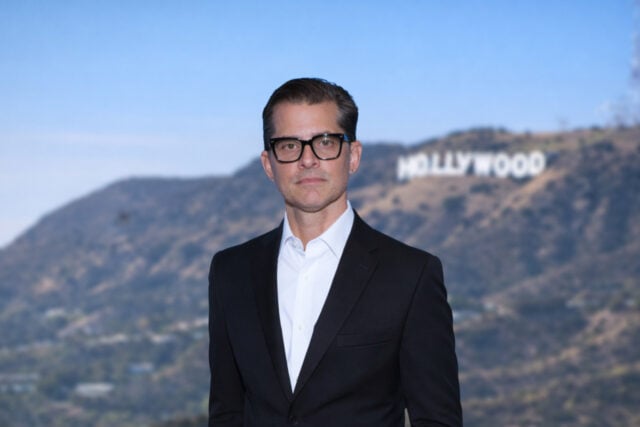
Bennett Graebner spent 17 years as executive producer and showrunner of The Bachelor franchise before stepping back to focus on screenwriting. He watched the AI debate intensify from inside a production where even modest adoption was shut down by studio attorneys.
“For me, AI, it’s like a really smart, always available writing partner who also is on the spectrum and can be unbelievably forgetful,” Graebner says. “It’s a tool and one that you can use, but it’s not going to do the heavy lifting. The humans are going to do the heavy lifting.”

That distinction between tool and replacement sits at the center of every major confrontation Hollywood now faces over the technology.
What Did Disney’s Billion-Dollar Bet Reveal?
Disney’s OpenAI deal was the largest single corporate commitment to generative AI in entertainment history. Bloomberg reported that studios had been “eager to tout the potential benefits of AI to investors, but afraid to divulge their biggest experiments, lest they antagonize talent and alienate labor unions.” Disney broke that silence with a move that signaled both confidence in the technology and willingness to absorb the backlash.
Under the agreement, Sora users can generate short-form videos featuring characters from Marvel, Pixar, and Star Wars. Disney excluded the use of performers’ voices, names, and likenesses, but the deal still drew immediate criticism from animators and actors who saw it as a step toward replacing human labor with automated output.
Bloomberg also noted that entertainment attorney Kevin Yorn, whose clients include Scarlett Johansson, warned that AI “collapses the boundary between a person and a file.” That language captured a fear shared across the creative workforce Graebner has led for nearly two decades: that digital tools designed for efficiency will inevitably be deployed for displacement.
Why Did a Synthetic Performer Provoke an Industry-Wide Backlash?
Tilly Norwood arrived quietly. Particle6, a London-based production company, unveiled the AI-generated figure in a comedy sketch posted online in July 2025. Months later, company founder Eline Van der Velden announced at the Zurich Film Festival that several talent agencies were interested in signing the synthetic creation for film and television work.
Hollywood’s reaction was swift and hostile. Emily Blunt, shown a photo of Norwood during a Variety podcast interview, responded with visible alarm. Whoopi Goldberg opened an episode of The View by challenging the premise outright.
SAG-AFTRA president Sean Astin told NPR that “nothing will ever replace a human being” and confirmed that union contracts prohibit studios from using synthetic performers without notice and bargaining.
Job Displacement Fears Have Concrete Numbers Behind Them
NPR’s reporting highlighted a 2024 study predicting that more than 20 percent of film, television, and animation jobs could be consolidated, replaced, or eliminated by generative AI in the United States by 2026. Background and voice performers face the most immediate vulnerability, while lead actors with established audiences remain relatively protected. Hollywood producer Charlie Fink, writing for Forbes, told NPR he expected “a ton of synthetic actors” but doubted they would appear in premium productions.
Norwood herself could only deliver monologues facing a camera. She could not perform scenes with other actors, react in real time, or convey the kind of spontaneous emotional truth that Graebner built his producing career around capturing on The Bachelor.
What Stops Studios from Using Tools They Already Have?
Even producers who see practical value in AI are running into institutional resistance that has nothing to do with creative philosophy. Multiple industry insiders have described attempts to introduce basic AI applications for brainstorming, meeting transcription, and scheduling, only to be shut down by studio legal departments wary of unresolved liability questions.
The resistance extends beyond Hollywood. TheWrap’s year-end analysis reported that 96 percent of CEOs across industries said they had failed to see any meaningful return on investment from AI adoption, according to a survey by Atlassian.
Hollywood’s version of that disappointment carries additional legal weight. Studios face potential copyright liability for training data, contractual obligations to unions governing digital replicas, and the reputational risk of alienating talent whose participation drives production value.
Early Experiments Delivered Uneven Returns
Gartner analyst Chris Ross told TheWrap that “2025 is really an onramp to what we’re going to see in 2026.” Studios tested AI for pre-visualization, script breakdowns, and dubbing with mixed results.
Amazon pulled AI-dubbed anime episodes after audiences rejected the robotic voice work. Lionsgate scaled back its initial AI ambitions after early experiments failed to deliver projected savings.
Fox CTO Melody Hildebrandt described more successful applications at TheWrap’s TheGrill conference, noting her company had used AI to quickly repackage sports clips into vertical shorts for social media distribution. Universal VP Annie Chang cited similar efficiency gains in pre-production scheduling and logistics. Neither application touched the creative content itself.
Can Production Adopt AI Without Displacing Its Workforce?
SAG-AFTRA began formal contract negotiations with the Alliance of Motion Picture and Television Producers on February 9, 2026. The current agreement expires June 30. AI protections secured during the 2023 strike established baseline requirements for consent and compensation when studios use digital replicas, but union leadership has acknowledged those measures were only a starting point.
SAG-AFTRA’s chief negotiator Duncan Crabtree-Ireland told Deadline that studios had taken a “much more cautious uptake” of AI than he initially expected, crediting both contractual limitations and public sentiment for slowing adoption. Sean Astin, who succeeded Fran Drescher as union president, framed AI as an immediate labor issue rather than a speculative one, particularly for background performers, day players, and voice actors who make up a significant portion of the industry’s working class.
Thirty-eight states adopted more than 100 AI-related laws by late 2025, according to the National Conference of State Legislatures, creating a regulatory patchwork that complicates compliance for studios operating across jurisdictions. A December 2025 executive order from the White House attempted to establish a single national framework but notably left state-level child safety protections intact.
For producers like Graebner, who spent his career managing large creative teams across international locations, the practical question is narrower than the policy debate suggests. AI can generate a list of date ideas for a reality show. It cannot read the room when a contestant is holding back, recognize the moment two people genuinely connect, or make the split-second editorial judgment about which story to follow through a 14-hour shooting day.
Will the 2026 Contracts Settle the Question?
Jason Zada, founder of AI studio Secret Level, told TheWrap that “everyone in Hollywood is eager and in their bathing suits and standing around the pool, waiting for the first person to jump in.” Luma AI CEO Amit Jain predicted the first film “significantly aided by AI” would arrive sometime in 2026.
Bennett Graebner has jumped into plenty of pools during his career, most notably the one that turned a three-week reality TV gig into a 17-year run. He recognizes AI’s utility for brainstorming and logistics. He also knows, from thousands of hours spent drawing stories out of real people, that the work audiences actually care about happens in the space between two human beings.
Whether Hollywood’s next round of contracts, investments, and production decisions protects that space or gradually erodes it will define the industry’s creative direction for the decade ahead.
Disclaimer
Artificial Intelligence Disclosure & Legal Disclaimer
AI Content Policy.
To provide our readers with timely and comprehensive coverage, South Florida Reporter uses artificial intelligence (AI) to assist in producing certain articles and visual content.
Articles: AI may be used to assist in research, structural drafting, or data analysis. All AI-assisted text is reviewed and edited by our team to ensure accuracy and adherence to our editorial standards.
Images: Any imagery generated or significantly altered by AI is clearly marked with a disclaimer or watermark to distinguish it from traditional photography or editorial illustrations.
General Disclaimer
The information contained in South Florida Reporter is for general information purposes only.
South Florida Reporter assumes no responsibility for errors or omissions in the contents of the Service. In no event shall South Florida Reporter be liable for any special, direct, indirect, consequential, or incidental damages or any damages whatsoever, whether in an action of contract, negligence or other tort, arising out of or in connection with the use of the Service or the contents of the Service.
The Company reserves the right to make additions, deletions, or modifications to the contents of the Service at any time without prior notice. The Company does not warrant that the Service is free of viruses or other harmful components.