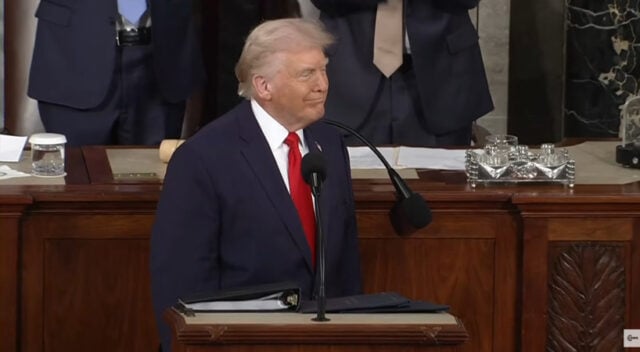
WASHINGTON — In a defiant and sweeping State of the Union address on Tuesday night, President Donald Trump declared that the United States has entered a “Golden Age,” framing his first year back in office as a “turnaround for the ages.” Speaking to a joint session of Congress and a polarized nation, the President leaned heavily into themes of American exceptionalism and “America First” nationalism, even as he grapples with a landmark Supreme Court defeat and sagging approval ratings ahead of the 2026 midterm elections.
The address, which lasted over an hour, was a high-stakes attempt to recalibrate the national narrative. Trump walked into the House chamber—where Speaker Mike Johnson displayed George Washington’s 1793 gavel to honor the nation’s upcoming 250th anniversary—to thunderous cheers from Republicans and a stony silence from most Democrats.
A “Transformation Like No One Has Ever Seen”
Trump began by painting a picture of a nation rescued from the brink of collapse. “Tonight, after just one year, I can say with dignity and pride that we have achieved a transformation like no one has ever seen before,” Trump said early in his remarks.
The President cited the Dow Jones Industrial Average surpassing 50,000 as definitive proof of his “MAGA” economic engine. He claimed to have “tamed” the inflation that plagued the previous administration, though he acknowledged that “affordability” remains the primary concern for the American working class. To address this, he announced a new “Ratepayer Protection Pledge,” a policy intended to force tech giants building massive AI data centers to pay higher electricity rates, ostensibly to lower the burden on everyday citizens. However, the economic victory lap faced immediate friction from reality. Recent data showed GDP growth slowing to 1.4% in the final quarter of 2025—a sharp drop from the 4.4% seen earlier in the year. Democrats and some economists point to the record-long 43-day government shutdown last fall as a primary culprit for the cooling economy.

Defiance Toward the High Court
The most anticipated moment of the night was Trump’s reaction to the Supreme Court’s recent ruling that struck down his sweeping universal tariffs. The Court ruled last week that the President lacked the unilateral authority to impose such broad duties under the International Emergency Economic Powers Act.
Standing just feet away from the robed justices, Trump did not hold back. While he stopped short of the vitriolic “foreign power” accusations he had leveled on social media, he signaled he would not abandon his trade war. “We will never go back to the days of being the world’s piggy bank,” Trump roared. He announced he would invoke Section 122 of the Trade Act of 1974 to maintain a 10% global tariff, a move legal experts say will likely trigger another round of constitutional litigation.
Border Security and National Safety
Immigration remained the cornerstone of the President’s agenda. Trump claimed the U.S. now possesses the “most secure border in history,” citing a 56% drop in fentanyl trafficking over the past year. He demanded that Congress pass the “SAVE America Act,” which would implement strict new voter identification requirements and mandate proof of citizenship for federal elections—a proposal Democrats have labeled a “voter suppression” tactic.
The President also defended his administration’s massive deportation operations, which have come under fire following the recent shooting of two U.S. citizens by federal agents in Minneapolis. Trump framed the operations as a necessity for “public safety,” vowing that “criminal illegal aliens” would no longer find haven in American communities.
A “Quick-Hit” Foreign Policy
On the global stage, Trump leaned into his “peace through strength” rhetoric. He touted the brokering of a ceasefire in Gaza and the raid that led to the ouster of Venezuelan leader Nicolás Maduro as evidence of a more muscular and effective U.S. foreign policy.
However, a shadow hung over the chamber regarding Iran. Trump confirmed that he is considering military strikes to neutralize Tehran’s nuclear capabilities, stating the world would know his decision within “ten to fifteen days.” This brinkmanship, combined with his continued skepticism of NATO and recent cuts to humanitarian aid, drew visible concern from the diplomatic gallery.
Social Issues and the 250th Anniversary
As the nation nears its semiquincentennial in July, Trump used the anniversary to lean into cultural grievances. He introduced Sage Blair, a student from Liberty University, to highlight his administration’s push to ban gender-affirming care for minors, calling it a “restoration of reality.” He also called for a national end to Diversity, Equity, and Inclusion (DEI) programs, a line that earned a standing ovation from the GOP side of the aisle but prompted several Democrats to walk out of the chamber.
The Democratic Rebuttal
The official Democratic response was delivered by Virginia Governor Abigail Spanberger, who offered a starkly different view of the “union.” Spanberger accused the President of “governing by chaos” and argued that his tariffs are effectively a “national sales tax” that has driven up the cost of living for middle-class families.
“The American people don’t want a ‘Golden Age’ of rhetoric; they want a government that works, prices that are stable, and a leader who respects the law,” Spanberger said.
Conclusion: A Nation at a Crossroads
As Trump exited the House chamber to the familiar strains of “God Bless the U.S.A.,” the political reality of 2026 remained clear: the country is as divided as ever. While the President sees a “turnaround for the ages,” his detractors see a fragile economy and a constitutional crisis in the making. With the midterms looming, the 2026 State of the Union served as the opening salvo in a battle for the soul—and the checkbooks—of the American electorate.
News Sources & Links
- Associated Press: ‘We’re winning so much.’ Trump’s State of the Union seeks to calm economic jitters
- Council on Foreign Relations (CFR): Trump’s 2026 State of the Union: Foreign Policy Issue Guide
- PBS NewsHour: Live Updates: Trump’s 2026 State of the Union Address
- The Guardian: Trump delivers State of the Union – but what is the union’s actual state?
- Fox43/Associated Press: President Trump delivers first State of the Union address of his second term
- Financial Express: Trump SOTU Live: Warnings that tariffs can get ‘far worse’
Disclaimer
Artificial Intelligence Disclosure & Legal Disclaimer
AI Content Policy.
To provide our readers with timely and comprehensive coverage, South Florida Reporter uses artificial intelligence (AI) to assist in producing certain articles and visual content.
Articles: AI may be used to assist in research, structural drafting, or data analysis. All AI-assisted text is reviewed and edited by our team to ensure accuracy and adherence to our editorial standards.
Images: Any imagery generated or significantly altered by AI is clearly marked with a disclaimer or watermark to distinguish it from traditional photography or editorial illustrations.
General Disclaimer
The information contained in South Florida Reporter is for general information purposes only.
South Florida Reporter assumes no responsibility for errors or omissions in the contents of the Service. In no event shall South Florida Reporter be liable for any special, direct, indirect, consequential, or incidental damages or any damages whatsoever, whether in an action of contract, negligence or other tort, arising out of or in connection with the use of the Service or the contents of the Service.
The Company reserves the right to make additions, deletions, or modifications to the contents of the Service at any time without prior notice. The Company does not warrant that the Service is free of viruses or other harmful components.