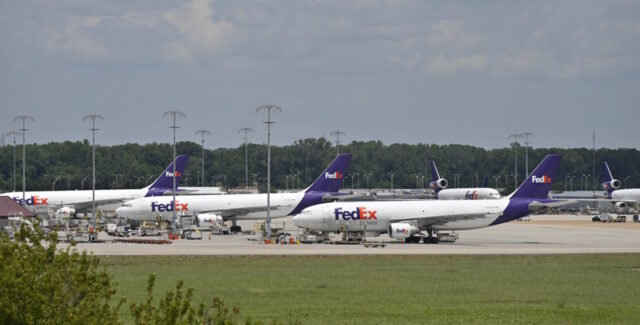
The landscape of American trade underwent a seismic shift in February 2026, when the United States Supreme Court issued a 6-3 ruling that dismantled a sweeping “reciprocal” tariff regime. In the wake of this landmark decision, FedEx—one of the world’s largest logistics providers—has officially joined a massive corporate coalition in suing the federal government. Seeking a “full refund” of duties paid under a policy now deemed unconstitutional, FedEx’s legal action highlights a multi-billion-dollar tug-of-war between the private sector and the Treasury.
The Spark: A Courtroom Defeat for Emergency Powers
The controversy centers on President Donald Trump’s use of the International Emergency Economic Powers Act (IEEPA) to impose aggressive tariffs on nearly every country that trades with the U.S. In February 2025, the administration invoked national security concerns to impose these duties, expanding them in April to include a “reciprocity” tax aimed at leveling the playing field with 57 nations.
However, the Supreme Court ruled in Learning Resources, Inc. v. Trump that the president overstepped his executive authority. The court clarified that while the IEEPA allows for freezing assets or restricting trade during emergencies, it does not grant the executive branch the unilateral power to impose broad taxes—a power the Constitution reserves strictly for Congress.
FedEx Enters the Fray
On Monday, February 23, 2026, FedEx filed its complaint in the U.S. Court of International Trade (CIT). By doing so, it joins a list of more than 1,000 companies—including Costco, Revlon, and DoorDash—that are demanding their money back.

FedEx’s position is unique because of its role as an “importer of record.” The company frequently pays customs duties upfront to expedite shipments through the border, later passing those costs on to recipients. In its filing, FedEx alleged it has “suffered injury” and incurred high administrative costs to manage the complex tariff environment. While the lawsuit does not disclose a specific dollar amount, internal projections from late 2025 suggested the company anticipated a $1 billion hit to its fiscal 2026 earnings due to trade policy volatility.
The Economic Stakes: $175 Billion in Limbo
The scale of the potential refunds is staggering. Federal data shows that as of late 2025, the Treasury had collected more than $133 billion specifically from IEEPA-linked tariffs, with some estimates suggesting the total pool of contested funds could reach $175 billion.
For companies like FedEx, these refunds represent more than just a line item; they are a necessary injection of liquidity to offset a year of shrinking trade lanes. According to FedEx CEO Raj Subramaniam, the company was forced to reduce its trans-Pacific outbound capacity by 25% in 2025 as trade between the U.S. and China cooled. A refund would provide the capital needed to reinvest in automation and “nearshoring” logistics as supply chains move away from China toward Southeast Asia and Mexico.
A Fragmented and Chaotic Refund Process
Despite the Supreme Court victory, the path to a payout is anything but clear. Legal experts, including Duke Law professor Tim Meyer, warn that the government has not yet established a streamlined “portal” or process for these refunds.
| Key Challenge | Description |
| Individual Litigation | Without a government-led refund program, each of the 1,000+ cases may need to be tried individually in the CIT. |
| Administrative Burden | Proving the exact amount paid for specific goods over a year of shipments is a data-heavy nightmare for SMEs. |
| Political Resistance | The White House has signaled it will seek alternative legal paths (such as Section 122 of the Trade Act) to maintain its protectionist stance. |
Furthermore, a significant ethical and logistical question remains: who actually gets the money? While companies paid the tariffs to the government, many passed those costs on to consumers through higher prices. There is currently no mechanism to ensure that a FedEx refund results in a rebate for the small business owner who paid more for their international shipping last July.
The Administration’s Pivot
President Trump has sharply criticized the ruling, calling it “disloyal” and vowing that his trade policy remains unchanged. Almost immediately following the court’s decision, the administration announced a new 10% global tariff—briefly threatened at 15%—under Section 122 of the Trade Act of 1974. This law allows for temporary tariffs of up to 150 days to address “large and serious balance-of-payments deficits.”
While this move provides the administration with a stopgap, trade experts believe these “new” tariffs will also face immediate legal challenges. Shippers are now operating in a state of “perpetual pivot,” attempting to calculate margins in a market where tax rates can change via social media posts.
Conclusion: A Long Road Ahead
FedEx’s lawsuit marks a turning point where corporate America has shifted from compliance to active litigation. As the Court of International Trade begins to process the backlog of claims, the logistics industry will be watching closely. For FedEx, the goal is “redress for injuries” and the return of billions in capital. For the broader economy, the result will determine whether the 2025 trade experiment ends in a massive redistribution of wealth back to the private sector or a years-long stalemate in the federal courts.
Sources and Links
- Associated Press: FedEx joins other US companies in seeking a refund after Trump tariffs are ruled illegal
- The Guardian: FedEx sues US government, seeking ‘full refund’ over Trump tariffs
- Fox Business: FedEx sues Trump administration for full tariff refunds after Supreme Court ruling on IEEPA
- The Loadstar: News: FedEx sues Trump administration for tariff refund
- CFO Brew: FedEx hurt by tariffs in Q1, but sales and profit rose
Disclaimer
Artificial Intelligence Disclosure & Legal Disclaimer
AI Content Policy.
To provide our readers with timely and comprehensive coverage, South Florida Reporter uses artificial intelligence (AI) to assist in producing certain articles and visual content.
Articles: AI may be used to assist in research, structural drafting, or data analysis. All AI-assisted text is reviewed and edited by our team to ensure accuracy and adherence to our editorial standards.
Images: Any imagery generated or significantly altered by AI is clearly marked with a disclaimer or watermark to distinguish it from traditional photography or editorial illustrations.
General Disclaimer
The information contained in South Florida Reporter is for general information purposes only.
South Florida Reporter assumes no responsibility for errors or omissions in the contents of the Service. In no event shall South Florida Reporter be liable for any special, direct, indirect, consequential, or incidental damages or any damages whatsoever, whether in an action of contract, negligence or other tort, arising out of or in connection with the use of the Service or the contents of the Service.
The Company reserves the right to make additions, deletions, or modifications to the contents of the Service at any time without prior notice. The Company does not warrant that the Service is free of viruses or other harmful components.