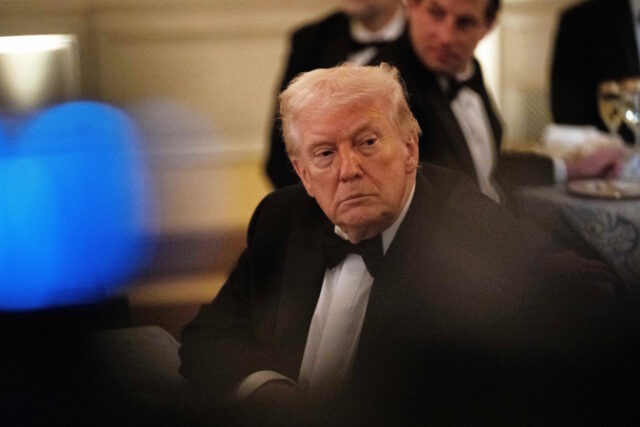
Thirteen months into his second term, President Donald Trump is preparing to walk into the House Chamber on February 24, 2026, to deliver a State of the Union address that may be the most critical of his political career. He does so under a cloud of public dissatisfaction and a significant judicial blow. Just days before the speech, the U.S. Supreme Court struck down a cornerstone of his economic platform—his global tariffs—setting the stage for a high-stakes confrontation between the executive and judicial branches of government.
The Numbers: A Presidency Underwater
As the President finalizes his remarks, a flurry of new polling paints a bleak picture of his standing with the American public. According to the latest Washington Post-ABC News-Ipsos poll released on February 22, Trump’s approval rating has plummeted to 39%, with 60% of Americans expressing disapproval of his performance. Perhaps more concerning for the White House is the intensity of that opposition: 47% of respondents say they “strongly disapprove” of his leadership—the highest such figure since the aftermath of the January 6 Capitol riot.
The decline is not just a general malaise but a specific rejection of key policy pillars. Despite the President’s frequent claims of “winning” on affordability, the public remains unconvinced.
- Inflation: Only 32% of Americans approve of his handling of rising prices.
- The Economy: While 41% approve of his general economic management, nearly half (48%) say the economy has worsened since his January 2025 inauguration.
- Immigration: Despite a central campaign focus on mass deportations, his approval on immigration has slipped to 40%, with 58% of the public indicating they believe current enforcement tactics go “too far.”
The “Independents” Problem
For a president eyeing the 2026 midterm elections, the most alarming data point lies with independent voters. A CNN/SSRS poll conducted in mid-February found that Trump’s approval among independents has cratered to 26%, a 15-point drop from this time last year. Without the support of the center, the Republican Party’s slim four-seat margin in the House appears increasingly precarious.

Even within his own party, there are visible “cracks in the armor.” Pew Research reports that while Republican support remains high at 73%, the share of Republicans who believe Trump acts ethically in office has dropped from 55% last year to 42% today.
A Judicial Wall: The Tariff Reversal
The timing of the State of the Union could not be more fraught. On February 20, the Supreme Court ruled 6-3 to strike down the President’s global tariffs, which he had imposed under the International Emergency Economic Powers Act. The Court held that such sweeping trade measures require explicit congressional approval, a move that effectively guts a primary tool of Trump’s “America First” trade policy.
Sources close to the White House suggest the President will use the podium to directly challenge the Court’s ruling. In a recent rally in Georgia, Trump signaled his mood, calling the judicial resistance a barrier to “affordability” and suggesting that he, not the courts, understands the economic needs of the “forgotten man.”
What to Expect: Defiance Over Diplomacy
Policy experts from Brookings and the Council on Foreign Relations anticipate a speech that leans heavily into populism rather than bipartisan outreach. Given that 57% of Americans believe the “state of the union” is currently not strong, Trump is expected to pivot toward a narrative of “historic successes” being sabotaged by “deep state” actors and judicial overreach.
The Democratic response, to be delivered by Virginia Governor Abigail Spanberger, is expected to capitalize on these polling lows, framing the administration as “out of touch” with the average family’s cost-of-living concerns.
As the nation tunes in on Tuesday night, the President won’t just be speaking to the lawmakers in the room; he will be fighting to reclaim a narrative that, according to the data, is rapidly slipping through his fingers.
Sources and Links
- Washington Post/ABC News/Ipsos: 60% disapprove of Trump ahead of State of the Union
- NPR/PBS News/Marist: Poll: Most say the state of the union is not strong
- CNN/SSRS Polling: Trump’s approval rating with independents hits a new low
- Pew Research Center: Confidence in Trump Dips in 2026
- Council on Foreign Relations: Donald Trump Delivers the State of the Union Address Tuesday Night
- Littler Workplace Policy Institute: Supreme Court Strikes Down President Trump’s Tariffs
- Gallup Interactive: Presidential Job Approval Center
Disclaimer
Artificial Intelligence Disclosure & Legal Disclaimer
AI Content Policy.
To provide our readers with timely and comprehensive coverage, South Florida Reporter uses artificial intelligence (AI) to assist in producing certain articles and visual content.
Articles: AI may be used to assist in research, structural drafting, or data analysis. All AI-assisted text is reviewed and edited by our team to ensure accuracy and adherence to our editorial standards.
Images: Any imagery generated or significantly altered by AI is clearly marked with a disclaimer or watermark to distinguish it from traditional photography or editorial illustrations.
General Disclaimer
The information contained in South Florida Reporter is for general information purposes only.
South Florida Reporter assumes no responsibility for errors or omissions in the contents of the Service. In no event shall South Florida Reporter be liable for any special, direct, indirect, consequential, or incidental damages or any damages whatsoever, whether in an action of contract, negligence or other tort, arising out of or in connection with the use of the Service or the contents of the Service.
The Company reserves the right to make additions, deletions, or modifications to the contents of the Service at any time without prior notice. The Company does not warrant that the Service is free of viruses or other harmful components.