Written by James McIntosh — Fact checked by Jill Seladi-Schulman, Ph.D.
Researchers believe that they have identified a biological “bridge” between age-related hearing loss and cognitive decline.
While scientists have previously been aware of a link between hearing and the risk of cognitive decline, there has been uncertainty around what mechanisms might be behind it.
The new study, published in eNeuro, takes a step toward understanding after examining the brains of people with presbycusis, a form of age-related hearing loss.

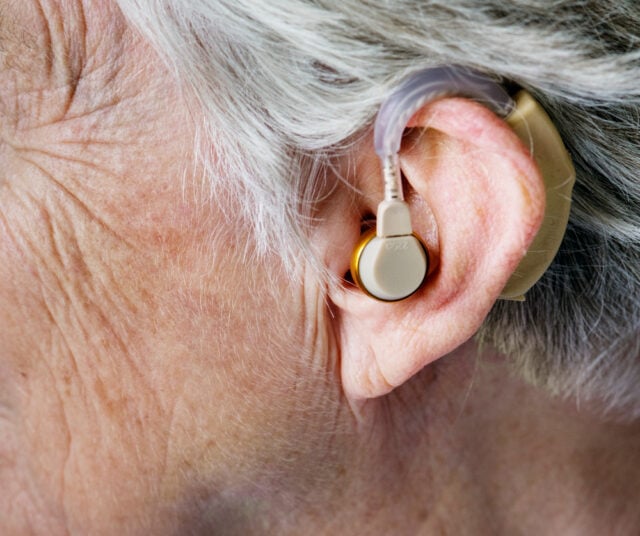
Presbycusis is the most common causeTrusted Source of hearing loss worldwide and affects an estimated two-thirds of Americans aged 70 and above.
It affects both ears and is marked by a reduced ability to understand parts of speech that involve high frequencies: Voiceless consonant sounds that we make without use of our vocal cords like “ch,” “f,” and “p.”
Previous studies have examined connectionsTrusted Source between hearing loss and changes in the structure of the brain as well as how the brain is functioning. They have noted these structural and functional changes in people with presbycusis have a close association with cognitive decline.
However, when it comes to this form of hearing loss, researchers have not fully investigated the combination of these functional and structural changes together, which is where this new study comes in.
What did the researchers measure?
The study set out to compare 55 participants with presbycusis with 55 control participants. All participants were aged between 50 and 74 years.
Among the participants with presbycusis, 35 had mild hearing loss, 19 had moderate hearing loss, and 1 had severe hearing loss.
The researchers used magnetic resonance imaging (MRI) to examine the brains of the participants. They also got the participants to complete tests to assess their hearing as well as their cognitive functioning.
As the aim of the study was to investigate the effects of the relationship between brain structure and function, the researchers devised a measurement called functional-structural ratio (FSR) in the following way:
- they used a measurement of brain activity called amplitude of low-frequency fluctuations (ALFF) to assess how the brain was functioning in a particular area
- they looked at the volume of gray matter to assess the structure of the brain in a particular area
- They calculated the FSR by dividing the average ALFF signal by the average gray matter volume.
Among the people with presbycusis, the researchers found that worse performances in the hearing loss and speech recognition tests were associated with lower FSR scores in certain parts of the brain.
FSR reduction in the same brain areas was also associated with lower scores in a number of cognitive tests, including those assessing audio-verbal learning and decision-making.
These parts of the brain were:
- the putamen and fusiform gyrus, which play a role in processing sounds
- the precuneus and medial superior frontal gyrus, which play a role in decision-making and memory.
“Crucially, reduced FSR correlates with both worsening hearing thresholds and cognitive impairment,” wrote the authors. “This highlights FSR as a key neurobiological link between hearing loss and cognitive decline.”
How cognitive problems and hearing loss are linked
The authors believe that this study is the first to analyze the coupling of functional and structural changes in specific regions of the brain for people with presbycusis.
“This provides the first direct neurobiological evidence linking hearing loss to cognitive decline via shared neural reorganization,” they wrote.
As the study looked at the participants’ brains at a specific moment in time, the authors are unable to determine whether it is pre-existing changes in the brain that lead to hearing loss or if it is the loss of hearing that leads to changes in how the brain is structured and functions.
The authors now aim to validate their findings through further studies, but in the meantime they believe that their research could have future implications for patient care.
“The most important takeaway is that preserving hearing health may protect brain integrity,” said Ning Li, one of the study authors based in Shandong Provincial Hospital, China, in a press release.
“Because changes in the FSR correlate with both hearing loss and cognitive decline, this ratio could eventually serve as a biomarker—a tool for doctors to identify who is at the highest risk for dementia simply by looking at their brain scans,” Li added.
Medical News Today spoke with Steve Allder, MD, a consultant neurologist at Re:Cognition Health in London in the United Kingdom, who was not involved with the study. Allder told us that a new biomarker here could be highly valuable.
“It would allow early detection of at-risk individuals before symptoms appear, guide personalized interventions, and improve understanding of how sensory decline contributes to dementia. Such a marker could also track progression or treatment response, making dementia care more proactive.”
We also spoke with Courtney Voelker, MD, PhD, a board-certified neurotologist at Providence Saint John’s Health Center in Santa Monica, CA, who was also uninvolved with the study. Voelker mentioned how treating hearing loss early could make a significant difference to people’s cognitive functioning.
“When we treat patients’ hearing loss with hearing aids or cochlear implants (depending on the severity of hearing loss), cognition increases and social isolation and depression decrease,” she said.
On the other hand, she added, “untreated hearing loss can lead to social isolation, depression, anxiety, loss of employment, and can contribute to cognitive decline. “
Disclaimer
Artificial Intelligence Disclosure & Legal Disclaimer
AI Content Policy.
To provide our readers with timely and comprehensive coverage, South Florida Reporter uses artificial intelligence (AI) to assist in producing certain articles and visual content.
Articles: AI may be used to assist in research, structural drafting, or data analysis. All AI-assisted text is reviewed and edited by our team to ensure accuracy and adherence to our editorial standards.
Images: Any imagery generated or significantly altered by AI is clearly marked with a disclaimer or watermark to distinguish it from traditional photography or editorial illustrations.
General Disclaimer
The information contained in South Florida Reporter is for general information purposes only.
South Florida Reporter assumes no responsibility for errors or omissions in the contents of the Service. In no event shall South Florida Reporter be liable for any special, direct, indirect, consequential, or incidental damages or any damages whatsoever, whether in an action of contract, negligence or other tort, arising out of or in connection with the use of the Service or the contents of the Service.
The Company reserves the right to make additions, deletions, or modifications to the contents of the Service at any time without prior notice. The Company does not warrant that the Service is free of viruses or other harmful components.