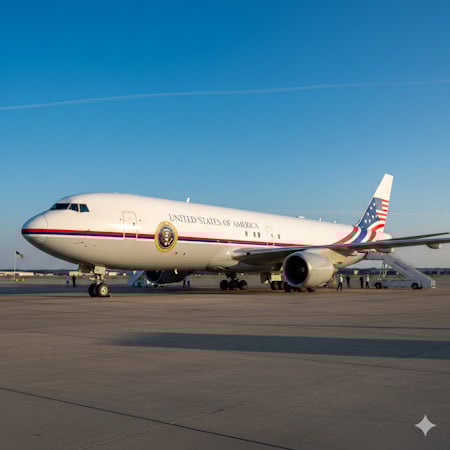
The Master Plan: Project “Stars and Stripes”
Painting the “Flying Oval Office” is more than a maintenance task; it is a high-stakes diplomatic and engineering feat. When moving from the classic “Kennedy Blue” to a bolder red, white, and blue palette, the project must balance national identity with rigorous technical requirements.
1. Phase I: Design and Aerodynamic Modeling
The first step involves finalizing the “livery” (the aircraft’s paint scheme). While the goal is a red, white, and blue motif, the placement of these colors is critical. Darker colors, particularly on the upper fuselage, can increase solar heat absorption, potentially stressing the aircraft’s cooling systems while on the tarmac.
- Design Selection: Utilizing a “Z-scheme” or a “sweeping flag” motif that maintains a primarily white upper fuselage for heat reflection.
- Digital Twin Testing: Using Computational Fluid Dynamics (CFD) to ensure that the pigment weight and placement do not disrupt the aircraft’s center of gravity or drag coefficients.
2. Phase II: Facilities and Environment
The painting of a Boeing 747-8 (the base for the VC-25B) requires a specialized, climate-controlled hangar.
- Location: Likely a Boeing facility in San Antonio, Texas, or a high-security military installation.
- Environmental Controls: Temperature must be maintained between 65°F and 80°F with humidity strictly regulated to ensure proper paint adhesion and “cure” times.
3. Phase III: Surface Preparation (The “Strip”)
You cannot simply paint over old layers; the weight would be prohibitive.

- Chemical Stripping: Eco-friendly chemical agents are used to remove existing paint down to the bare aluminum or composite skin.
- Inspection: Once “naked,” the airframe undergoes Non-Destructive Inspection (NDI) to check for hairline fractures, corrosion, or lightning strike damage.
- Sanding: Mechanical sanding ensures a “mechanical bond” for the new primer.
4. Phase IV: The Painting Process
This is a multi-stage application using specialized aerospace coatings (typically high-solids polyurethanes).
| Layer | Purpose | Key Detail |
| Pre-treatment | Corrosion inhibition | Chromate-free conversion coating. |
| Primer | Adhesion | Essential for the paint to stick at Mach 0.85. |
| Base Coat (White) | The Canvas | Usually a high-reflectivity “Insignia White.” |
| Color Application | Red and Blue | Masking off the “Cheatlines” and the iconic Tail Flash. |
| Clear Coat | Protection | Provides the “wet look” and protects against UV radiation at 45,000 feet. |
5. Phase V: Technical Markings and Emblems
The “United States of America” text and the Presidential Seal are applied using high-precision stencils.
- The Seal: Hand-painted or high-durability decals applied to the door-surrounding areas.
- The Flag: Traditionally, the American flag on the tail is painted so the union (the stars) faces forward, symbolizing the nation moving toward the future.
6. Phase VI: Weight and Balance Recalibration
Paint on a 747-8 can weigh upwards of 600 to 1,000 pounds.
- Re-weighing: After the paint is cured, the aircraft is placed on massive scales.
- Documentation: The exact weight is logged into the flight management system to ensure precision in fuel calculations and takeoff performance.
Strategic Considerations
- Heat Management: A darker blue belly is acceptable, but a dark roof is a cooling liability. Our plan utilizes a “Cool Roof” white top.
- Durability: The paint must withstand temperature fluctuations from -60°F at altitude to 120°F on desert runways.
Sources and Research Links
- Boeing Defense: VC-25B Program Overview
- U.S. Air Force: Fact Sheet: VC-25A/B
- Federal Aviation Administration (FAA): Advisory Circular 43.13-1B (Aircraft Painting and Finishing)
- General Services Administration (GSA): Federal Standard 595C (Colors used in Government Procurement)
Disclaimer
Artificial Intelligence Disclosure & Legal Disclaimer
AI Content Policy.
To provide our readers with timely and comprehensive coverage, South Florida Reporter uses artificial intelligence (AI) to assist in producing certain articles and visual content.
Articles: AI may be used to assist in research, structural drafting, or data analysis. All AI-assisted text is reviewed and edited by our team to ensure accuracy and adherence to our editorial standards.
Images: Any imagery generated or significantly altered by AI is clearly marked with a disclaimer or watermark to distinguish it from traditional photography or editorial illustrations.
General Disclaimer
The information contained in South Florida Reporter is for general information purposes only.
South Florida Reporter assumes no responsibility for errors or omissions in the contents of the Service. In no event shall South Florida Reporter be liable for any special, direct, indirect, consequential, or incidental damages or any damages whatsoever, whether in an action of contract, negligence or other tort, arising out of or in connection with the use of the Service or the contents of the Service.
The Company reserves the right to make additions, deletions, or modifications to the contents of the Service at any time without prior notice. The Company does not warrant that the Service is free of viruses or other harmful components.