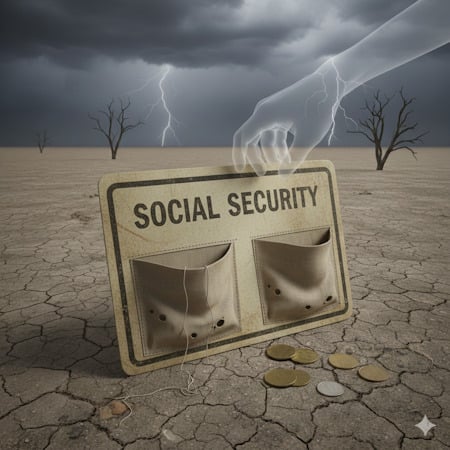
The coffers that fund Social Security’s retirement payments are running dry faster than expected.
An economic outlook released Wednesday by the nonpartisan Congressional Budget Office has determined that Social Security’s Old Age and Survivors Insurance trust fund will become insolvent by 2032, one year sooner than last estimated.
This impacts one of two major trust funds that fuels Social Security payments. The dwindling reserve is earmarked for benefits to retirees and immediate family members of deceased workers, accounting for over 62 million Americans, or about 90% of all Social Security beneficiaries. The remaining beneficiaries receive disability benefits funded by a separate trust.
But experts say that’s a pretty big if — and the financial woes besetting Social Security sound a lot scarier than they really are.

Is Social Security really going bankrupt?
About a third of Americans say they believe Social Security won’t be there for them when they retire, according to a December survey from the CATO Institute, a libertarian think tank.
These fears are stoked by the idea that Social Security is going bankrupt. But economist Stephen Nuñez argues that the word “bankrupt” is misleading and isn’t a good way to think about what’s happening with Social Security.
“There is no bankruptcy or collapse in the cards,” Nuñez, an economic director at the liberal-leaning Roosevelt Institute, wrote in a recent report.
That’s because, experts say, even if Social Security’s trust funds were fully depleted, about 80% of Social Security benefits would continue to flow because they are funded in real time through payroll taxes. And that scenario assumes Congress ignores the issue.
“Even if nothing is done, people will continue to receive the bulk of their benefits,” Alicia Munnell, founder of the Center for Retirement Research at Boston College, wrote last May. “No one, however, wants to see an immediate 20% across-the-board benefit cut in Social Security retirement benefits.”
Social Security is extremely popular regardless of political affiliation, leading Nuñez to find it unlikely that lawmakers will simply let Social Security fall into insolvency.
He noted that Social Security faced a similar shortfall in the 1980s, and lawmakers rallied to pass reforms in 1983. Those changes were supposed to ensure decades of financial stability until 2058. However, the Great Recession and increased income inequality have changed the calculus the reforms were built upon, and Social Security is in need of a legislative tweak again.
Some popular fixes include subjecting wages over $400,000 to the payroll tax, gradually increasing the retirement age, and reducing benefits for top earners.
Nuñez said finding the best fix — “rather than predictions of doom and gloom” — should be the focus.
Disclaimer
Artificial Intelligence Disclosure & Legal Disclaimer
AI Content Policy.
To provide our readers with timely and comprehensive coverage, South Florida Reporter uses artificial intelligence (AI) to assist in producing certain articles and visual content.
Articles: AI may be used to assist in research, structural drafting, or data analysis. All AI-assisted text is reviewed and edited by our team to ensure accuracy and adherence to our editorial standards.
Images: Any imagery generated or significantly altered by AI is clearly marked with a disclaimer or watermark to distinguish it from traditional photography or editorial illustrations.
General Disclaimer
The information contained in South Florida Reporter is for general information purposes only.
South Florida Reporter assumes no responsibility for errors or omissions in the contents of the Service. In no event shall South Florida Reporter be liable for any special, direct, indirect, consequential, or incidental damages or any damages whatsoever, whether in an action of contract, negligence or other tort, arising out of or in connection with the use of the Service or the contents of the Service.
The Company reserves the right to make additions, deletions, or modifications to the contents of the Service at any time without prior notice. The Company does not warrant that the Service is free of viruses or other harmful components.