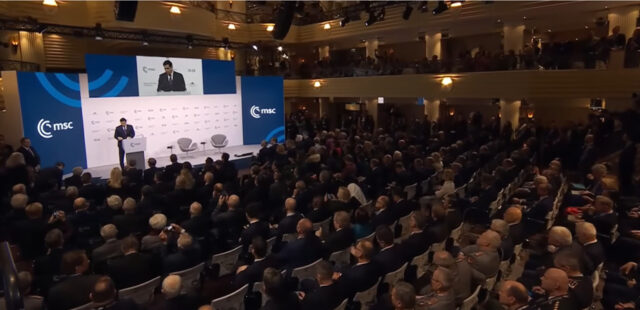
MUNICH — Speaking before a hall of world leaders at the 2026 Munich Security Conference (MSC), U.S. Secretary of State Marco Rubio delivered a high-stakes address that sought to bridge the widening chasm between Washington and its oldest allies. Describing the United States as a “child of Europe,” Rubio paired a conciliatory tone with a firm ultimatum: the era of “managed decline” is over, and the survival of Western civilization depends on a restructured alliance built on strength, not dependency.
Video provided by YS Department of State
A Civilizational Bond
Rubio’s central theme was the shared heritage of the West. He argued that the bond between America and Europe is not merely a clinical calculation of national interests but a spiritual and cultural connection. “Armies do not fight for abstractions,” Rubio declared. “They fight for a people, a nation, and a way of life. That is what we are defending: a great civilization that has every reason to be proud of its history and confident of its future.”
He explicitly rejected the notion of a “transatlantic divorce,” calling such rumors neither the “goal nor the wish” of the administration. However, he warned that the “euphoria” following the Cold War had led to a “dangerous delusion” that trade and international institutions could replace the nation-state.

Confronting the “Climate Cult” and Migration
The most friction-heavy portion of Rubio’s address targeted what he described as the internal “malaises” of the West. He took aim at European energy and environmental policies, labeling them the product of a “climate cult” that prioritized carbon abstractions over industrial survival.
“We want an alliance that is not paralyzed into inaction by fear—fear of climate change, fear of war, fear of technology,” Rubio stated. He argued that aggressive green mandates had “shackled” Western ingenuity and offshored productive capacity to rivals like China, effectively “funding our own obsolescence.”
Equally blunt was his assessment of migration. Framing it as a crisis of “civilizational erasure,” Rubio argued that mass migration had become a destabilizing force that threatened the social cohesion and cultural continuity of European nations. He insisted that border security is not a “fringe concern” but a prerequisite for any sovereign state wishing to remain an ally.
The Rebuttals: Europe’s “Shock Therapy”
The response from European leaders was immediate and multifaceted, ranging from diplomatic relief to sharp ideological rejection.
- Ursula von der Leyen (EU Commission President): While she admitted to being “reassured” by Rubio’s softer tone compared to previous administration officials, she maintained that “some lines have been crossed that cannot be uncrossed.” She noted that while U.S. “shock therapy” had successfully awakened Europe to its defense needs, the continent would now pursue “strategic autonomy” to ensure it is never again at the mercy of Washington’s political “whims.”
- Friedrich Merz (German Chancellor): Merz delivered the most direct rebuttal to Rubio’s cultural framing. “The culture wars of the MAGA movement are not ours,” Merz said, emphasizing that Germany’s commitment to human dignity and constitutional protections would not be traded for populist rhetoric. He further warned that the U.S. is “not strong enough to go it alone” in a fractured world.
- Emmanuel Macron (French President): Macron took issue with the characterization of Europe as a continent in decline. He argued that Europe had been “vilified” as a place of unfettered immigration and emphasized that the EU would continue to “de-risk” its economy not just from China, but from all big powers, to protect its own sovereignty.
- Keir Starmer (British Prime Minister): Starmer cautioned colleagues against falling into a “warm bath of complacency” due to Rubio’s polite delivery. He urged a “more European NATO” that relies on hard power rather than American reassurances.
Ukraine and the “Board of Peace”
Regarding the war in Ukraine, Rubio focused on “problem-solving,” highlighting President Trump’s “Board of Peace” as a pragmatic alternative to stalled diplomatic channels. While he expressed skepticism about Moscow’s sincerity, he confirmed the U.S. would “continue to test” whether a viable peace settlement exists. The speech signaled a shift from unconditional aid to a goal-oriented strategy aimed at ending the conflict.
Sources and Links
- U.S. Department of State: Secretary of State Calls on European Leaders to Defend Western Civilization
- The Washington Post: Rubio says U.S., Europe ‘belong together,’ despite rifts over Trump policies
- Courthouse News: Rubio offers olive branch to rattled European allies, but with conditions
- The Guardian: Rubio tells Europe US wants renewed alliance – but on Trump’s terms
- Atlantic Council: What Rubio said in Munich, what Europe heard, and what comes next
- Responsible Statecraft: Rubio’s spoonful of sugar helps hard medicine go down in Munich
- Breaking Defense: Rubio tries to reassure Europe that US is not about to sever transatlantic ties
Disclaimer
Artificial Intelligence Disclosure & Legal Disclaimer
AI Content Policy.
To provide our readers with timely and comprehensive coverage, South Florida Reporter uses artificial intelligence (AI) to assist in producing certain articles and visual content.
Articles: AI may be used to assist in research, structural drafting, or data analysis. All AI-assisted text is reviewed and edited by our team to ensure accuracy and adherence to our editorial standards.
Images: Any imagery generated or significantly altered by AI is clearly marked with a disclaimer or watermark to distinguish it from traditional photography or editorial illustrations.
General Disclaimer
The information contained in South Florida Reporter is for general information purposes only.
South Florida Reporter assumes no responsibility for errors or omissions in the contents of the Service. In no event shall South Florida Reporter be liable for any special, direct, indirect, consequential, or incidental damages or any damages whatsoever, whether in an action of contract, negligence or other tort, arising out of or in connection with the use of the Service or the contents of the Service.
The Company reserves the right to make additions, deletions, or modifications to the contents of the Service at any time without prior notice. The Company does not warrant that the Service is free of viruses or other harmful components.