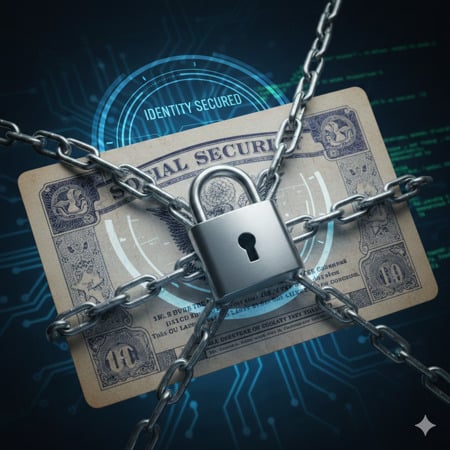
For decades, the standard advice for identity protection was simple: freeze your credit. By locking your files at Equifax, Experian, and TransUnion, you could effectively prevent scammers from opening new loans or credit cards in your name. However, as cybercriminals become more sophisticated—leveraging AI-powered tools and massive troves of leaked data—the vulnerabilities have shifted. Today, your Social Security Number (SSN) is being targeted not just for financial credit, but for employment fraud and government benefit diversion.
As recently highlighted by Kiplinger, simply “guarding” your nine-digit number is no longer enough in a world where a cyberattack occurs every 39 seconds. To truly protect your future, you must transition from a passive defense to an active one. This means utilizing government-sanctioned “locks” to secure your SSN at the source.
The Evolution of the Threat
Your Social Security number was never intended to be the master key to your entire digital and financial life. Yet, it has become exactly that. While a credit freeze stops a thief from buying a car in your name, it does nothing to stop them from using your SSN to get a job or hijack your retirement benefits.
According to Kiplinger, “Locking your SSN is a strategic move that shuts down the two most common avenues for fraud: illegal employment and unauthorized access to your government records.” If a scammer uses your number to gain employment, the IRS may see unreported income on your profile, leading to grueling audits and tax complications. Even worse, if a criminal gains access to your Social Security Administration (SSA) account, they could potentially redirect your future benefits to their own bank account.

The Two Keys to the Lock
Because there is no single “on/off” switch for an SSN, you must utilize two distinct features provided by the federal government to achieve a result similar to a credit freeze.
1. The E-Verify “Self Lock” Managed by the Department of Homeland Security, the E-Verify system is used by millions of employers to confirm a candidate’s eligibility to work in the United States. By using the “Self Lock” feature through a myE-Verify account, you prevent anyone—including a scammer—from passing an employment background check using your SSN.
This lock lasts for one year and must be renewed annually. It is a critical barrier against employment identity theft. If you are actually applying for a new job, you simply log in and temporarily “thaw” the lock, much like you would with a credit report.
2. The SSA “Electronic Access Block” While the E-Verify lock protects your employment history, the SSA’s Electronic Access Block protects your actual government records. When you activate this block, you prevent anyone from accessing or changing your Social Security information online or via the automated phone system.
Kiplinger notes that this is an aggressive but effective measure: “When you do this, no one, including you, will be able to see or change your personal information.” To make changes or check benefits, you would need to visit a Social Security office in person or speak to a live agent and provide rigorous proof of identity. This “digital deadbolt” is the ultimate defense against account takeover.
Building Your “Identity Fortress”
Securing your identity in 2026 requires a multi-layered approach. Experts suggest a specific order of operations to ensure you don’t lock yourself out of your own accounts before they are properly set up.
First, create and verify your “my Social Security” account at SSA.gov using secure portals like Login.gov or ID.me. Doing this early ensures that you—and not a scammer—claim your digital identity. Only after this account is established should you contact the SSA to request the Electronic Access Block.
Once the government records are secure, you should move to the “financial firewall” by freezing your credit with the three major bureaus and requesting an Identity Protection PIN (IP PIN) from the IRS. This six-digit code serves as a secondary password for your tax return, helping prevent fraudulent filings.
A Commitment to Digital Well-Being
The shift from “monitoring” to “locking” represents a fundamental change in how Americans must view their personal data. We are no longer in an era where we can afford to be reactive. Waiting for a notification of a suspicious login or a letter from the IRS often means the damage has already been done.
As Kiplinger concludes, “In a world where identity is the new currency, a locked SSN ensures that you are the only one authorized to spend it.” Taking an afternoon to navigate these government portals and phone lines might feel like a bureaucratic hurdle, but the peace of mind it provides is a necessary component of modern financial health. By building your “identity fortress” today, you ensure that your retirement benefits, tax refunds, and credit reputation remain firmly in your own hands.
Source: Kiplinger
Disclaimer
Artificial Intelligence Disclosure & Legal Disclaimer
AI Content Policy.
To provide our readers with timely and comprehensive coverage, South Florida Reporter uses artificial intelligence (AI) to assist in producing certain articles and visual content.
Articles: AI may be used to assist in research, structural drafting, or data analysis. All AI-assisted text is reviewed and edited by our team to ensure accuracy and adherence to our editorial standards.
Images: Any imagery generated or significantly altered by AI is clearly marked with a disclaimer or watermark to distinguish it from traditional photography or editorial illustrations.
General Disclaimer
The information contained in South Florida Reporter is for general information purposes only.
South Florida Reporter assumes no responsibility for errors or omissions in the contents of the Service. In no event shall South Florida Reporter be liable for any special, direct, indirect, consequential, or incidental damages or any damages whatsoever, whether in an action of contract, negligence or other tort, arising out of or in connection with the use of the Service or the contents of the Service.
The Company reserves the right to make additions, deletions, or modifications to the contents of the Service at any time without prior notice. The Company does not warrant that the Service is free of viruses or other harmful components.