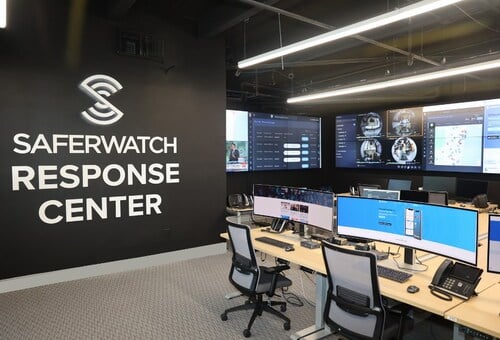
The arrest of Geno Roefaro, the owner and CEO of SaferWatch, on federal bribery charges in New York has sent a “panic button” alert across Florida’s law enforcement and educational landscape. For years, SaferWatch has been marketed as a gold standard for campus safety, providing the silent, mobile panic alert systems required by 2020’s Alyssa’s Law. However, as federal prosecutors unveil allegations of high-level corruption, the deep-seated relationships between Roefaro and some of Florida’s most powerful public officials are coming under intense scrutiny.
 According to investigative reporting by The Florida Bulldog, the impact of the New York arrest is “reverberating across Florida, but most urgently in Broward, Miami-Dade and Palm Beach.” The core of the scandal involves allegations that Roefaro used bribes to secure lucrative government contracts. While the initial charges stem from dealings in New York, the sheer volume of “testimonials” and “partnerships” Roefaro cultivated in Florida has raised a haunting question: Were Florida’s public officials also paid to praise the product?
A Commercial for Corruption?
Perhaps no figure is more intertwined with SaferWatch than Broward Sheriff Dr. Gregory Tony. As The Florida Bulldog reports, Sheriff Tony “did more than give SaferWatch a blurb.” He reportedly used the Broward Sheriff’s Office (BSO) resources to create what amounted to a “two-minute commercial endorsement” for the app. In the video, Tony appears in full uniform, surrounded by BSO branding, urging the public to download the app and “become a part of the safety solution.”
The relationship was not merely promotional; it was financial. Election records cited by The Florida Bulldog reveal that Tony received tens of thousands of dollars in campaign contributions from Roefaro for his political action committee, Broward First. The most recent check, totaling $10,000, was reportedly cut in August 2024. These contributions, coupled with Tony’s heavy promotion of the app at religious institutions and schools, have created an optical nightmare for the Sheriff’s Office.

Superintendents and Chiefs Under Fire
The panic is not limited to BSO. Broward Public Schools Superintendent Dr. Howard Hepburn also lent his voice and authority to the brand, appearing on the company’s website with a quote urging “school stakeholders” to download the mobile app. Similarly, Miami-Dade Schools Police Chief Ivan Silva and Palm Beach County Public Schools Chief of Police Dan Alexander provided glowing endorsements, framing the app as a “crucial layer of protection” for students and staff.
As The Florida Bulldog aptly notes, “the line-up of testimonials by public officials that Roefaro managed to obtain… isn’t confined to Sheriff Tony and Superintendent Hepburn.” The list of those who “lent their names and prestige” includes police chiefs from Fort Lauderdale, Sunrise, Davie, Wilton Manors, Coral Gables, and Pinecrest, as well as sheriffs from Volusia, Clay, and Santa Rosa counties. In many of these promotional materials, the officials are pictured in their taxpayer-funded uniforms, effectively using the authority of their office to benefit a private, for-profit business.
The Alyssa’s Law Connection
SaferWatch rose to prominence largely due to Alyssa’s Law, named after Alyssa Alhadeff, a victim of the Marjory Stoneman Douglas High School shooting. The law mandates that every Florida school have a silent panic alarm connected to law enforcement. SaferWatch positioned itself as the premier solution for this mandate.
However, with the CEO now accused of using “tens of thousands of dollars in cash and gifts, including luxury hotel lodging, a helicopter tour and Broadway tickets” to win contracts in New York, the integrity of these school safety contracts in Florida is being questioned. Critics argue that if contracts were awarded based on political donations or personal perks rather than the technical merit of the software, the safety of Florida’s children may have been used as a bargaining chip.
The Fallout and the Future
In the wake of the arrest, many of the officials listed on the SaferWatch “client” page have gone silent or are moving to scrub their associations with the company. The central inquiry remains: did the “pay-to-play” model alleged in New York migrate south to the Sunshine State?
As investigative journalists and federal authorities continue to peel back the layers of Roefaro’s business dealings, the “panic” described by The Florida Bulldog is unlikely to subside. For the parents, teachers, and citizens of Florida, the scandal is a sobering reminder of how easily the noble cause of public safety can be compromised by the lure of corporate influence and political back-scratching.
The question is no longer just about whether the app works, but whether the officials who sold it to the public were serving their constituents or their contributors. As the investigation widens, Florida’s law enforcement leaders may find that the very “panic button” they promoted has now been pressed on their own careers.
Source: FloridaBulldog
Disclaimer
Artificial Intelligence Disclosure & Legal Disclaimer
AI Content Policy.
To provide our readers with timely and comprehensive coverage, South Florida Reporter uses artificial intelligence (AI) to assist in producing certain articles and visual content.
Articles: AI may be used to assist in research, structural drafting, or data analysis. All AI-assisted text is reviewed and edited by our team to ensure accuracy and adherence to our editorial standards.
Images: Any imagery generated or significantly altered by AI is clearly marked with a disclaimer or watermark to distinguish it from traditional photography or editorial illustrations.
General Disclaimer
The information contained in South Florida Reporter is for general information purposes only.
South Florida Reporter assumes no responsibility for errors or omissions in the contents of the Service. In no event shall South Florida Reporter be liable for any special, direct, indirect, consequential, or incidental damages or any damages whatsoever, whether in an action of contract, negligence or other tort, arising out of or in connection with the use of the Service or the contents of the Service.
The Company reserves the right to make additions, deletions, or modifications to the contents of the Service at any time without prior notice. The Company does not warrant that the Service is free of viruses or other harmful components.