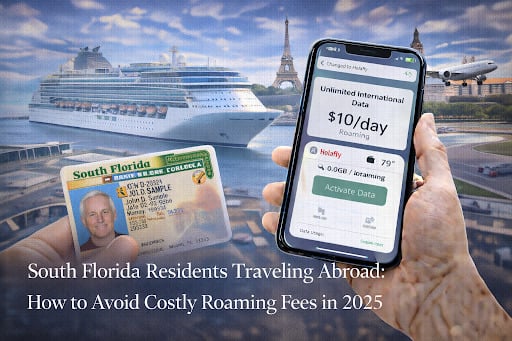
South Florida has long been one of the most internationally connected regions in the United States. With major cruise ports in Miami and Fort Lauderdale, busy international airports, and a culturally diverse population with ties across Latin America, Europe, and the Caribbean, residents travel abroad more frequently than many other Americans. Whether it’s a Mediterranean cruise, a family visit overseas, or a business trip to Europe, international travel is part of everyday life for many South Floridians.
But while flights and accommodations are often planned well in advance, one detail is frequently overlooked: mobile connectivity. And in 2025, overlooking it can mean returning home to an unexpectedly high phone bill.
The Hidden Cost of International Roaming
Many travelers assume their domestic mobile plan will “just work” abroad. Technically, it often does. However, international roaming can come with significant fees, particularly for data usage. Checking maps, uploading photos, or streaming short videos can quickly consume data—sometimes without the user realizing how much is being used.
Roaming charges vary by country and carrier, but even moderate usage can add hundreds of dollars in additional costs. For retirees on fixed incomes or families traveling on a budget, these surprise charges can disrupt carefully planned expenses.

Data consumption today is far higher than it was a decade ago. Smartphones constantly sync email, update apps, and run background processes. Even light browsing can accumulate quickly.
Why Public Wi-Fi Isn’t Always the Solution
To avoid roaming fees, many travelers turn to public Wi-Fi in airports, hotels, cafés, and cruise terminals. While this can reduce mobile data usage, it is not always reliable or secure.
Public networks may have limited coverage, slow speeds, or time restrictions. More importantly, unsecured Wi-Fi can expose personal information to cybersecurity risks. Travelers who check banking apps, access sensitive work emails, or make online purchases may unknowingly put their data at risk.
In destinations with inconsistent Wi-Fi infrastructure, relying solely on public access can limit flexibility. Navigation apps, ride-hailing services, and real-time translation tools often require continuous connectivity.
Why Connectivity Matters More Than Ever
International travel in 2025 looks very different from travel 15 years ago. Mobile data now supports nearly every aspect of the travel experience:
- Navigating unfamiliar cities using GPS-based apps
- Accessing boarding passes and digital tickets
- Booking last-minute reservations
- Staying in contact with family
- Receiving real-time travel alerts
For South Florida residents who frequently travel to multiple countries in a single trip—particularly on cruises—seamless cross-border connectivity becomes even more important.
Without a clear plan, travelers may switch networks repeatedly, triggering roaming charges in each country visited.
Planning Connectivity Before Departure
Just as travelers compare airfare and hotel rates, comparing connectivity options before departure can prevent unnecessary costs. Some mobile carriers offer international packages, but pricing structures can be complex and limited to specific destinations.
In response to these challenges, many travelers are exploring digital-first alternatives that allow them to set up data access before boarding their flight. In this context, options that let travelers get unlimited data with Holafly are increasingly appealing. These types of solutions provide prepaid international data plans that activate digitally, eliminating the need to swap physical SIM cards or rely on roaming.
By securing data coverage in advance, travelers can land at their destination with immediate access to maps, messaging apps, and booking platforms—without worrying about daily usage limits or fluctuating fees.
Who Should Consider a Travel Data Plan?
Certain groups of South Florida residents may benefit especially from planning connectivity in advance.
Retirees visiting family abroad often want consistent communication and easy access to navigation tools.
Business travelers need uninterrupted access to email and conference calls.
Cruise passengers visiting multiple international ports may want continuous data without having to switch plans.
Remote workers and digital entrepreneurs require stable connectivity to maintain productivity while traveling.
For these travelers, peace of mind is often as important as cost savings.
Travel Smart, Travel Prepared
South Florida’s global lifestyle shows no signs of slowing down. As international travel remains strong in 2025, understanding how mobile connectivity works abroad is becoming part of responsible trip planning.
Avoiding surprise roaming charges doesn’t require complicated technical knowledge—just awareness and preparation. By evaluating options before departure, travelers can maintain control over their budget, protect their digital security, and stay connected throughout their journey.
In today’s travel environment, connectivity is not a luxury—it’s infrastructure. And for South Floridians heading overseas, planning ahead may be one of the smartest travel decisions they make this year.
Disclaimer
Artificial Intelligence Disclosure & Legal Disclaimer
AI Content Policy.
To provide our readers with timely and comprehensive coverage, South Florida Reporter uses artificial intelligence (AI) to assist in producing certain articles and visual content.
Articles: AI may be used to assist in research, structural drafting, or data analysis. All AI-assisted text is reviewed and edited by our team to ensure accuracy and adherence to our editorial standards.
Images: Any imagery generated or significantly altered by AI is clearly marked with a disclaimer or watermark to distinguish it from traditional photography or editorial illustrations.
General Disclaimer
The information contained in South Florida Reporter is for general information purposes only.
South Florida Reporter assumes no responsibility for errors or omissions in the contents of the Service. In no event shall South Florida Reporter be liable for any special, direct, indirect, consequential, or incidental damages or any damages whatsoever, whether in an action of contract, negligence or other tort, arising out of or in connection with the use of the Service or the contents of the Service.
The Company reserves the right to make additions, deletions, or modifications to the contents of the Service at any time without prior notice. The Company does not warrant that the Service is free of viruses or other harmful components.