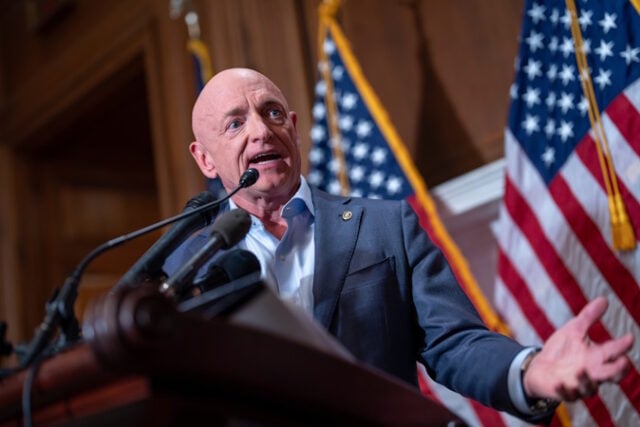
In a landmark decision for military retirees and elected officials alike, Senior U.S. District Judge Richard Leon ruled on February 12, 2026, that the Department of Defense may not move forward with disciplinary actions against Senator Mark Kelly (D-Ariz.). The case, which centered on a video in which Kelly and other veteran lawmakers advised active-duty troops to refuse “illegal orders,” has become a flashpoint for the intersection of military discipline, free speech, and the separation of powers.
Background: The “Illegal Orders” Controversy
The legal battle began in late 2025 after Senator Kelly, a retired Navy captain and astronaut, appeared in a social media video alongside other Democratic lawmakers with military and intelligence backgrounds, including Senator Elissa Slotkin. In the video, the group urged service members to uphold their constitutional oaths and reminded them of their legal right—and duty—to disregard orders that violate the law.
The video drew immediate and fierce condemnation from President Donald Trump, who labeled the statements as “seditious behavior” and suggested they were “punishable by death.” Following this rhetoric, Defense Secretary Pete Hegseth issued a formal Secretarial Letter of Censure against Kelly. Hegseth further initiated proceedings to retroactively demote Kelly from his retired rank of captain, a move that would have significantly reduced his military pension and stripped him of his veteran status as an officer.
The Legal Challenge
Kelly filed suit in January 2026, represented by Benjamin Mizer of Arnold & Porter. The lawsuit argued that the Pentagon’s actions were a clear case of First Amendment retaliation. Specifically, Kelly’s legal team asserted that:

- Free Speech: As a retiree and a civilian senator, Kelly’s political speech is protected by the First Amendment.
- Chilling Effect: Using military law to punish a retired veteran for political speech would create a “chilling effect” on millions of other veterans.
- Separation of Powers: The executive branch was effectively attempting to intimidate a sitting member of the Senate Armed Services Committee for performing his legislative and oversight duties.
The Justice Department countered that military retirees remain subject to the Uniform Code of Military Justice (UCMJ) and can be recalled to active duty for prosecution. They argued that Kelly’s video undermined the chain of command and military discipline.
Judge Leon’s Ruling
Judge Richard Leon, a George W. Bush appointee, was visibly skeptical of the government’s arguments during hearings earlier in the month. In his final 2026 ruling, Leon issued a preliminary injunction blocking the Pentagon from pursuing any further disciplinary or demotion proceedings against Kelly.
“This Court has all it needs to conclude that Defendants have trampled on Senator Kelly’s First Amendment freedoms and threatened the constitutional liberties of millions of military retirees,” Leon wrote in his opinion. Invoking a famous cultural reference to underscore the obvious nature of the retaliation, he added, “After all, as Bob Dylan famously said, ‘You don’t need a weatherman to know which way the wind blows.'”
The judge emphasized that the Pentagon failed to cite a single precedent where speech restrictions on active-duty personnel were legally applied to retired service members expressing political opinions. He noted that Kelly’s speech was not just that of a private citizen, but of an elected official engaging in public discourse on matters of national importance.
The Grand Jury Rejection
The judge’s decision followed another major legal victory for Kelly. Just days prior, on February 10, 2026, a federal grand jury in Washington, D.C., declined to indict Kelly and five other lawmakers on criminal charges related to the same video. Despite pressure from the Department of Justice, the grand jury returned a “no bill,” effectively ending the administration’s attempt to prosecute the lawmakers for sedition or inciting mutiny.
Outside the courthouse, Senator Kelly framed the ruling as a win for the rule of law. “I wore the uniform to defend this country and the Constitution,” Kelly said. “Secretary Hegseth tried to punish me for doing my job as a Senator and for speaking the truth about our laws. Today, the courts reminded this administration that they are not above the Constitution.”
Legal experts suggest this ruling sets a vital precedent. If the Pentagon had succeeded, it would have established that the Executive Branch could use the UCMJ as a tool to silence any of the millions of veterans currently living as civilians, provided they still hold a retired rank.
While the government has five days to appeal the injunction, Judge Leon’s strongly worded opinion suggests a high hurdle for any reversal. For now, the ruling serves as a significant check on the use of military authority to regulate the speech of political opponents.
Sources and Links
- Pentagon Can’t Penalize Mark Kelly Over ‘Illegal Orders’ Video – Bloomberg Law
- Judge picks apart Pentagon defense for Mark Kelly censure – Courthouse News Service
- Grand jury refuses to indict Sen. Mark Kelly in connection with illegal military orders video – KJZZ
- Mark Kelly v. Pete Hegseth | The First Amendment Encyclopedia
- Judge Seems Skeptical of Legal Justification for Pentagon’s Punishment of Sen. Mark Kelly – Military.com
Disclaimer
Artificial Intelligence Disclosure & Legal Disclaimer
AI Content Policy.
To provide our readers with timely and comprehensive coverage, South Florida Reporter uses artificial intelligence (AI) to assist in producing certain articles and visual content.
Articles: AI may be used to assist in research, structural drafting, or data analysis. All AI-assisted text is reviewed and edited by our team to ensure accuracy and adherence to our editorial standards.
Images: Any imagery generated or significantly altered by AI is clearly marked with a disclaimer or watermark to distinguish it from traditional photography or editorial illustrations.
General Disclaimer
The information contained in South Florida Reporter is for general information purposes only.
South Florida Reporter assumes no responsibility for errors or omissions in the contents of the Service. In no event shall South Florida Reporter be liable for any special, direct, indirect, consequential, or incidental damages or any damages whatsoever, whether in an action of contract, negligence or other tort, arising out of or in connection with the use of the Service or the contents of the Service.
The Company reserves the right to make additions, deletions, or modifications to the contents of the Service at any time without prior notice. The Company does not warrant that the Service is free of viruses or other harmful components.