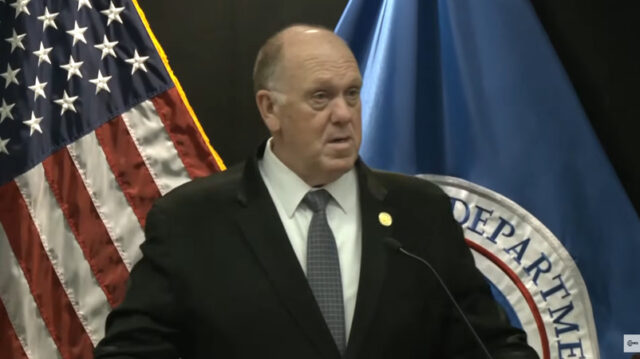
In a pivotal announcement from the Bishop Henry Whipple Federal Building in Minneapolis, White House border czar Tom Homan officially declared an end to “Operation Metro Surge” on Thursday, February 12, 2026. The move signals the conclusion of what has been described as the largest and most volatile immigration enforcement deployment in U.S. history, a two-month operation that transformed the Twin Cities into a flashpoint for the national debate on mass deportation.
Video courtesy of DWS
The Drawdown Begins
Homan confirmed that a “significant drawdown” of the approximately 3,000 federal agents is already underway, with the majority expected to leave the state over the coming week. This follows a preliminary reduction last week when 700 agents were reassigned. By the end of this transition, federal personnel levels in Minnesota are expected to return to their pre-surge baseline of roughly 100 to 150 agents.
“I have proposed, and President Trump has concurred, that this surge operation conclude,” Homan stated during the press conference. “We fixed the issues here, we’ve had some great success, and we’re leaving Minnesota safer.”

The agents being withdrawn are slated to return to their home stations or be redeployed to other major U.S. cities as part of the administration’s broader commitment to a nationwide mass deportation campaign.
A Legacy of Arrests and Unrest
The operation, which began in early December 2025, resulted in more than 4,000 arrests in the Minneapolis-St. Paul area. Homan touted these figures as proof of the operation’s efficacy, claiming the city is now “less of a sanctuary state for criminals.” According to federal data, the arrests included individuals with convictions for homicide, assault, and sex offenses, as well as known gang members.
However, the “success” cited by the federal government came at a heavy cost. The surge was defined by:
-
Fatalities: Two U.S. citizens—Renee Good, a mother and poet, and Alex Pretti, an ICU nurse—were fatally shot by federal agents in separate incidents during the crackdown.
-
Economic Impact: Minneapolis Mayor Jacob Frey reported that the city lost up to $20 million a week during the operation, as residents feared leaving their homes and businesses on Lake Street struggled to remain open.
-
Legal Battles: Minnesota Attorney General Keith Ellison, alongside the cities of Minneapolis and Saint Paul, filed a federal lawsuit against the Department of Homeland Security, alleging the surge violated the First and Tenth Amendments.
Why the Shift?
Homan cited two primary factors for the decision to withdraw. First, he pointed to an “unprecedented level of coordination” with local county jails, which are now more consistently notifying ICE when undocumented individuals are being released. Second, he noted a “steep drop” in the need for quick-response teams to handle “agitators” and protesters.
“I don’t want to see any more bloodshed,” Homan remarked, referring to the violent clashes and deaths that have haunted the operation.
Critics, however, suggest the retreat is a strategic response to mounting political pressure. A recent AP-NORC poll indicated that nearly two-thirds of Americans believe the administration’s immigration crackdown has “gone too far.” Governor Tim Walz, who had previously described the operation as an “occupation,” expressed cautious relief. “The long road to recovery starts now,” Walz posted on social media. “The impact on our economy, our schools, and people’s lives won’t be reversed overnight.”
The Road Ahead
While the surge in Minnesota is ending, Homan was clear that the administration is not backing down from its national goals. He reiterated that the personnel leaving Minnesota are simply moving to the next phase of President Trump’s mass deportation promise.
A small “security footprint” will remain in the Twin Cities to monitor for potential unrest, and all remaining federal agents in the area will now be required to wear body-worn cameras—a policy change enacted mid-operation following the public outcry over the deaths of Good and Pretti.
Sources and Links
- Star Tribune: Border czar Tom Homan: Minnesota ICE surge to end
- PBS NewsHour: Homan announces end to Minnesota immigration crackdown
- CBS News Minnesota: Border czar says Minnesota ICE surge is ending
- The Guardian: US border czar says immigration crackdown in Minnesota will ‘conclude’
- KARE 11: 700 federal agents to leave Minnesota, around 2,000 remain
Disclaimer
Artificial Intelligence Disclosure & Legal Disclaimer
AI Content Policy.
To provide our readers with timely and comprehensive coverage, South Florida Reporter uses artificial intelligence (AI) to assist in producing certain articles and visual content.
Articles: AI may be used to assist in research, structural drafting, or data analysis. All AI-assisted text is reviewed and edited by our team to ensure accuracy and adherence to our editorial standards.
Images: Any imagery generated or significantly altered by AI is clearly marked with a disclaimer or watermark to distinguish it from traditional photography or editorial illustrations.
General Disclaimer
The information contained in South Florida Reporter is for general information purposes only.
South Florida Reporter assumes no responsibility for errors or omissions in the contents of the Service. In no event shall South Florida Reporter be liable for any special, direct, indirect, consequential, or incidental damages or any damages whatsoever, whether in an action of contract, negligence or other tort, arising out of or in connection with the use of the Service or the contents of the Service.
The Company reserves the right to make additions, deletions, or modifications to the contents of the Service at any time without prior notice. The Company does not warrant that the Service is free of viruses or other harmful components.