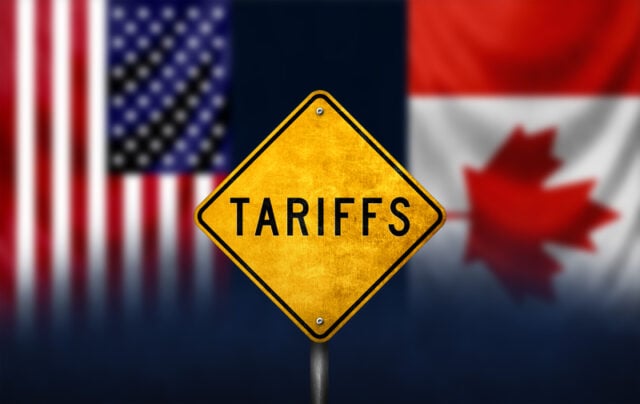
WASHINGTON, D.C. — In a high-stakes legislative maneuver that signals growing congressional unease with executive trade powers, a bipartisan coalition in the U.S. House of Representatives voted on Wednesday to rescind the controversial tariffs currently levied against Canada. The move, centered on H.J.Res. 72, represents one of the most significant challenges to the administration’s “emergency” trade agenda since it began nearly a year ago.
The resolution passed with a narrow 219–211 margin, bolstered by six Republicans who broke ranks to join a unified Democratic caucus. The vote followed months of mounting economic pressure on border states and industries reliant on the integrated North American supply chain, where the cost of raw materials and consumer goods has spiked due to the duties.
A Breakdown of the “Emergency”
The tariffs in question stem from a national emergency declared in February 2025 under the International Emergency Economic Powers Act (IEEPA). The administration originally justified the measures—which included a 25% additional tariff on Canadian imports, later raised to 35% for select goods—by citing the flow of fentanyl and illicit drugs across the northern border as an “extraordinary threat” to national security.
However, critics in Congress argue the emergency was a pretext for aggressive protectionism that bypassed standard trade agreements like the USMCA (United States-Mexico-Canada Agreement). During the floor debate, Representative Gregory Meeks (D-NY), who sponsored the resolution, argued that the administration had “weaponized” tariffs against a steadfast ally, ultimately harming American families.

“Not only have these tariffs done immense harm to our relationship with Canada, but they have also driven up prices here at home,” Meeks said. “It is time for Congress to reclaim its constitutional authority over trade.”
The Bipartisan Rebellion
The passage of the resolution was made possible by six Republican defections: Don Bacon (NE), Thomas Massie (KY), Brian Fitzpatrick (PA), Kevin Kiley (CA), Dan Newhouse (WA), and Jeff Hurd (CO).
For many of these members, the decision was a matter of local economic survival. Representative Rick Larsen (WA-02), a lead advocate for the repeal, noted that the average family in his state paid over $2,000 more for basic expenses in 2025 due to the trade friction. Representative Hurd echoed this sentiment, stating that farmers and manufacturers in his Colorado district had reached a breaking point.
The vote was a direct defiance of a clear warning from the White House. On Wednesday evening, a social media post from the President warned that any Republican voting against the tariffs would “seriously suffer the consequences come Election time.” Despite this, the dissenting Republicans argued that the Constitution gives the legislative branch the “power of the purse” and the authority to regulate foreign commerce, not the executive.
Economic and Diplomatic Fallout
The impact of the tariffs has been felt acutely across several sectors:
- Automotive: With parts crossing the border multiple times, the cost of North American-assembled vehicles has risen by an estimated $4,000 to $10,000 per unit.
- Energy: Canada remains the top supplier of crude oil and natural gas to the U.S.; the duties have contributed to sustained volatility in energy prices.
- Agriculture: Retaliatory measures from Ottawa, though partially rolled back in late 2025, have continued to hamper U.S. exports of dairy and processed foods.
The Canadian government has maintained that the drug-trafficking justification is unfounded, pointing to increased border security and the appointment of a “fentanyl czar” in Ottawa as evidence of their commitment to security cooperation. Canadian officials have largely welcomed the House’s move as a step toward “making the relationship boring again.”
What Happens Next?
While the House vote is a major symbolic and political victory for free-trade advocates, the road ahead is steep.
- The Senate: The upper chamber passed its own version of a tariff repeal in October 2025. Now, the Senate must take up and pass the specific House resolution (H.J.Res. 72) to move it forward.
- The Veto: If the resolution reaches the President’s desk, a veto is almost certain. To override a veto, Congress would need a two-thirds majority in both chambers—a threshold the current 219–211 House vote falls far short of.
- The Supreme Court: Parallel to the legislative fight, the U.S. Supreme Court is expected to rule later this year on whether the IEEPA truly authorizes the President to impose broad-based tariffs without a specific, non-economic national security threat.
Despite the likely veto, the vote provides a snapshot of the growing friction within the GOP over trade policy. As the 2026 USMCA Joint Review approaches this July, the debate over whether the U.S. should remain in a free-trade bloc or pivot to a permanent “fortress” tariff model will likely dominate the midterm election cycle.
For now, the resolution moves to the Senate, where proponents hope the momentum from the House will force a final showdown over the future of the northern border’s economy.
Sources
-
Official Statement: Larsen Leads Charge to End Canada Tariffs and Lower Costs (Feb 11, 2026).
-
Legislative News: Bipartisan Majority in House Defies Trump, Passes Stanton-Led Resolution (Feb 11, 2026).
-
Economic Analysis: The Facts on U.S.–Canada Tariffs Nearly One Year Into Trump’s Plan – The Fulcrum (Feb 11, 2026).
-
Regional Coverage: U.S. House votes against Trump’s tariff on Canada with help of Hurd and five other Republicans – Colorado Public Radio (Feb 11, 2026).
-
International Reporting: US House backs bid to block Canada tariffs in rebuke of Trump – The Guardian (Feb 11, 2026).
-
Trade Policy Tracking: Trump Tariffs: Tracking the Economic Impact of the Trump Trade War – Tax Foundation (Feb 2026).
Disclaimer
Artificial Intelligence Disclosure & Legal Disclaimer
AI Content Policy.
To provide our readers with timely and comprehensive coverage, South Florida Reporter uses artificial intelligence (AI) to assist in producing certain articles and visual content.
Articles: AI may be used to assist in research, structural drafting, or data analysis. All AI-assisted text is reviewed and edited by our team to ensure accuracy and adherence to our editorial standards.
Images: Any imagery generated or significantly altered by AI is clearly marked with a disclaimer or watermark to distinguish it from traditional photography or editorial illustrations.
General Disclaimer
The information contained in South Florida Reporter is for general information purposes only.
South Florida Reporter assumes no responsibility for errors or omissions in the contents of the Service. In no event shall South Florida Reporter be liable for any special, direct, indirect, consequential, or incidental damages or any damages whatsoever, whether in an action of contract, negligence or other tort, arising out of or in connection with the use of the Service or the contents of the Service.
The Company reserves the right to make additions, deletions, or modifications to the contents of the Service at any time without prior notice. The Company does not warrant that the Service is free of viruses or other harmful components.