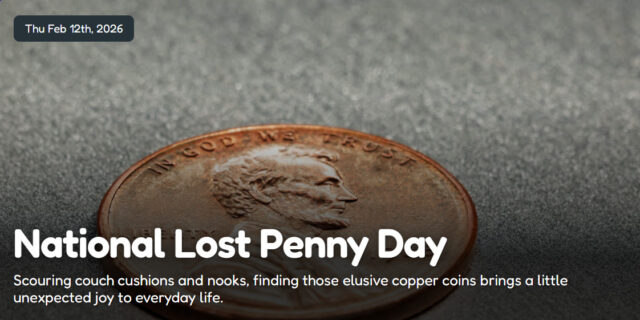
National Lost Penny Day is an annually recurring event observed on February 12. Mostly pennies are useless metal currency coins that neither fit in your wallet nor your purse. Often they will slip out of your pocket, wallet, or purse, and it’s quite unlikely you will find them again. This day is dedicated to making an effort out of your busy routine to find the lost penny that may have slipped under the sofa or the car seat. Finding your lost penny is quite a good sign, and for this reason, it has its dedicated day.
- 757 AD – The penny was officially introduced into England in 757 A.D., and they traveled to America with the first settlers.
- 1787 – The Continental Congress authorizes the copper Fugio cent, attributed to Benjamin Franklin, featuring the mottos “Fugio” and “Mind Your Business,” becoming the first official U.S. one-cent piece.
- 1793 – The Mint produced its first circulating coins—all $111.78 worth of them—in March 1793. That first batch consisted of 11,178 copper cents.
- 1857 – Pennies are resized and minted into smaller dimensions.
- 1909 – Pennies were the first U.S. coin to feature a historical figure… Abraham Lincoln. The Lincoln penny was introduced in 1909.
- 1959 – For the 150th anniversary of Lincoln’s birth, the reverse of the Lincoln cent is redesigned to show the Lincoln Memorial, replacing the original wheat-ear design used since 1909.
- 1982 – Due to rising copper prices, the Mint shifts the cent’s composition from mainly copper to copper‑plated zinc, making it cheaper to produce while keeping its familiar appearance.
- 2008 – The U.S. spends $134 million to produce $80 million worth of pennies.
- 2010 – The U.S. Mint introduces a new reverse featuring a Union shield with a scroll reading “One Cent,” symbolizing national unity and replacing the long‑running Lincoln Memorial design.
- 2024 – The 2024 U.S. Mint Annual Report confirmed the cost to make a penny was 3.69 cents.
- 2025 – President Donald Trump asks the US Treasury to stop minting new pennies – source. As pennies fall out of circulation, merchants will need to round transactions to the nearest five cents.
- The U.S. Mint produces more than 13 billion pennies each year, although the official name is the “cent,” not penny.
- Nearly 70% of all coins minted in the U.S. are pennies, and it costs 3.7 cents to make a penny.
- An estimated 114 billion pennies are currently in circulation for as long as possible.
- The reverse side of pennies have changed over the years.
- “Wheat” back pennies were made from 1909 to 1958.
- 1959 to 2008 pennies had the Lincoln Memorial, introduced the year of Lincoln’s 150th birthday.
- To commemorate Lincoln’s 200th birthday and the 100th anniversary of the Lincoln penny, 2009 pennies have four different backs depicting scenes from Lincoln’s life.
- Pennies from 2010 to the present day feature a shield representing the Union, with Lincoln holding the country together.
Superstitions:
- People originally believed that pennies would bring them a lot of luck due to their religious beliefs.
- Ancient civilizations believed that copper and other metals were gifts from the gods, intended to protect people from evil.
- Another superstition concerns the two sides of a coin, which people believe represent the battle between good and evil.
- If you find a penny with its head up, it means you have luck on your side. However, luck is not going to be as much in your favor if you find a coin and it is tails-side up.
- Some people say that if you find a penny and it is tails up, you should flip it over and leave it so that it brings the next person who finds it luck.
- Do not spend a penny that you find. Instead, save it for luck.
- If you place a penny in your shoe, it will bring good fortune.
- Carrying three pennies with you is going to bring you good luck.
- Throwing a penny over your left shoulder into a wishing well or a body of water will grant your wish.
- Tossing a penny when you have a problem enables fate to take care of the issue for you.
- Coins with holes in them are considered especially lucky.
- If you put the first penny you get every day into your pocket, you are going to attract more as the day continues.
- If you find a penny, it means that there is more money coming your way.
- If you keep a coin in your baby’s crib, the baby will grow up to be wise, wealthy, and healthy.
- To secure good luck, you should carry a penny that was minted in your birth year.
- Having a jar filled with pennies in your kitchen is good luck.
- If you toss a penny overboard while you are traveling at sea, it will bring you a safe trip.
- Carry a penny for luck. Some say you should carry a penny wrapped in paper in your pocketbook, so you can say you are never broke.
- Tossing a penny overboard while traveling at sea guarantees a safe trip.
Sources:

Disclaimer
Artificial Intelligence Disclosure & Legal Disclaimer
AI Content Policy.
To provide our readers with timely and comprehensive coverage, South Florida Reporter uses artificial intelligence (AI) to assist in producing certain articles and visual content.
Articles: AI may be used to assist in research, structural drafting, or data analysis. All AI-assisted text is reviewed and edited by our team to ensure accuracy and adherence to our editorial standards.
Images: Any imagery generated or significantly altered by AI is clearly marked with a disclaimer or watermark to distinguish it from traditional photography or editorial illustrations.
General Disclaimer
The information contained in South Florida Reporter is for general information purposes only.
South Florida Reporter assumes no responsibility for errors or omissions in the contents of the Service. In no event shall South Florida Reporter be liable for any special, direct, indirect, consequential, or incidental damages or any damages whatsoever, whether in an action of contract, negligence or other tort, arising out of or in connection with the use of the Service or the contents of the Service.
The Company reserves the right to make additions, deletions, or modifications to the contents of the Service at any time without prior notice. The Company does not warrant that the Service is free of viruses or other harmful components.