In a significant blow to the Department of Justice’s recent efforts to secure 2020 election records, U.S. District Judge J.P. Boulee has ordered the federal government to unseal the documents used to justify a massive FBI raid on Fulton County’s election operations. The order, issued late Sunday, mandates that the search warrant affidavit and related paperwork be made public by Tuesday, February 10, 2026.
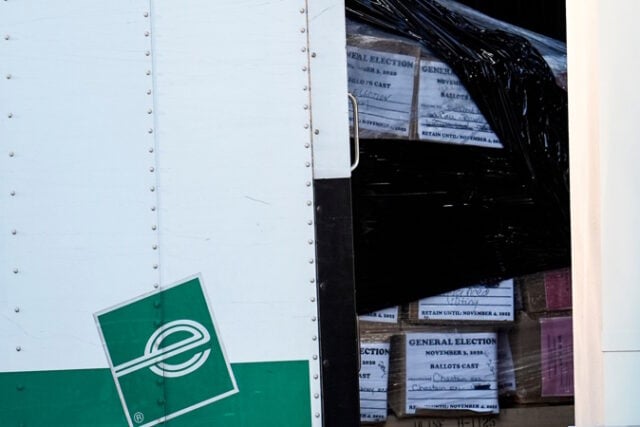
The decision follows weeks of escalating legal and political tension in Georgia, centered on the January 28 raid in which FBI agents seized approximately 650 boxes of ballots and election materials from the Campbellton Fairburn Road facility in Union City.
The Legal Battle Over Transparency

Judge Boulee’s ruling came in response to emergency motions filed by Fulton County officials, who argued that the federal government’s seizure of original 2020 ballots was an unprecedented overreach. The county’s legal team alleged that the DOJ relied on “disproven theories of fraud” to secure the warrant, violating Fourth Amendment protections.
“The search and seizure of Fulton County’s election materials, without disclosure of the underlying supposed justification, only serve to create greater outrage and confusion,” the county argued in its filing.

While the Justice Department initially sought to keep the affidavit sealed—a standard practice during active criminal investigations—Judge Boulee noted in his order that the government eventually did not object to the unsealing. This shift comes amid mounting pressure from media organizations, including CNN, The Associated Press, and The Atlanta Journal-Constitution, all of whom filed motions to intervene, citing the immense public interest in the case.
A High-Stakes Investigation
The FBI’s seizure of the records is reportedly tied to two specific federal criminal statutes:
- Election Record Retention: A law requiring counties to preserve election records for at least 22 months following a federal election.
- Voting Rights Coercion: A statute prohibiting the knowing tabulation of fraudulent ballots or the coercion of voters.
The raid has reignited the firestorm surrounding the 2020 election results in Georgia. For years, Fulton County has been a primary target of claims regarding election integrity. However, County Commission Chair Robb Pitts has remained defiant, stating that the county has successfully conducted 17 elections since 2020 without evidence of systemic fraud.
“Our Constitution itself is at stake in this fight,” Pitts said during a press conference. “We will fight using all resources against those who seek to take over our elections.”
Political Implications for 2026

The unsealing of these documents arrives at a volatile moment in American politics. President Donald Trump, who signed the Epstein Files Transparency Act just months prior, has consistently called for more aggressive federal oversight of “blue” voting jurisdictions. Critics and Georgia Democrats have characterized the FBI raid as a “partisan attack” intended to intimidate election workers ahead of the 2026 midterm elections.
Conversely, proponents of the investigation argue that the unsealing will finally reveal the “probable cause” that convinced a federal judge to authorize the raid in the first place. If the affidavit contains credible evidence of irregularities, it could reshape the national conversation on election security; if it relies on debunked conspiracy theories, it may further damage the DOJ’s credibility during a period where other federal judges, such as Judge Mustafa T. Kasubhai in Oregon, have recently ruled that the department can “no longer be trusted” in its voter roll crusades.
What to Expect on Tuesday
By Tuesday, the public will likely see a redacted version of the affidavit. These redactions are expected to protect the identities of confidential informants or sensitive investigative techniques. However, the “meat” of the document—the specific allegations and evidence provided by the FBI to justify the seizure of 650 boxes of ballots—will be laid bare.
The unsealing marks a pivotal moment for transparency. As the documents go live, legal experts will be looking to see if the DOJ has uncovered genuinely “new” information or if the raid was an extension of long-standing political grievances regarding the 2020 vote count.
Sources and Links
- The Atlanta Journal-Constitution: Federal judge to unseal DOJ records on Fulton County ballot seizure
- CBS News: Fulton County asks federal judge to return 2020 election records seized by FBI
- Associated Press: Judge orders release of grand jury transcripts from abandoned investigation (Note: Search for ongoing Fulton County coverage)
- Democracy Docket: Federal judge rules DOJ can ‘no longer’ be trusted in voter roll crusade
Disclaimer
Artificial Intelligence Disclosure & Legal Disclaimer
AI Content Policy.
To provide our readers with timely and comprehensive coverage, South Florida Reporter uses artificial intelligence (AI) to assist in producing certain articles and visual content.
Articles: AI may be used to assist in research, structural drafting, or data analysis. All AI-assisted text is reviewed and edited by our team to ensure accuracy and adherence to our editorial standards.
Images: Any imagery generated or significantly altered by AI is clearly marked with a disclaimer or watermark to distinguish it from traditional photography or editorial illustrations.
General Disclaimer
The information contained in South Florida Reporter is for general information purposes only.
South Florida Reporter assumes no responsibility for errors or omissions in the contents of the Service. In no event shall South Florida Reporter be liable for any special, direct, indirect, consequential, or incidental damages or any damages whatsoever, whether in an action of contract, negligence or other tort, arising out of or in connection with the use of the Service or the contents of the Service.
The Company reserves the right to make additions, deletions, or modifications to the contents of the Service at any time without prior notice. The Company does not warrant that the Service is free of viruses or other harmful components.