For decades, Coconut Grove was known as Miami’s “bohemian” corner—a lush, canopy-covered retreat for artists, sailors, and academics who preferred the shade of ancient banyan trees to the neon glitz of South Beach. But today, the neighborhood’s quiet charm is being recalibrated by the arrival of the world’s most powerful balance sheets. In a transformation that has sent shockwaves through the national real estate market, Coconut Grove has emerged as the premier destination for the “Billionaire Exodus” from the West Coast.
The most recent and striking evidence of this shift came with news that Google co-founder Larry Page—currently ranked among the wealthiest individuals on the planet—has spent a staggering $173.4 million on two separate estates in the Grove. As reported by The Wall Street Journal, these acquisitions are not merely lifestyle upgrades; they represent a strategic migration of capital. The Journal noted that the deals come as “Page and other Silicon Valley moguls descend on Miami in the face of California’s proposed tax on billionaires.”
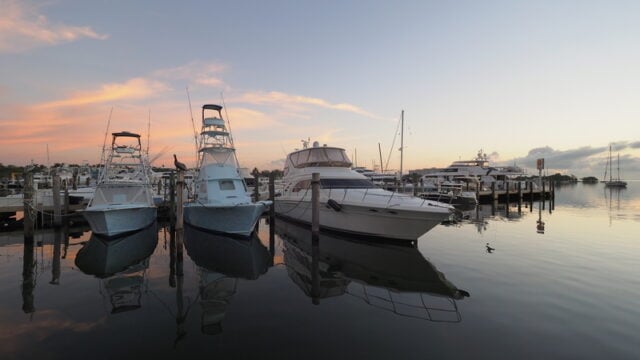
This 3-year-old video shows much of what Coconut Grove has to offer.
Video courtesy Angie Blanco.
The Great California Escape
The catalyst for this sudden gold rush is largely political. California has been weighing a proposed ballot initiative that would impose a one-time, 5% tax on the worldwide assets of billionaires. Crucially, the proposal was designed to apply retroactively to California residents as of January 1, 2026. This “exit tax” threat has turned Coconut Grove into a high-stakes refuge.

According to The Wall Street Journal, the urgency among the ultra-wealthy is palpable. Dina Goldentayer, a prominent luxury agent with Douglas Elliman, told the Journal: “Pretty much every other day I’m showing property to a client from the San Francisco Bay Area. Every conversation I overhear, they’re talking about the wealth tax and how it’s retroactive. They’re in a hurry, and they’re all looking at the same houses.”
For Page, the “hurry” resulted in the purchase of two of the neighborhood’s most storied properties. In December, property records show he paid $101.5 million for a 4.5-acre waterfront compound on Biscayne Bay, previously owned by the family of the late Progressive Insurance chief Jonathan Lewis. Just days later, in early January, he added a second nearby estate for $71.9 million, purchased from heiress Sloan Lindemann Barnett and her husband, Roger Barnett.
Why the Grove?
While Palm Beach has long been the traditional seat of Florida’s old money, and Star Island serves as the playground for celebrities, Coconut Grove offers something different: privacy and “walkability.” In a city defined by car culture, the Grove’s village center allows residents to walk to high-end boutiques and Michelin-starred restaurants—a rarity that appeals to Californians accustomed to the hybrid urban-suburban feel of Palo Alto or Atherton.
Lourdes Alatriste, another top agent in the area, has noted that this unique perk has turned the Grove into a focal point for tech moguls. It is a neighborhood where a billionaire can walk their dog under a canopy of oaks without the paparazzi-fueled chaos of Miami Beach.
The market data support this skyrocketing demand. In 2025, Florida recorded 19 residential sales above $50 million—surpassing both New York and California. The Journal highlights that Coconut Grove has become a central pillar of this boom, following the lead of hedge fund titan Ken Griffin, who moved his Citadel headquarters to Miami and famously purchased a $106.8 million estate in the Grove in 2022.
A Neighborhood Reimagined
The influx of “tech money” is fundamentally altering the fabric of the community. The properties being acquired are often “off-market” trophy homes that never see a public listing. The secrecy surrounding these deals is intense; several agents told The Wall Street Journal that they were bound by nondisclosure agreements so strict that breaking them could “end their careers.”
This culture of silence is necessary for figures like Page and Sergey Brin—the latter of whom is also rumored to be in discussions for a Miami home—who prioritize security and anonymity. The estates themselves are becoming self-contained fortresses. Page’s $101.5 million acquisition, for instance, is a sprawling compound that includes two main residences, a private gym, spa facilities, and a resort-style pool, all tucked behind massive gates and dense tropical foliage.
However, the local impact is a double-edged sword. While the surge in property values has been a windfall for long-term homeowners and the city’s tax base, it has also accelerated the gentrification of one of Miami’s most historic areas. The Grove was founded in the 1800s and has a deep-rooted Bahamian heritage; today, the modest cottages that once defined the area are being replaced by “modern boxes” and sprawling mega-estates.
The Future of the “Silicon Grove”
The trend shows no signs of slowing. As long as California’s fiscal policies remain a point of contention for the ultra-wealthy, Florida’s lack of state income tax and its welcoming business climate will continue to act as a powerful magnet.
Larry Page’s move is more than just a real estate headline; it signals to the rest of the tech world that the center of gravity is shifting. Miami is no longer just a place to retire or vacation; for the architects of the digital age, it is becoming the new headquarters.
As The Wall Street Journal’s reporting suggests, the race for “trophy homes” in Coconut Grove is a race for stability in an era of shifting tax codes. For those with billions to protect, the lush, quiet streets of the Grove aren’t just a beautiful place to live—they are the ultimate insurance policy. In the coming years, as more Silicon Valley titans follow the path blazed by Page and Griffin, Coconut Grove will likely solidify its status not just as a Miami neighborhood, but as one of the most exclusive and influential enclaves in the world.
Source: The Wall Street Journal
Disclaimer
Artificial Intelligence Disclosure & Legal Disclaimer
AI Content Policy.
To provide our readers with timely and comprehensive coverage, South Florida Reporter uses artificial intelligence (AI) to assist in producing certain articles and visual content.
Articles: AI may be used to assist in research, structural drafting, or data analysis. All AI-assisted text is reviewed and edited by our team to ensure accuracy and adherence to our editorial standards.
Images: Any imagery generated or significantly altered by AI is clearly marked with a disclaimer or watermark to distinguish it from traditional photography or editorial illustrations.
General Disclaimer
The information contained in South Florida Reporter is for general information purposes only.
South Florida Reporter assumes no responsibility for errors or omissions in the contents of the Service. In no event shall South Florida Reporter be liable for any special, direct, indirect, consequential, or incidental damages or any damages whatsoever, whether in an action of contract, negligence or other tort, arising out of or in connection with the use of the Service or the contents of the Service.
The Company reserves the right to make additions, deletions, or modifications to the contents of the Service at any time without prior notice. The Company does not warrant that the Service is free of viruses or other harmful components.