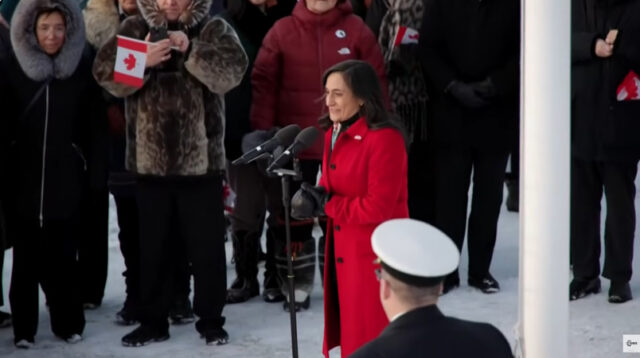
NUUK, Greenland — Against a backdrop of shifting ice and even more volatile geopolitics, Canada officially raised its flag in the Greenlandic capital of Nuuk on Friday. The opening of the Canadian consulate marks a pivotal expansion of Ottawa’s diplomatic footprint in the Far North, signaling a commitment to Arctic sovereignty and Inuit partnership at a time when the region has returned to the center of global territorial debate.
Video courtesy DWS
The ceremony was led by Foreign Affairs Minister Anita Anand and Governor General Mary Simon—the first Inuk person to hold the office—whose presence underscored the deep cultural and ancestral ties between the Inuit of Canada and Greenland. As the Maple Leaf was hoisted over the new mission, a spontaneous rendition of “O Canada” broke out among the attendees, who included Greenlandic officials and a delegation of Inuit leaders from northern Quebec and Nunavut.
A New Chapter in Arctic Diplomacy
The decision to establish a permanent diplomatic presence in Nuuk was first outlined in Canada’s Arctic Foreign Policy in late 2024. While the move was initially framed as a means to bolster trade and environmental cooperation, its significance has sharpened following a series of diplomatic tremors from Washington.

The mission is intended to facilitate “people-to-people” ties and streamline cooperation on climate change research, but its most vital role may be symbolic. By establishing a physical office, Canada has effectively “planted its feet” in Greenlandic soil, affirming that the island’s future is a matter of multilateral concern rather than a bilateral real estate deal.
“The significance of raising this flag today is that we stand together with the people of Greenland and Denmark,” Minister Anand told reporters. “This is about building long-term resilience in the Arctic, ensuring that the rules-based international order remains the guiding force of the North.”
The Shadow of “Greenland for Sale”
The opening comes in the wake of renewed tensions regarding the status of the world’s largest island. During his first term, U.S. President Donald Trump famously floated the idea of the United States purchasing Greenland from the Kingdom of Denmark. While the proposal was dismissed as “absurd” by Danish Prime Minister Mette Frederiksen in 2019, the rhetoric resurfaced with greater intensity following the 2024 U.S. election.
In early 2025 and throughout the winter of 2026, President Trump intensified his assertions that Greenland is a national security imperative for the United States. Citing the expansion of Russian and Chinese naval activity in the Arctic, the Trump administration suggested that Denmark lacked the resources to adequately defend the territory. The rhetoric reached a fever pitch in January 2026, when the President hinted at “doing something on Greenland” and briefly threatened tariffs against European allies who conducted independent military exercises in the region.
Although the President later backed away from threats of force during a January 21, 2026, meeting at the World Economic Forum in Davos, the episode rattled the NATO alliance. Canada, which shares a 3,000-kilometer maritime border with the Kingdom of Denmark, has been a vocal critic of any move that undermines Greenlandic or Danish sovereignty.
From “Whisky Wars” to Strategic Solidarity
The relationship between Canada and Greenland has not always been so serious. For decades, the two nations engaged in the “Whisky War,” a lighthearted sovereignty dispute over Hans Island, a barren rock in the Nares Strait. Soldiers from both sides would take turns removing the other’s flag and leaving behind a bottle of Canadian rye or Danish schnapps.
That dispute was peacefully resolved in 2022 by splitting the island, creating a land border between the two countries. Today, that legacy of peaceful resolution is being held up as a model for Arctic governance.
“That’s not how Canada and Denmark roll,” Prime Minister Mark Carney noted recently, emphasizing that territorial changes in the modern era must be governed by diplomacy and the consent of the governed, not by coercion.
Looking Ahead
For the 57,000 residents of Greenland, the Canadian consulate offers a new bridge to their western neighbors. Greenlandic Foreign Minister Vivian Motzfeldt hailed the opening as a “historic day,” noting that Greenland plans to reciprocate by opening its own representation office in Ottawa by 2028.
As the Canadian Coast Guard icebreaker CCGS Jean Goodwill sat anchored in the Port of Nuuk—a visible sign of Ottawa’s maritime commitment—the message was clear: the Arctic is no longer a remote periphery, but a frontline of 21st-century diplomacy. With the Nuuk consulate now operational, Canada has secured its seat at the table, ensuring that the voice of the North remains distinctly Northern.
Mainstream Sources
-
The Canadian Press: Greenland’s foreign minister hails new Canadian consulate as ‘historic’
-
CTV News: Gov. Gen. Simon, Anand open new consulate in Greenland
-
Global Affairs Canada: Minister Anand to travel to Denmark and Greenland
-
Nunatsiaq News: Canadian consulate in Greenland is operational
-
Encyclopaedia Britannica: Why Is the U.S. Interested in Greenland? History and Context
-
The Arctic Institute: Greenland During Trump 2.0: Is America Poised for Arctic Expansion?
-
House of Commons Library (UK): President Trump and Greenland: Frequently asked questions
Disclaimer
Artificial Intelligence Disclosure & Legal Disclaimer
AI Content Policy.
To provide our readers with timely and comprehensive coverage, South Florida Reporter uses artificial intelligence (AI) to assist in producing certain articles and visual content.
Articles: AI may be used to assist in research, structural drafting, or data analysis. All AI-assisted text is reviewed and edited by our team to ensure accuracy and adherence to our editorial standards.
Images: Any imagery generated or significantly altered by AI is clearly marked with a disclaimer or watermark to distinguish it from traditional photography or editorial illustrations.
General Disclaimer
The information contained in South Florida Reporter is for general information purposes only.
South Florida Reporter assumes no responsibility for errors or omissions in the contents of the Service. In no event shall South Florida Reporter be liable for any special, direct, indirect, consequential, or incidental damages or any damages whatsoever, whether in an action of contract, negligence or other tort, arising out of or in connection with the use of the Service or the contents of the Service.
The Company reserves the right to make additions, deletions, or modifications to the contents of the Service at any time without prior notice. The Company does not warrant that the Service is free of viruses or other harmful components.